Stage Door Follow-Up
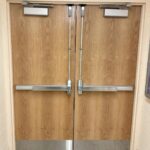
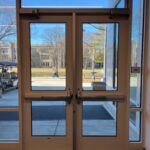
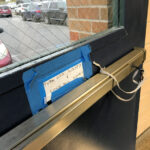
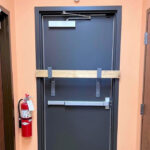
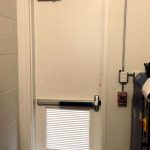
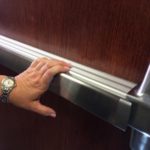
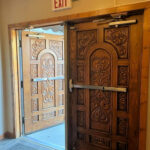
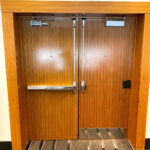
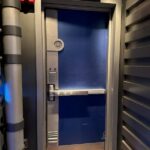
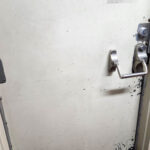
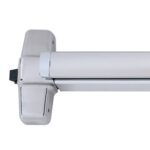
Last week I asked for ideas about what could have been done differently with the hardware on a stage door. Today's post is a follow-up with the solution that I would specify.

Last week I asked for ideas about what could have been done differently with the hardware on a stage door. Today's post is a follow-up with the solution that I would specify.
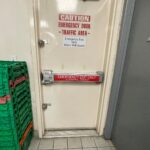
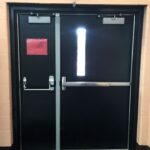
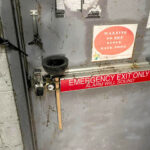
Hal Kelton of DOORDATA Solutions sent me today's Wordless Wednesday photo of an "emergency door", and well... I'm wordless!
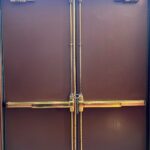
Cesar Montalvo of Wesco sent me today's Wordless Wednesday photo, taken in the heavy equipment bay of a military facility. These doors are 18 feet tall!
Today's Quick Question: Do the model codes require a certain amount of contrast between the releasing hardware and the door, so the hardware is distinguishable for egress purposes?
Kevin Taylor of Allegion sent me today's Fixed-it Friday photo of an installation problem that has been "fixed" with instructional signage.
I'm sorting through some boxes of old papers and I found this ad from Architectural Record, dated May 1967! No, I was not collecting hardware memorabilia back then - I wasn't even born yet!
While this may seem like "just another chained exit" (boooring...), I am reminded of the MANY times that locked or blocked exits have resulted in fatalities during an emergency.
Today's Fixed-it Friday photos are a great "before and after" example from a high school gymnasium. If you have photos you'd like to share, there's an upload link in today's post.
Last weekend I took my daughters and their friends to the movies, and that's where I saw today's Wordless Wednesday application on the theater exit.
Earlier this week I shared photos from a college visit with my youngest daughter. I also saw this mullion on campus with a key cylinder...is anyone familiar with the purpose of the cylinder?
I received today's Fixed-it Friday photo from Jim Elder of Secured Design, LLC - it was taken in an elementary/middle school. While this seems like a simple and common fix, it can severely impact security.
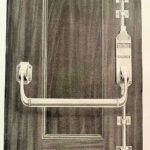
During an ongoing organizational project in my house, I found an amazing original advertisement for Von Duprin, and coincidentally today I am on my way to the home of Von Duprin - Indianapolis - so I'm posting this here for you all to enjoy.
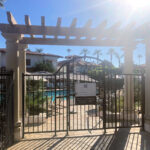
Today's Quick Question: Is it acceptable by code to supply the dogging feature on panic hardware installed on a door or gate serving a swimming pool enclosure? What do you think?
I don't think the use of the door hardware in today's Wordless Wednesday photo is part of the cycle testing for durability - not to mention the stored materials blocking the exit!
Jon Payne sent me today's Wordless Wednesday photo of the secondary exit in a busy truck stop. This is why I firmly believe that AHJs should not allow non-code-compliant security measures "after hours"...those devices often end up installed 24/7.
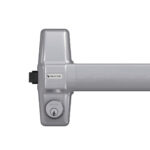
I recently saw a photo in a door and hardware installer's group on social media, with a question about the purpose of the cylinder on the head of the panic hardware. Was it supposed to lock the latch? Or control the locked/unlocked indicator?
I've seen a lot of creative holiday decorations that impact the exits, but what do you think about today's Wordless Wednesday photos, sent by a retired fire marshal?
I have updated this Decoded article to include current requirements from the 2023 edition of NFPA 70, in addition to previous editions beginning with the 2002 National Electrical Code.
One of our specwriters contacted me earlier this week, in search of the Quiet Doorman product. Does anyone have a source for this panic bar retainer or something similar? WWYD?
I saw this Fixed-it Friday dogging method recently, and I can't for the life of me figure out what the original purpose of this part was. It looks so familiar! Can someone help me out??
I find it interesting to see how people adapt doors and hardware for their convenience - sometimes at the expense of security or code requirements. In today's Fixed-it Friday post is an example that I saw during the recent DHI conNextions conference.
It's hard to believe that it has been 6 YEARS since I last updated this post on zombie-resistant door openings, and 9 YEARS sine I wrote the original version. With the new model codes coming out soon it's time for another update, and what better day to post it than on Halloween??
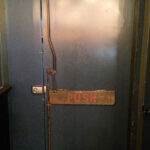
I recently saw this Throwback Thursday photo and coincidentally, I had just looked at the requirements for panic hardware in the 1927 edition of the NFPA Building Exits Code. The word "PUSH" on this hardware rang a bell...
Yesterday I shared an updated Decoded article on clear opening width and height, and this Quick Question was raised: Does the projection of a surface-mounted strike for rim panic hardware affect the clear width of a door opening?
Qasim Mousa from Allegion's office in Saudi Arabia, sent me today's Fixed-it Friday photo, taken at a new school. This is a great example of how so-called "value engineering" can negatively impact a project.
Although there is a section in the I-Codes dedicated to automatic doors, this section does not address the hardware used for security and egress. Locks for automatic sliding doors are covered in other sections of the model codes.
I'm wondering why these doors swing toward the soccer field, but it's hard to know the egress route without a floor plan. Regardless, someone has solved the problem of unauthorized access to the stands with today's non-code-compliant Fixed-it Friday modification.
My next Decoded article looks at some of the exceptions where doors serving assembly spaces are NOT required to have panic hardware. Did I miss any? Leave a comment and let me know!
For my Fixed-it Friday posts, I typically share photos of creative modifications - often applications that are not code-compliant. But I also like to share product changes that solve a problem. In today's post, a retrofit kit for the Schlage AD993.
I received this Quick Question the other day, and it has been a while since I've written about this topic: Is it acceptable to install panic hardware on a 2-foot-wide door that is part of a 5-foot-wide unequal leaf pair?
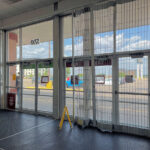
Last week when I was with our specwriter apprentice/sales development program cohort, I stopped into a large retail store and noticed their Wordless Wednesday method for entrance/exit control at the main entrance.
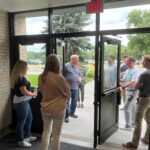
I spent part of last week with Kevin Braaten, Shannon Tracey, and the current members of our specwriter apprentice and sales development programs, and we went on a field trip - one of my favorite ways to see applications "in the wild."
In this article for Door Security + Safety, I have used information from various sources to support interpretations of the intent of the accessibility standards. If you have anything to add, leave a comment asap!
I saw this Fixed-it Friday photo posted by Vincent Zito on the Locksmith Nation Facebook page, and I asked for permission to share it. This is NOT an authorized means of repairing this product, which looks like it has faced more than its share of abuse.
Kevin Whitney of Allegion sent me today's Wordless Wednesday photo...I wonder if the exit is still required, if the doors are still openable, and why there is signage for a key-operated lock when the doors have panic hardware. So many questions.
Would this door be code-compliant if only one of the panic devices actually latched? Or would it be considered "special knowledge or effort" because the building occupant would have to know which touchpad to use?
My next monthly column in USGlass Magazine answers this question: How can an exterior space—like a courtyard or roof terrace—be secured to prevent unauthorized access to the building? Do you know the answer?
Today's Quick Question: If an electrical room is required to have outswinging doors with panic hardware, does this requirement apply to all of the doors that are part of the means of egress between the electrical room and the public way?
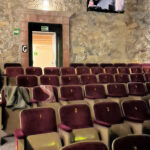
Our local library has a small theater that holds just under 100 people. The space only had one code-compliant exit and the building is hundreds of years old and difficult to modify. TGIFixed-it Friday!
My second monthly column in USGlass Magazine answers this question about double-cylinder deadbolts: Where can key-operated locks be used on doors in a means of egress? Do you know the answer?
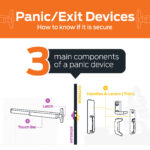
I recently shared this resource on panic hardware, and there were several suggestions from readers of iDigHardware that resulted in some changes to the infographic. Thanks to all who weighed in - here's the updated version.
In Mark Kuhn's latest post, he makes a compelling argument for specifying panic hardware in some locations where it is not technically required by code. Do you agree with Mark's reasoning?
Tony Klagenberg of AMI sent me today's Wordless Wednesday photo, which looks like it was taken in a gas station or convenience store located in an area where crime is a concern. I'm wondering if someone thought this would give them extra security.
Today's Fixed-it Friday photo was sent in by Shari Dial of Walsh Door & Security - the photo shows the rear exit serving a gas station in rural Illinois. If you see any interesting doors in your summer travels, you can submit photos using the photo submission link.
Do you ever wonder about some of the strange terminology we use for specific construction products, especially door hardware? This guest blog post, written by TJ Gottwalt of Allegion, answers some questions about the term "dogging."
Today's Fixed-it Friday photos were taken at the main entrance of a function space that has an occupant load of 600 people. I was so fixated on the creative locking method that I didn't take a close-up of the closer fix, but the security fix has me wordless.
I once wrote a hardware spec for the hotel chain where today's Fixed-it Friday photos were taken. Based on that experience and the architect's attention to detail on that project, I'm positive that this is not what they would expect to see on a return visit.
I recently started a new column in USGlass Magazine, and each month I will be answering a code question related to door openings. The question in the current post is one that many of you are familiar with: Where is panic hardware required?
I received today's Fixed-it Friday photo from Scott Tobias of arkaSpecs, and I definitely did a double-take. Then I found out that he's on vacation with his family, and this egress door serves a ride at a popular theme park. What do you think?
Jim Billings sent me today's Fixed-it Friday photo, which was posted in a Facebook group with a comment that it was found in a postal facility. Any theories about what happened here?