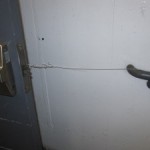
Scissor Pull
I find this cool in a freaky sort of way.

I find this cool in a freaky sort of way.
After my request for readers to send me photos of hardware applications seen on their summer vacations, I received some photos of the entrance doors to the Notre Dame des Victoires Church in Quebec City, Canada. The church was erected in 1688, and is Quebec's oldest stone church.
Yesterday I spent a few hours auditing a class on the Schlage AD-Series Electronic Locks. If you haven't seen this lock yet, you should go to the website and take a look. The whole idea behind it is that it's adaptable. You can change the type of credential reader (keypad, mag-stripe, proximity/Smart Card/Multi-Tech reader) , the function (classroom/storeroom, office, apartment, privacy), or even the level of access control (offline, networked, wireless), and the changes can be made without taking the lock off the door. So you install a stand-alone keypad lock today...tomorrow you can change it to a networked wireless lock with a Smart Card reader, and only the credential reader and inside escutchen need to be replaced. The rest of the change is accomplished with free firmware.
Here's another door from the Shalin Liu Performance Center in Rockport, Massachusetts. It's actually a curved door from the existing building attached to a new door. Because of the thickness of the two doors, wide throw hinges were used. Wide throw hinges are typically used when more clearance is required behind the door when open 180 degrees, not to be confused with swing clear hinges, which move the door out of the opening when open to 90 degrees (see below for comparison).
Last night's CSI meeting was a tour of the recently-completed Shalin Liu Performance Center in Rockport, Massachusetts. It was kind of a hike especially with the threat of traffic problems, but I thought I might be able to get some good door pictures.
I posted a while back about the proposed 8th edition of 780 CMR, the Massachusetts State Building Code. The link that I had provided to the proposed code stopped working, but the information is now available online, including a read-only link to the 2009 IBC, the proposed Massachusetts addendums, and the comments and proposals from the February public hearing.
I haven't thought much about these since I was in DHI school (a really long time ago), but today I saw two types of paumelle hinges along with some olive knuckle hinges in the same facility. Beautiful hinges, but a very tough door and frame prep.
I swear, this blog is not going to become a collection of photos that can be found elsewhere on the web, but since two people sent me this photo today and it's pretty horrible, I just have to post it. It's another one from thereIfixedit.com, which is a really funny collection of weird stuff that people do to try to fix things.
I'm off to Carmel this week so it's going to be a busy one. I don't know if I'll get to the next smoke door post but I'll post some more application photos to tide you over. Here's another gravity closer with a bonus padlock on a temperature rise egress door. And before someone comments that these don't need to be temp rise doors, this opening is in Israel so I'm not sure which code was in use when they were installed.
I think I'm onto something...asking everyone to send their vacation photos of oddball hardware applications has already netted me several, including this photo of a gravity closer from Quebec City. The cable goes from the face of the door, through the pulley that the brown outfit is hanging on, then through another pulley and attaches to a weight that the green outfit is hanging on. Complicated, but pretty inexpensive as long as you don't need door control. ;-)
Last week I said that as new countries came to visit this site, I'd post a door photo from that country. Sounds like fun, right? Well, it's not as easy as it looks from where you're sitting.
After that last post I think we all need a break. Here's a "fix" from thereIfixedit.com:
According to the International Building Code (IBC), every required exit stairway that extends more than 75 feet ABOVE the lowest level of fire department vehicle access (high rise buildings), and every required exit stairway that serves floor levels more than 30 feet BELOW the level of exit discharge must comply with the referenced sections on smokeproof exit enclosures. (IBC 2009 - 403.5.4 & 405.7.2, IBC 2003 & 2006 - 403.13 & 405.8.2)
Every day I find a new excuse to avoid reading and writing about smoke doors. I swear I'll get back to them, but as construction gets rolling again we're getting really busy.
This is a new one. Translation: "Emergency Exit. Break and Press."
I've seen lots of creative ways of dogging fire exit hardware, but this one gets an "E" for Effort (along with an "F" for Fail). These devices are on fire doors in a hotel ballroom, and while someone went to great lengths on this modification, these doors are supposed to be self-latching to compartmentalize the building during a fire. The doors also had kick-down holders, so they're not self-closing either. :-(
It's been almost a year since I started keeping track of which countries have visited this site, and the count currently stands at 110 countries. WOW! The visits from new countries has slowed dramatically since there are already so many on the list, so I thought it might be fun to post a door photo from each new country as they're added.
I think these are about the tiniest closers I've ever seen. One was obviously not enough to get the bathroom door closed, so another one was added. The door still wouldn't close, so the closer was flipped around and mounted the opposite way. The door STILL wouldn't close, AND the sound of the closers was horrendous! (video evidence below)
When someone wants to install an electromagnetic lock on the pull side of the door, I feel like it's my civic duty to warn them that the installation will not be pretty. I was finally able to get a photo of this application in the T.F. Green Airport today, so I'll be able to use it as descriptive evidence in the future.
I know I'm supposed to be talking about smoke doors but each of those posts takes quite a bit of research time. I'm headed out of town tomorrow for a meeting about fire door inspection, so I'll get back to the smoke doors later in the week.
My old buddy George Nimee used to tell a story about a school custodian who put black grease on the top of all the closer arms in the school. When the kids jumped up and grabbed the closer arm their hands would get all greasy, they'd wipe their hands on their shirts, and the custodian would know who'd been hanging on the closer arm. Ingenious!
Tonight I attended the local DHI chapter meeting, where I was one of the presenters in a "cracker barrel" style presentation on fire door assembly inspection. It was kind of like FDAI speed dating. We had 6 tables, each with a different topic and 1 or 2 presenters per table, and the attendees cycled through all of the tables to hear a 10-minute presentation on each topic.
I know you're probably anxious for me to get back to the smoke series, but it's Mothers' Day so I'm going to take one more day off. Instead I'm posting the photos below, which I took yesterday at the local college campus center. Our school was using their function room for a fundraiser, and this door was the emergency exit for the room. On the other side of the door is a construction zone, and neither door was operable.
I'm working on the next post about smoke but this has been an extremely busy week.
NFPA 80 - Standard for Fire Doors and Other Opening Protectives, is a document which most of us in the hardware industry began studying in our earliest hardware school courses and refer back to throughout our careers. This standard is THE publication on fire doors, and is referenced by all of the codes and standards used in the U.S. that have anything to say about fire doors. You'd think that because of the close relationship between fire doors and smoke doors (some fire doors ARE smoke doors, after all) that NFPA 80 would have something to say about smoke. As it turns out, not much.
I usually like to start with the quick and easy items on my to-do list, which is why it takes me forever to get to the big stuff. It's a fault, and I recognize that, but nobody's perfect. I tried to find the easy place to start this series of posts, but there seems to be only one logical place to begin - NFPA 105.
It’s official. I can’t hide from it any longer. People ask me about “smoke doors” almost every day, but if you know me you know that I have a lot going on, so whenever I try to scale the mountain of information about this topic I get sidetracked by the little things that need my attention.
On Thursday, May 13th, the New England Chapter of the Door & Hardware Institute will be holding our meeting at a new location - Vinny T's in Dedham, Massachusetts. The meeting topic is fire door assembly inspection (FDAI), and many of the local fire door inspectors will be participating in the presentations. The format is "cracker-barrel" style, where there are 5 or 6 short (10-minute) presentations about various sub-topics, with time for Q&A.
I apologize for the shortage of posts last week. I spent most of the week in Indianapolis (where our main office is located) or in transit to or from Indy. Believe it or not, the hardware at the hotel wasn't really blogworthy, although I did see some fire-rated doors without coordinators (ho-hum). The door to my room had a closer on it and closed most of the time. It was not latched when I checked in and went to my room for the first time, but there was no boogie-man, just a lovely cheese plate left by the catering department.
Someone asked me a question recently that I had to stop and think about. In the old days, wire glass could only be used in fire doors. It could not be used in non-rated doors. The question was, "Can the wire glass that meets the impact resistance requirements be used in non-rated doors?"
I spent the weekend in Portland, Maine, and I think I may be in love. What a beautiful city! I was there for my sister-in-law's baby shower and I think I made my brother and SIL a little nervous driving and door-hunting at the same time. It was kind of a rainy weekend so I'll do a more extensive post when I become an aunt in a couple of months, but here's a preview of some of the gorgeous doors around town. It's sad that the doors being installed today are so plain and generic. The door bloggers of the future won't have any cool photos to post!
A while back, I wrote a post about the requirement for fire doors to be self-closing, and I referenced a fire at the Rosepark Care Home in Uddington, Scotland. The fire occurred in 2004, but the results of the investigation are being reported now. I've been collecting news articles related to fire and egress doors on www.firedoorguide.com, and there are several articles there about the Rosepark fire.
Last night I went to a presentation at one of our 3 local middle schools, which I'm guessing was built in the 70's. What struck me right away was that the exterior doors are all about 10' tall, and the interiors are about 9' with a transom panel above. What a strange application for a school. They still seem to be working pretty well though.
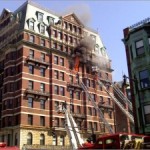
There was a 9-alarm fire last week in Boston, in a 10-story condominium building. Several residents had to be rescued by firefighters, because they didn't evacuate the building immediately when the alarm sounded. One resident, who waited 10-15 minutes (by her estimate) to leave, found a stairwell full of smoke and a locked door to the roof. She was found at the roof door in full cardiac arrest with no pulse and no respirations. She was revived by firefighters and she survived. She's extremely lucky.
I'm not a big fan of glass doors because the options for hardware are so limited, but they do supply some interesting fail moments. You'd think that after multiple people ran into the same sidelite, they'd stick on some fake snowflakes or something...
It's a little scary how excited I get when I find photos in my inbox...mostly because it makes the subsequent post pretty easy and I don't have to try to make the doors I see during my own wanderings meaningful. I received these photos from one of our esteemed trainers, who travels around teaching people about hardware. Any hardware people who have attended a class in a hotel meeting room can vouch for the scary hardware applications you can find there.
Long before I started this blog, I had a personal one for my friends and family to keep up on what's going on in our household. Usually, I don't mix the two...most of my friends and family aren't very interested in door hardware, and I'm not sure I want my colleagues knowing that I sometimes squirt my kids with a spray bottle when they're misbehaving, but occasionally the lines get blurry.
This weekend we took advantage of the beautiful spring weather to get outside and soak up some Vitamin D at a local farm and on an Easter boat cruise. Lots of sun and signs of spring, but not a lot of doors.
I think I've seen so many non-code-compliant doors that I'm becoming numb to them. In the old days I would be spurred into action by the sight of a blocked exit or propped-open fire door. Yesterday I was at the local bagel joint and I saw their marked emergency exit blocked with stored high-chairs. No surprise. I went to my chiropractor's office and in the 3-story stairwell, two doors were propped open by the construction crew doing a 2nd-floor office fit-up, and the third floor door's latchset had been removed and replaced with a push plate and pull. Ho-hum.
It has been a while since I've received a new batch of photos from Israel but these were worth the wait. The Hurva is a reconstructed synagogue in the Old City of Jerusalem, with a long, storied history. Construction on the original synagogue began in the early 1700's, but the unfinished building was destroyed in 1721. It was rebuilt in 1864 and destroyed again in 1948. The most recent reconstruction began in 2005, and the reconstructed synagogue was officially opened on March 15, 2010.
As I've said before, I often look at my stats and see how people arrived at my blog. I see a lot of people searching for information about fire door inspection and other information about fire doors, when to use panic hardware and various egress questions, and plenty of accessibility questions. Sometimes people arrive searching for something a little different, so I thought it would be fun to share these requests on occasion.
The fire at the Triangle Shirtwaist Factory in New York City on March 25th, 1911, claimed 146 lives - mostly young immigrant women. Building owners locked the exit doors to keep the workers in and the union organizers out, so when a fire broke out on the 8th floor it was impossible for some of the 600+ workers on the 8th, 9th, and 10th floors to escape. The fire escape was not sufficient to hold the number of fleeing occupants, and collapsed. Firefighters' ladders were several stories too short, and water from the fire hoses could not reach the upper floors of the building. Sixty workers jumped to their deaths.
This building in Calcutta was involved in a fatal fire today, with 24 deaths reported so far and additional people still missing. The top floors of the building had been added illegally, but the building owner paid a fine and all was forgiven. The fire department reportedly had never inspected the building.
No matter how much time I spend thinking about doors and hardware (that's so sad), there's always someone waiting in the wings with a question or problem I haven't thought of yet. When I worked for a hardware distributor, that usually meant that because I had never thought about that particular issue before, I had doors on a jobsite that were going to cost us time and money to fix. Now that most of my work is earlier in the process (spec-writing), there's usually plenty of time to catch any coordination issues before the doors are actually fabricated.
I went to see an architect on Friday, for what I thought would be a 2-hour meeting to discuss the security requirements for a new project. 3 1/2 hours later (time flies when you're talking about hardware!) I emerged to the sunlight (and the parking ticket), after literally resorting to cheerleading to get the architect through one more floor of the building (Her: "Lori, my brain hurts." Me: "Come on! You can do it!!").
After my post about the Parkside West fire, a couple of people have asked me what I have against spring hinges. I'm not one to discriminate against hardware of any function, style, or finish, but I also like things to do what they're supposed to do. If I could get my kids to act more like cast iron door closers, I'd be a happy camper. I'm not picking on spring hinges here - Ives makes spring hinges and is also one of the brands that keeps a roof over my head. They just need to be used for the right applications.
Last week I attended a security meeting for a new horticulture building at the Mt. Auburn Cemetery in Cambridge, Massachusetts. I've written hardware specs for hundreds of projects but never a building for a cemetery. I had never been to Mt. Auburn, so I looked it up on Google Maps, my first clue that this was not your typical cemetery.
Last Tuesday night, approximately fifty people were left homeless by a fire at the Parkside West Apartments in New London, Connecticut, which apparently began on a stove in a 3rd-story apartment. One of the newspaper accounts of the fire investigation reported that the fire marshal stated "in the third-floor apartment where the fire is believed to have started, a weatherstrip prevented the door from closing, allowing smoke to spread."
I get a little self-conscious when I'm taking photos of doors because I think people are probably wondering why in the world I would be doing that. I haven't been approached by Security yet, but I'm sure that day will come.
At the Boston Chapter CSI meeting tonight, we had a presentation by the appropriately-named "Woody" Vaughn of Vaughn Woodwork Consultants about the new Architectural Woodwork Standards. (I think I need a hardware-inspired nickname, but that will have to wait for another post.)