Security Sales & Integration: Cracking the Code
My recent article in Security Sales & Integration addresses panic hardware from an access control perspective.

My recent article in Security Sales & Integration addresses panic hardware from an access control perspective.
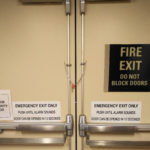
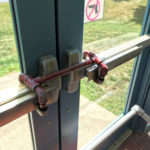
The intent of the application in today's Fixed-it Friday photos is obviously to deter the use of the doors - do you think this is code-compliant? Have you ever seen any documentation on these plastic loops?
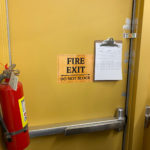
It's fire exit hardware, so it has to latch!
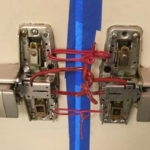
I know these doors aren't actually secured with licorice, and I HOPE this building is under construction and unoccupied. Thank you to Keith Zettler for today's Fixed-it Friday photo.
Have you watched the Six Locked Doors documentary yet? And yes, this door has an exit sign. And a "no exit" sign. And an "emergency exit" sign. :(
I can not for the life of me think of any circumstances that would make me consider locking egress doors in a school using this method. Just no. Never. #wordless
Is the UL 294 listing required by the model codes for panic hardware with the electric latch retraction / electric dogging feature (EL/QEL)?
There are so many code issues with this "exit" in a children's museum that I'm just going to remain #wordless. Could you quickly operate this door in an emergency?
This Chinese restaurant has 30 tables, which means that the occupant load is probably over 100 people - definitely over 50. What's wrong with this (WW) picture?
This video was made by Von Duprin in the 1940's...I'm very proud that I can continue to share the importance of life safety and free egress!
Another Friday, another "fix." This fire door probably won't perform as designed and tested, should a fire occur. Why does convenience so often win out over safety??
Billy Rogers of Rogers Installations sent me today's Wordless Wednesday photo, and I'm feeling a little ill. This pair of doors serves a 9,000 seat auditorium, and the man on the right appears to be from the fire department. :(
It's chilling to consider what will happen when someone needs to use this exit in an emergency. The other exterior doors have the same security measure in place. :(
It's Wordless Wednesday again...can you believe that I've been posting WW photos every week since January of 2011?? And there's no end in sight! Keep the WW and FF photos coming!
This article was published in the October 2019 issue of Locksmith Ledger, and includes some questions that you can use to determine whether your code knowledge is up-to-date.
Ahhh...that feeling you get when you overhear someone telling their coworker that they think they've spotted a code violation - and they took a photo of it!
It took me a second to see what was happening here, and now I'm #wordless. Thank you to Kim Murkette of Isenhour Door for the photo!
It can sometimes be difficult to determine whether a particular type of hardware requires special knowledge or effort to operate since this is left up to each AHJ to interpret. Not this time...
Any idea what is corroding or oxidizing inside of this door - and to this extent?? I've never seen anything like it! What's the solution? WWYD?
I can almost understand how trash cans get placed in front of exit doors, but the (semi-permanent) use of zip-ties is hard to take.
People ask me all the time...Do ALL doors have to meet the requirements of the IBC? How do you differentiate between an egress door and a non-egress door?
It warms my heart that in the last 10 years, the number of people who actually notice these problems (and often do something to resolve them) has increased significantly.
I'm Wordless about today's Fixed-it Friday photo. Considering that this is a retail store, I'm not even sure how/why this happened. Any theories?
The door in these photos is at the top of the stairs in a bar, exiting from a non-sprinkled basement assembly room that is used for weddings and parties. What do you think? OK or NO WAY?
John Bianco uploaded these photos to the "There's no crying in Hollow Metal" Facebook page, and he said I could share them here for Fixed-it Friday. I'm not sure I've ever seen this fix. How about you?
Pat Filholm of All Secure Inc. sent me today's Fixed-it Friday photos. "If it ain't broke, don't fix it," I always say, but luckily in this case Pat will be upgrading their security.
Yesterday I posted a Fixed-it Friday photo even though it was Thursday, but don't worry! I saved up some FF photos during my trip to Italy, and I'm sharing them all today!
This is one of the most egregious examples of a non-code-compliant egress modification that I've ever seen, and yes, it was in a school.
I don't think it's a coincidence that panic hardware was one of the reasons I started learning about codes in the first place.
Do you see what I see? THIS is why temporary locking devices should not be approved for doors serving a means of egress. They often become permanent locking devices!
This is an egress door serving a stadium. Someone "fixed-it" from a security standpoint, but what about egress? This requires a key AND special knowledge and effort!
Today's Fixed-it Friday photo is from Nolan Thrope of Allegion. What's the old saying..."necessity is the mother of invention"?
This door - yes, with panic hardware - is on a restroom in Italy. The non-code-compliant hook modification solves the privacy problem. :|
Back in 1993, Bill Elliott told me to always specify rim panic hardware with a removable mullion on exterior pairs that require panics. It was good advice.
I received this photo from Audrey Weiser of DHI - she was looking for some code language that would clearly state that this application is not allowed. Unfortunately, there isn't anything specific (that I can think of) in the model codes.
Jeff Rapp of Wilkus Architects sent me today's Wordless Wednesday photos. I hope whatever this facility is trying to protect is worth the risk. :(
This question keeps coming up...Is panic hardware required for the residential floors of hotels and apartment buildings?
I need some help tracking down this lock (if it's still available) for a current project. Have you run across anything like this before?
Take a look at these egress doors serving a large arena. The struggle for security is real, but we can't forget about life-safety in the process!
This one is a real head-scratcher. How did this happen, AND what's the card reader for? #hardwaremysteries
A knob, lever, AND a mag-lock? And what's with the stainless plates? Are they covering old vision lights or do you think they were "original equipment"?
Sometimes door problems are not evident until you take a closer look. I wonder how many people have walked past these doors and never noticed...
Heads up - the 5-pound force limit on operable hardware is something everyone should be aware of long before the final inspection by the AHJ.
There is actually a strike designed for this purpose, but without job-site creativity I wouldn't have any posts for Fixed-it Friday.
Can panic hardware be painted in the field without voiding the label?
This Fixed-it Friday photo is of an egress door serving a martial arts studio. It's a good thing the students have special skills they can use in an emergency.
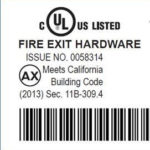
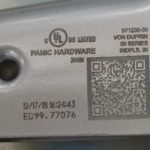
On numerous occasions I've gotten the call - a painter/cleaner/mischievous kid peeled the UL label off of the panic hardware or fire exit hardware.
I admit it. I have a thing for old hardware - especially when it's still functional, and even better when it's ours!
In case you haven't had enough baseball, John Cohrs of Central Indiana Hardware sent me this photo of the bullpen door from last night's World Series game (nice hardware!).
Fire marshal to restaurant owner: "This door requires panic hardware because the occupant load is over 50 people." Restaurant owner: "Done!"