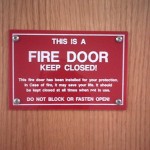
Time-Sensitive Opportunities!
There are 3 educational opportunities coming up, but you have to act fast! An on-demand video of a fire door test - 1 week only! Access Control Training begins Thursday! The next online Decoded course begins tomorrow!
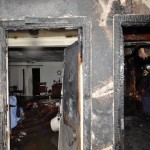
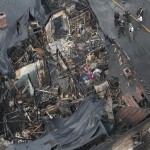
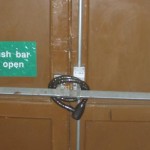
According to news reports, it sounds like an open door or possibly two open doors, along with an illegally locked second exit and insufficient smoke detectors may have contributed to the deaths of 4 children in Chicago's Roseland neighborhood...
Last week I was asked whether the 2012 edition of NFPA 101 - The Life Safety Code requires annual fire door inspections for health care facilities. As many of you know, the Joint Commission and the Centers for Medicare and Medicaid Services (CMS) will soon be using the 2012 edition of NFPA 101 when they survey health care facilities...
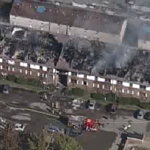
It's too early to know whether fire doors or other passive fire protection measures played any role in the fire last week in a Lowell, Massachusetts apartment building where 7 residents were killed. Regardless, this fire underscores the value of passive fire protection, because many apartment buildings do not have active fire suppression systems - sprinklers...
Rectifying clearance problems can be difficult and costly, so it may be tempting to leave non-compliant doors in place and assume that a little extra clearance won’t affect the performance of the fire door assembly; I can now say from first-hand experience that this is not true...
Back in the Olden Days when I went to hardware school, I couldn't wait to get my AHC certification and become an instructor. I really looked up to them (and still do!). They were very knowledgeable but they had a lot of fun too. Then life happened...
These are 3-hour fire doors which divide the modern wing of the museum from the older wings. This is an award-winning museum which houses more than 300,000 works of art in its priceless collection. The chance of a fire may seem unlikely, but if a fire occurs, the wedged-open fire doors will not protect the rest of the museum...
Fire door assemblies play a vital role in the protection of life safety, yet many people remain unaware of their existence. We pass through these doors every day in commercial, institutional, and multi-family residential buildings. A lack of awareness...
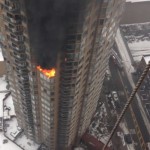
Last month I wrote about a fatal fire in a Manhattan high-rise residential building, where non-compliant fire doors likely had an effect on the outcome. There was initially a lot of publicity surrounding this tragedy and even a proposal for new legislation, but as I feared, within a couple of weeks the media was no longer reporting on the story. I recently read the article below in the monthly newsletter from the Center for Campus Fire Safety, and I loved it so much that I asked them if I could share it with you. It gives a different perspective on the same issues that I preach about all the time, from Phil Chandler, a firefighter and fire marshal. Many thanks to the Center for Campus Fire Safety, and to Phil.
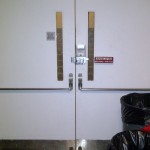
Instead of maintaining the fire exit hardware on this pair of fire doors, the rods and most of the latches were removed and an exit alarm was installed. The most disturbing part is that there are doors like this EVERYWHERE...fire doors and egress doors that will no longer perform as designed, tested, and required by code, because of lack of maintenance or improper modifications. And without widespread adoption of the fire and egress door inspection requirements, we're left to address these problems one door at a time. In each fatal fire the main focus seems to always be on sprinklers, but compartmentalization is key to preventing the spread of smoke and flames. It goes without saying that code-compliant egress is a life safety feature which can't be compromised.
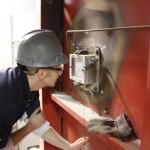
BM TRADA will be streaming a live fire door test over the internet on 17 September, offering viewers an opportunity to see for themselves the crucial role played by fire doors in saving lives and property.
Thank you to everyone who has sent me photos of doors they've seen in their travels (or while laying on the couch). Kelly Chimilar from Allmar Inc. noticed these doors with an obvious egress problem while watching Thursday Night Football. If you don't know what the problem is, I will hold a special online study session for you after work tonight. ;)
Georgia school shooting: A hero emerges - Christian Science Monitor
This post was printed in the August 2013 issue of Doors & Hardware
I love it when people take action to rectify a code issue - especially when it's a door problem. Two articles landed on my desk in the last few days about just that - citizens who saw a deficiency and didn't let it drop until it got some attention. Both stories are from the UK and both involve high-rise apartment buildings - maybe Theodore Firedoor is helping to educate people about code-compliant fire doors.
Yes, this is a fire door. Anyone see a problem here?
Theodore Firedoor...my hero! And I'm going to start using the word "dodgy" whenever possible. :D
I recently compiled my family's annual photo book, and I found A TON of door photos in the process. Here are a few doors I've seen in my travels...
Although the schools in Providence, Rhode Island, are supposed to be inspected by code officials annually, some had not been inspected for 10 YEARS. I wonder how many public schools are in the same boat?
I'm in Tucson this week for the BHMA Fall Meeting. My husband thinks it's all fun and games, but we've been working hard on some new standards - one for ligature-resistant hardware and one for residential hardware. There's a lot more on the agenda over the next couple of days, but it's a beautiful area to have a meeting, the hotel is great, and I saw my first javelina today (I still think it was a wild boar :D).
This article was originally published in the Summer 2012 issue of Life Safety Digest, a publication of the Firestop Contractors International Association (FCIA). The article has been revised slightly to reference more recent codes.
How is it possible that hotels almost always have fire and egress door issues? It seems like they would get it right once, then duplicate those good applications across the chain and make sure that they're maintained. Yet hotels have been a great source of Doors Gone Wrong.
Whenever I teach a class on fire door inspection, questions always come up about holes in fire doors and how to fill them. I promised a class of 120 last fall at the Yankee Security Conference that I would write a blog post about it, but there was really no good solution, particularly for wood doors - until now.
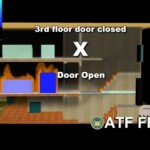
On January 19th, 2011, Firefighter Mark Falkenhan was killed in the line of duty while fighting an apartment fire at 30 Dowling Circle in the Hillendale section of Baltimore County, Maryland. The fire was investigated by the Bureau of Alcohol, Tobacco, Firearms and Explosives (ATF), and the video below details the events leading to this fatality.
UPDATE: This application was discussed at length on the Building Codes Forum, so go check it out to see what the AHJs had to say. The final decision was that the door should have been a 20-minute door, even if the contents of the electric room did not require a higher rating. As a 20-minute door it should have been self-closing and self-latching.
Last week I posted some photos of a pair of 20-minute doors with some "issues," and I want to thank everyone who left comments with their thoughts on the situation. Often, people tell me that they know something is required but aren't sure where to find it written, so I thought it would be good to follow up on what the issues were and why, as well as addressing some of the comments.
The 2010 Florida Fire Prevention Code, effective December 31, 2011, requires fire doors to be maintained in accordance with NFPA 80 and references the 2007 edition of that standard in Chapter 2 - Referenced Publications. The 2007 edition of NFPA 80 requires fire door assemblies to be inspected annually as part of the maintenance requirements, and the requirements for annual inspections of fire doors are specifically indicated in the 2010 Florida Fire Prevention Code (see 12.4 below). Fire door assemblies in new and existing facilities are to be inspected annually per the 11 criteria listed below, and a written record kept for review by the AHJ. Any deficiencies must be corrected "without delay." (Click here for FDAI FAQs.)

My coworker Don Cherry and I with special guests.
I've obviously been slacking because this video was posted a month ago. It's a follow-up to a report about the flawed fire safety system at the Staples Center, including problems with their fire doors. Here's a link, in case you missed it too.
How many more fires is it going to take before people understand that closed and latched doors save lives, code-compliant fire doors are self-closing and self-latching, and annual fire door inspections will make sure they stay that way?
I saw both of these doors today, in two different facilities. Yes, they are both fire rated. One is a cross-corridor pair and one is a stair door.
I know there have been a lot of posts this week and hopefully my subscribers aren't getting sick of the email notifications, but I've got a couple of really important things to post so bear with me. I can take next week off if you're sick of me. :-)
When I lived in a condominium complex in the mid-90's, I don't think I gave much thought to fire safety. I remember hearing the fire alarm in the middle of the night and going out to my balcony to see if I could smell smoke. If not, it must be a false alarm. That seems CRAZY to me now. Luckily, I lived in a fairly safe building. The stair doors and the cross-corridor doors were never propped open. The unit entry doors had spring hinges so they didn't close as reliably as if they'd had closers, but thankfully we never had a fire while I lived there. Someday when I'm helping my oldest daughter look for her first apartment, you can bet that I won't be as lax about fire safety. I may just zip her up in a flame resistant jumpsuit before I send her off to college. :-)
The 2010 Fire Code of New York State requires fire doors to be maintained in accordance with NFPA 80, and references the 2007 edition of that standard (Chapter 45 - Referenced Standards). The 2007 edition of NFPA 80 requires fire door assemblies to be inspected annually as part of the maintenance requirements, so by referencing NFPA 80-2007 for maintenance of fire doors, an annual inspection of these assemblies is required.
The 2010 California Fire Code requires fire doors to be maintained in accordance with NFPA 80 and smoke doors to be maintained in accordance with NFPA 105. The code references the 2007 editions of NFPA 80 and NFPA 105 (Chapter 47 - Referenced Standards). The 2007 editions of these standards require the door assemblies to be inspected annually as part of the maintenance requirements, so by referencing NFPA 80-2007 and NFPA 105-2007 for maintenance of fire doors and smoke doors, an annual inspection of these assemblies is required.
In response to my request for a list of FAQs, my colleague and pal Kurt Roeper sent this suggestion. It's definitely a frequently asked question, but the tricky part is coming up with the answer. I'm a big fan of the old adage, "How do you eat an elephant? One bite at a time." That's how I handle all the big tasks I'm faced with, and I think it will work for this one as well.
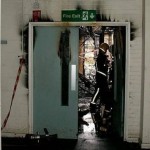
Just when I was wondering what I should post about tonight, I received this photo from Brendan Daley of SURV.
It's tough enough to get anyone to pay attention to fire doors, but when a fire is a result of a "voodoo sex ceremony," there's little to no chance that anyone will take note of the role played by the propped-open fire door. In a 5-alarm fire in Brooklyn on February 20th, the door to the apartment where the fire originated was propped open in an attempt to dissipate the smoke. A window in the apartment was also opened, and heavy winds blew the fire out into the corridor. Other open doors in the corridor allowed the fire to spread and the 7-story building was destroyed.
The suit was in regard to the breach of security caused by wedging open the fire door, but I thought this was kind of interesting:
Judging from the photos, these doors may not have been code-compliant, but they were still able to hinder the spread of smoke and fire, at least to some extent. That does not mean that any old non-compliant door will be fine so we might as well stop worrying about them...one of the biggest issues with fire doors is finding them propped open with a wedge or a more creative device. If the doors are open, they're worthless.
The other day I posted some photos of a fire door that had done its job and prevented a fire from spreading. Several of you emailed me about the photos, because they're SUCH a great illustration of what a fire door is for. It's easy to imagine what would have happened if it was propped open. Well, this morning I received even more photos of the same building (the Robert Moses Nature Center), from Bill Johnson of the Door Security and Safety Foundation, and this afternoon I received a link to a news article from Jerry Heppes of the Door & Hardware Institute. Thanks guys!!
Sometimes I feel like a broken record. Like maybe people are sick of hearing me talk about fire and egress doors, how they protect us, and what happens when they are disabled or neglected. When I meet someone, I don't immediately launch into a discussion about doors because I'm pretty sure they'll think I'm a weirdo from the start and probably avoid me the next time.
I've been doing some research for my FDAI presentation, looking for specific examples of how the inspection of fire doors and correction of deficiencies can have a direct impact on life safety as well as the protection of property. It's not very often that you see fire doors in the news, but these two recent examples showed up over the holidays:
For several months I've been working on a short presentation for code officials about Fire & Egress door Assembly Inspection. I really HAVE been working on it, just not continuously. In my defense, it's really easy to get sidetracked when you get 100 emails per day. But there's one sure-fire way to get me focused, and that's to set a deadline. Not just a due date on my to-do list that I can change on a whim, but a real deadline with other people who will be waiting to see the results of my hard work.
I spent most of today traveling to Connecticut to do a Code Jeopardy presentation for 31 building inspectors there. I'm pretty sure they thought I was crazy when I said that we were going to play a game, but they enjoyed it and learned something, and I was able to keep them awake even though they had just eaten a big slab of meatloaf. If you want to learn about codes in a fun an interactive way, let me know and I'll try to arrange Code Jeopardy for your group.
If you missed the New England Chapter DHI meeting last week...a Q&A presentation on codes, the question/answer document and the handout are now available on the chapter website.