
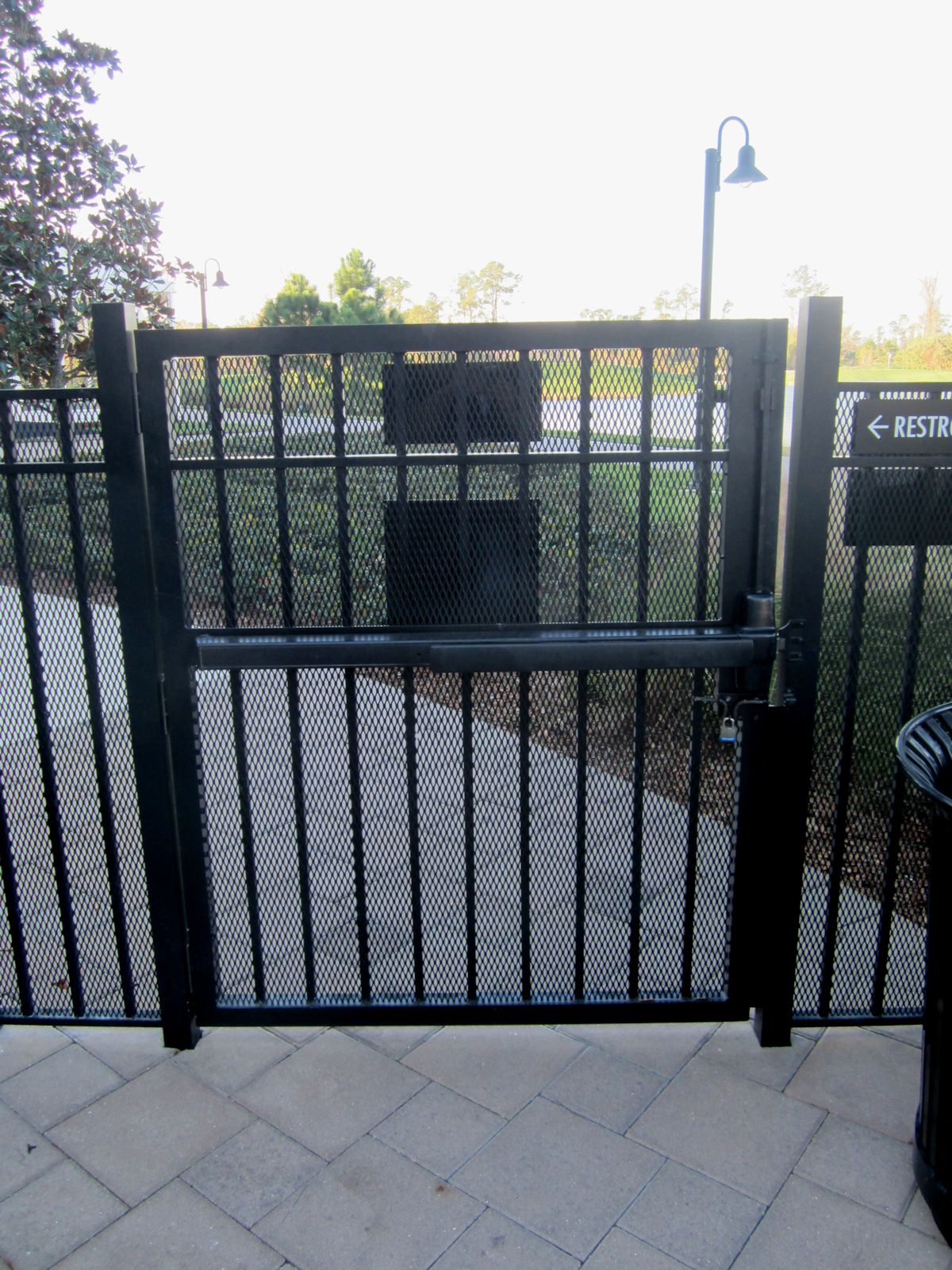
This gate does not have the required 10-high flush bottom area required by the accessibility standards.
Krystina Regan of Allegion brought up a great Quick Question that I had not considered before (that doesn’t happen very often!):
Are manually-operated swinging gates on accessible routes subject to the requirement for a flush, smooth surface on the push side, measured 10 inches up from the floor or ground?
What makes this a great question is that a) the answer is very clear in the accessibility standards, and b) I’m not sure that I’ve ever seen a gate that complies.
The requirement for the flush bottom surface is found in both the ADA Standards for Accessible Design and ICC A117.1 – Accessible and Usable Buildings and Facilities. Here is the section from the ADA standards, which includes the word “gate” (ICC A117.1 also says gate – Section 404.2.9):
404.2.10 Door and Gate Surfaces. Swinging door and gate surfaces within 10 inches (255 mm) of
the finish floor or ground measured vertically shall have a smooth surface on the push side extending
the full width of the door or gate. Parts creating horizontal or vertical joints in these surfaces shall be
within 1/16 inch (1.6 mm) of the same plane as the other. Cavities created by added kick plates shall
be capped.
EXCEPTIONS:
1. Sliding doors shall not be required to comply with 404.2.10.
2. Tempered glass doors without stiles and having a bottom rail or shoe with the top leading
edge tapered at 60 degrees minimum from the horizontal shall not be required to meet the 10
inch (255 mm) bottom smooth surface height requirement.
3. Doors and gates that do not extend to within 10 inches (255 mm) of the finish floor or ground
shall not be required to comply with 404.2.10.
4. Existing doors and gates without smooth surfaces within 10 inches (255 mm) of the finish floor
or ground shall not be required to provide smooth surfaces complying with 404.2.10 provided that
if added kick plates are installed, cavities created by such kick plates are capped.
Considering that the standards specifically mention the word “gate”, and the requirement for the 10-inch flush area on the push side is clearly described, it seems to me that if a manually-operated swinging gate is required to meet the accessibility standards it needs the flush, smooth area. There could be some gates that are exempt because of Exception 3, but this would not apply to pool gates. The International Pool and Spa Code requires pool gates to have a maximum of 2 inches of clearance at the bottom for grade surfaces that are not solid (grass, gravel), and a maximum of 4 inches of clearance at the bottom for solid surfaces (concrete).
Do you agree with this assessment? Thoughts?
You need to login or register to bookmark/favorite this content.





An interesting question relating to this is what is considered “smooth”?
Would mesh qualify as smooth? Since a 36″ wide gate with a solid panel on both sides can catch a lot of wind, does that create even more problems with closing speed, or opening force?
That’s a great question, Glenn, and it really depends on how the AHJ interprets the standards. I imagine some AHJs would have a problem if the mesh had larger holes, but IMO rigid mesh with smaller holes would be ok because it wouldn’t catch a crutch, cane, or wheelchair footpad (I’m not the AHJ though!).
– Lori