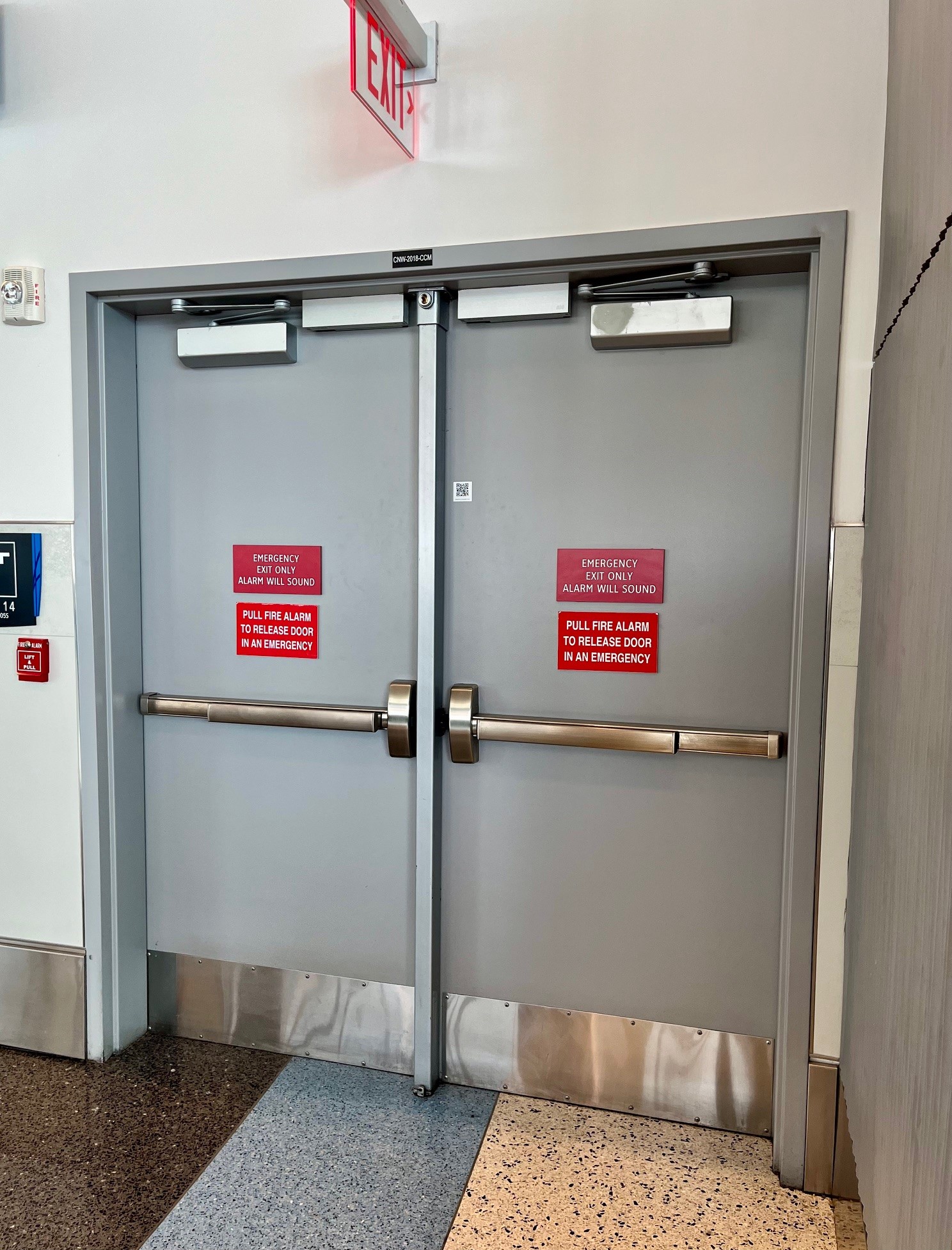
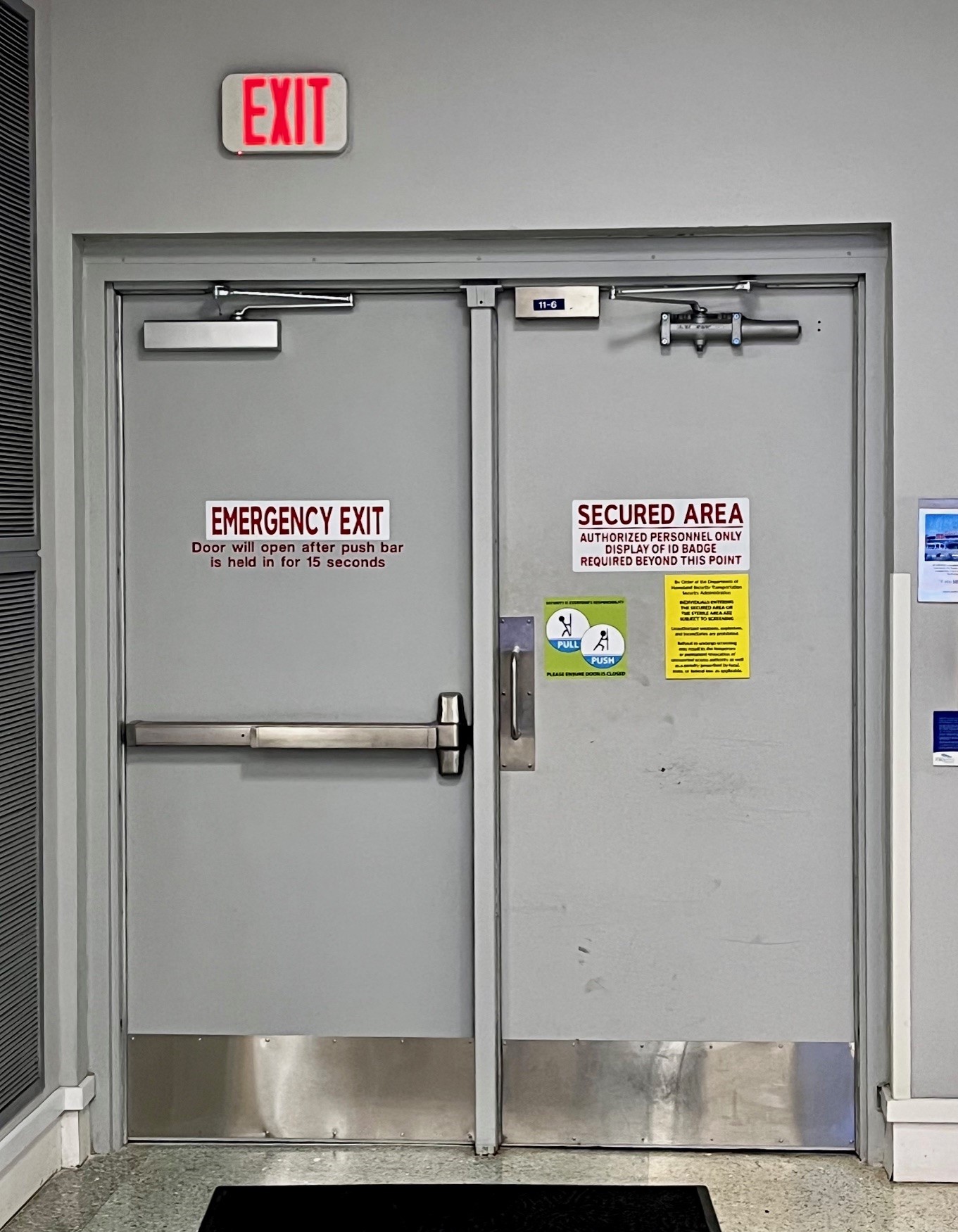
By the time this week is over I will have visited five airports – these are just two of the many doors I’ve seen so far. What problems do you notice in these Wordless Wednesday photos?
You need to login or register to bookmark/favorite this content.

By the time this week is over I will have visited five airports – these are just two of the many doors I’ve seen so far. What problems do you notice in these Wordless Wednesday photos?
You need to login or register to bookmark/favorite this content.





None!!! Federal control!!
Notice to many problems.
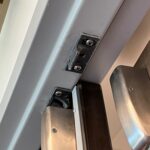
Two action egress on the top photo is a no-go. The bottom photo is a real head-scratcher. No local reset/override of the delayed egress device? And the filler has a hex-key dogging hole?? What’s going on there? And I’ve never seen a Rim x Push/Pull x Removable Mullion combination. Very odd. I sure hope it’s not fire rated. But what’s up with those closers?!?! Backwards!
Why have a pull handle on the push side of the door?
This is now a NORMAN DOOR…
https://youtu.be/qtCEoGyfsxk?si=1gCMk6z5JJkxEolg
Among other things, I’ve never seen signage like that. A delayed egress device that requires an individual to hold the push bar in for 15 seconds before the door will open? I think they misunderstood the code. They got the 15 seconds part right. The rest, not so much.
When delayed egress was added to NFPA 101 in 1981, the sign was required to read, “Keep pushing. This door will open in 15 seconds. Alarm will sound.” There are a couple of photos on this blog where the “keep pushing” message is used. This was changed in the next edition (1985) to the current message because the original message was easy to misinterpret as requiring the push bar to be held down, but the UBC continued using it until its last edition in 1997, and California didn’t change to the current message until 2016.
First photo is another instance of https://idighardware.com/2016/11/ww-airport-observations/
The second doorway is clever by placing all egress-related signage on the left door and restricted access signage on the right door to avoid the problematic signage often found on emergency exits. Does the left door even have delayed egress, though? The hardware is a regular panic bar and there is no visible maglock, and although there could be a maglock on the other side or flush mounted in the door frame, I don’t know why the maglock on the right door wouldn’t be arranged the same way.
In the first picture if the maglock is delayed egress the signage is wrong. If is a standard maglock no motion detector no emergency button.
In the second picture the LHR is a mess. Way is there a pull on the push side of the door and again no motion detector and no emergency button for the maglock.
In the second picture, I believe only the left door is intended to be used for egress, which is why the exit sign is directly above the left door. The right door is for staff access to the secure area, and since it is not used for egress, it does not need to have a sensor or auxiliary button.
Airport security requirements for separation of landside passengers from highly secured ramp-side/airside areas make egress more complicated than simply discharging passengers to the public way at the road in front of the terminal building. Below the passenger concourse level is typically a maze of mechanized baggage handling equipment, MEP and other utility and service functions, not easily broken up with exit passageways from the boarding area to the public way.
1. The recent runway trespasser at the Denver Airport who caused a collision and engine fire on a departing Frontier Airlines resulted in a flight delay for 231 passengers and crew, along with 12 minor injuries and 5 taken to hospitals, for an 11:19 pm flight on one of 4 north/south runways at DEN. A peak hour flight at a hub airport with fewer runways could have resulted in more extensive injuries and equipment damage along with hundreds of flight delays across the US.
2. TSA screens passengers for guns, knives, and liquids, but it cannot effectively predict bad behavior, lack of parental oversight of bored children, or stupidity. Read the news articles on the air rage that routinely occurs onboard the aircraft, and consider if one of those persons could easily exit the terminal building and gain access to the vehicles and equipment on the ramp.
3. There are over 500 commercial airports in the US, so there could be over 500 local interpretations of how to balance the egress requirements with federal security requirements.
4. Tailgating of unauthorized persons through an opening through which a credentialled person has just passed is a problem in airports. Sixteen years ago, an airport security person showed me a BOH security gate on which the airport removed the door closer to force the credentialled persons to manually close the gate to assure relocking before an unauthorized person could tailgate through the opening.
The door pull on the leaf with the mag lock might be a means to expedite the closing and relocking of the door for employees who do not have the time to wait while the door closes and they hear the bonding of the mag lock.
It is easy to point out the problems in the WW photos, but what are some viable solutions?