
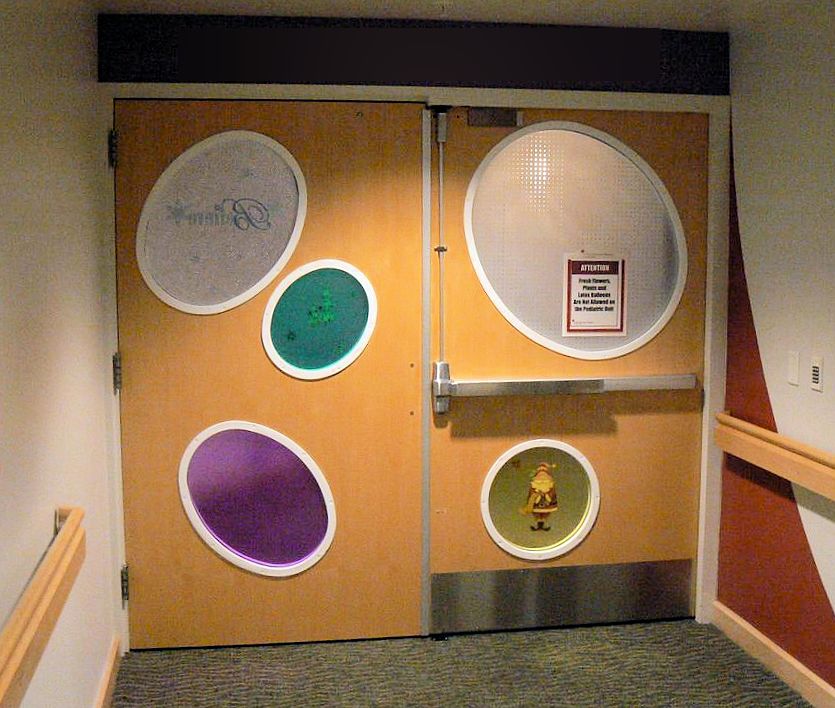
This Quick Question came up the other day, and reminded me of an upcoming clarification in the 2027 I-Codes:
On a double-egress pair, does each leaf have to provide the required clear opening width of 32 inches?
The model codes and accessibility standards all require a minimum clear opening width of 32 inches for most swinging doors, measured with the door open to the 90-degree position. The measurement is taken between the face of the door and the stop on the frame for single doors. For pairs with a mullion, the clear opening is measured from the face of the open door to the side of the mullion, and if there is no mullion, from the face of the open door to the edge of the other door leaf in the closed position. The codes and standards address allowable projections (typically for hardware) into the required clear width.
Two clarifications have been made to the 2027 edition of the International Building Code (IBC) and International Fire Code (IFC), which more clearly establish the intent of these codes. The first addresses standard pairs of doors without a mullion:
Two door leaves. Where a minimum clear opening width is required and a door opening includes two door leaves without a mullion, one leaf shall provide that required minimum clear opening width.
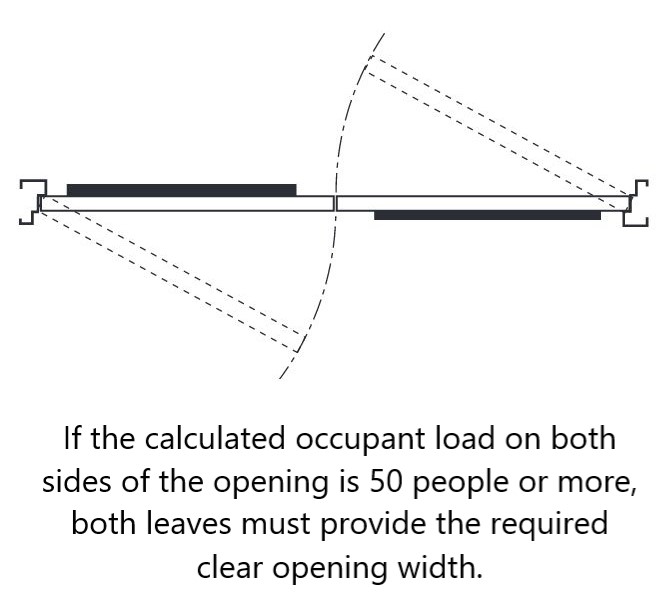 The second answers the Quick Question related to double egress pairs, where one leaf swings in each direction (one outswinging and one inswinging):
Opposite-swinging doors. Where a pair of opposite-swinging doors are in the means of egress, each door required to swing in the direction of egress travel shall provide the required minimum clear opening width.
Typically, a calculated occupant load of 50 people or more will require a door swinging in the direction of egress. The IBC Commentary further clarifies that if the occupant load is high enough that a leaf of the pair is required to swing in the direction of egress (50+ people), that leaf must provide the required minimum clear opening width – usually 32 inches. Note that there are locations where a larger clear opening width is required, either because of the occupant load/egress width requirements or because the doors are used for the movement of beds.
 If a double-egress pair is installed in a location where the occupant load does not require the door serving that space to swing in the direction of egress, the code does not require both leaves to provide 32 inches clear. For example, if a double-egress pair is serving a corridor where one side has an occupant load of 20 people and the other side has an occupant load of 50 people, only the door swinging away from the 50-person load must provide 32 inches clear. That same door swinging into the area with an occupant load of 20 people could be used as the means of egress for the 20-person occupant load, as inswinging egress doors are permitted in that situation.
Summary:
- If both leaves of the double-egress pair are serving calculated occupant loads of 50 people, both must provide the required clear opening width (usually 32 inches but may be required to be greater).
- If only one leave of the double-egress pair is serving a calculated occupant load of 50 people or more, only the door serving that space must provide the required clear opening width.
- Note that in a high hazard occupancy, the IBC requires doors serving any occupant load to swing in the direction of egress.
Any questions?
You need to login or register to bookmark/favorite this content.



This reminds me of another recent post about the unique pair of double egress doors at Brockton Hospital. I assume that would be a situation where only the one egress leaf would need to meet clear opening width requirements.
Yes! For the double-egress pair at Brockton Hospital, the larger leaf served as the means of egress and the other leaf was not required for egress. One leaf had to swing out because of the voltage/amperage of the equipment and the requirement for panic hardware. The other leaf was inswinging because of the ramp outside of the door – the door couldn’t physically swing out.
– Lori