
Today’s post is the twelfth post exploring the inspection criteria for fire door assemblies. The twelfth criterion listed in NFPA 80 for the inspection of swinging doors is:
(12) Meeting edge protection, gasketing and edge seals, where required, are inspected to verify their presence and integrity.
In today’s post I addressed a product that’s very simple, but still causes confusion – meeting stile and perimeter gasketing.
Click here to read other posts in this series and learn more about fire door inspection.
~~~
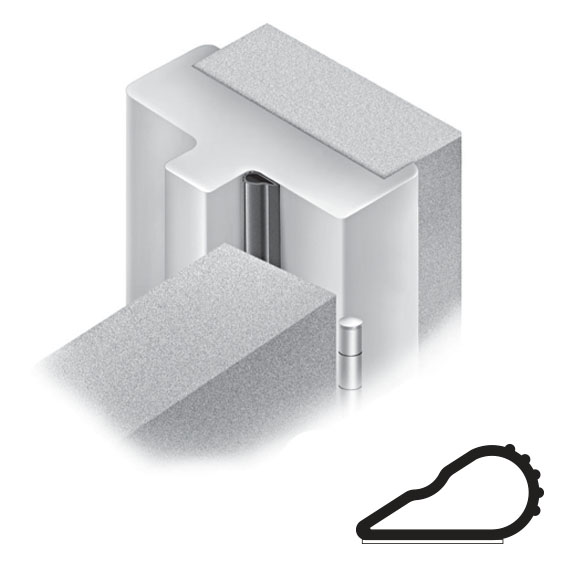 The requirements related to smoke transmission continue to be one of the most confusing code-related topics for doors and hardware. Some fire doors must also meet the mandates for smoke doors, and some smoke doors are not required to be fire rated. The related code sections are inconsistent, leading to confusion (and frustration!). I have this issue on my code development wish list for the 2030 model codes.
In this series of posts, we’ve talked about the various criteria for fire doors – closing, latching, modifications, labels, and more. The topic of today’s post – gasketing – should be very simple. There are no moving parts, and it’s either present and continuous, or it isn’t. But the tough question related to gasketing when inspecting a fire door in the field is…Does this fire door assembly require gasketing?
Unfortunately, it’s not as easy as scanning the model codes and referenced standards for the word “gasketing.” The only specific mention I can think of is that the model codes require astragals or rabbets at the meeting stiles of double-egress pairs in smoke barriers in health care facilities. If you know of other locations where the model codes and referenced standards specifically mandate gasketing, let me know!
The word gasketing also appears in the International Building Code (IBC) in the section on doors with “S” (smoke) labels. The section on smoke and draft control door labeling requirements states that doors complying with UL 1784 must have an S on the label. The code states: “This marking shall indicate that the door and frame assembly are in compliance where listed or labeled gasketing is installed.”
Does this mean that if you see an S on the label, the fire door assembly must have gasketing? Not necessarily. For many manufacturers, the S has been added to all fire door labels, so the labels can be used on doors that require gasketing to limit smoke transmission, and on doors that are not mandated to limit air infiltration. If listed or labeled gasketing is installed, the S applies. If the S rating is not needed for the location where the assembly is installed, gasketing is not required.
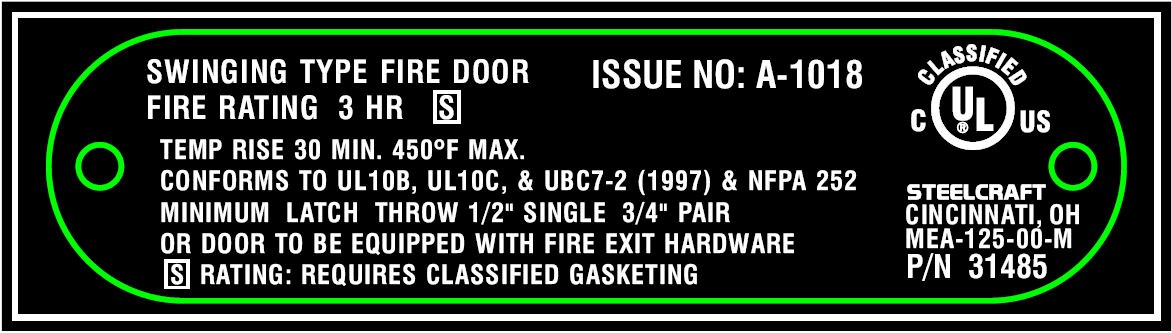
So how do we determine where gasketing is required by code? The key is to look for locations where the door openings must limit air infiltration in accordance with UL 1784 – Standard for Air Leakage Tests of Door Assemblies and Other Opening Protectives. For example, for smoke and draft control doors, the IBC states that when tested in accordance with UL 1784, the air leakage rate of the door assembly shall not exceed 3.0 cubic feet per minute per square foot [0.015424 m3/(s × m2)] of door opening at 0.10 inch of water (25 Pa) for both the ambient temperature test and the elevated temperature exposure test.
When door assemblies are required to meet this limit, it is difficult or impossible to achieve these values without gasketing at the head, jambs, and meeting stiles. For most doors, a seal at the bottom is not mandated, unless the door is required to meet the stated limits without the artificial bottom seal installed during the test (this occurs at some elevator lobby and hoistway doors). If the door must be tested without the artificial bottom seal it would typically require a sweep or automatic door bottom – both during the test and on the final assembly installed in the field.
Once a fire door assembly inspector determines whether gasketing is required for a particular fire door, compliance with the twelfth criteria is not difficult to assess. Is the gasketing present? Is it continuous? Has the gasketing been notched around the strike, overhead stop, or door closer shoe? This could compromise the seals’ ability to resist the passage of smoke and gases, and in turn could affect the ability of the fire door assembly to do its job.
Have you had experience with this issue? Share your insight in the comments!
You need to login or register to bookmark/favorite this content.






It is so very important to follow the manufacturer’s installation instructions! I frequently see doors that will not close and latch because the gasketing was not installed correctly.