
Today’s post is the third post exploring the inspection criteria for fire door assemblies. The third criterion listed in NFPA 80 for the inspection of swinging doors is:
(3) Glazing, vision light frames, and glazing beads are intact and securely fastened in place, if so equipped.
In today’s guest blog post, Devin Bowman, General Manager of Technical Glass Products (TGP) and AD Systems, shares information about glazing in fire door assemblies.
Click here to read other posts in this series and learn more about fire door inspection.
~~~
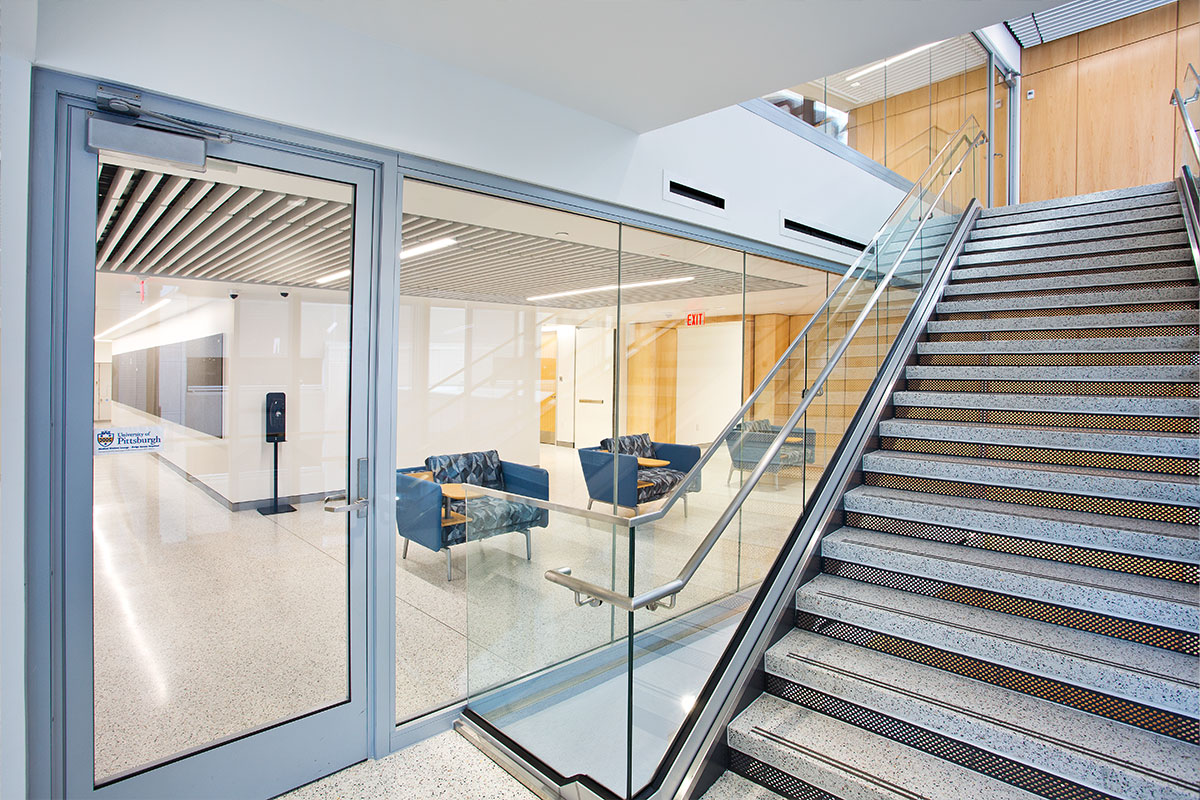
This full-lite fire-resistance-rated glass door offers narrow profile frames to maximize the glazing area along the project’s central stairwell. Credit: Courtesy of TGP
It’s What You Don’t See: Fire-Rated Glazing in Door Assemblies
In the past, model building codes limited the use of fire-rated glazing—typically for one of two reasons. First, when a fire door assembly includes glazing, the assembly is tested with glazing of a specific size to ensure proper performance during the test. Vision lights larger than the size tested may require a different fire rating, depending on the assembly, to meet code requirements. The other issue in the past was the traditional wired glass that was commonly used in fire door assemblies. This type of glass does not meet the impact requirements for doors and has been slowly phased out for most applications since the 2006 edition of the International Building Code (IBC).
These limitations made it difficult to design for increased daylight access and improved visual connection. To help sideline these limitations, manufacturers refined, improved and diversified their offerings. In doing so, not only did the performance of fire-rated glass improve but so did its aesthetic appeal and ability to more closely mimic the look of non-rated glazing assemblies.
Currently, designers and specifiers have a wide range of fire-rated glazing options that they can use as sidelights, transoms and vision panels. They can even create full-lite fire doors that meet code requirements for most fire door assemblies. This is true of both temperature-rise doors and non-temperature-rise systems.
Given the rise in fire-rated glazing options, it is important for building professionals, from architects and specifiers to inspectors and code officials, to understand the possibilities with these materials and systems. One of the key considerations is knowing the difference between fire-protection-rated and fire-resistance-rated glazing.
Fire-protection-rated vs fire-resistance-rated: know the difference
For the full assembly to be considered code-compliant, each component of a fire door must meet the minimum requirements for the door’s use within the built environment. This includes any glass used. While there are several data points that determine a product or systems’ appropriateness for an application, often determining if a fire rating is fire-protective or fire-resistive is the first hurdle in achieving code compliance.
Fire-protective glass undergoes the fire test and hose stream test, depending on its rating duration. In a certified, third-party lab, the glass and its frames are heated at a specified, repeatable rate until the temperature reaches a maximum that mimics conditions commonly observed in actual building fires. To be certified as fire-protective, these glazing systems must defend against the spread of fire and smoke for their rating duration—usually between 20 and 180 minutes. It is important to note that fire-protective glazing does not need to block the transfer of heat. As such, these systems are subject to area and size limitations under the applicable building code for a project.
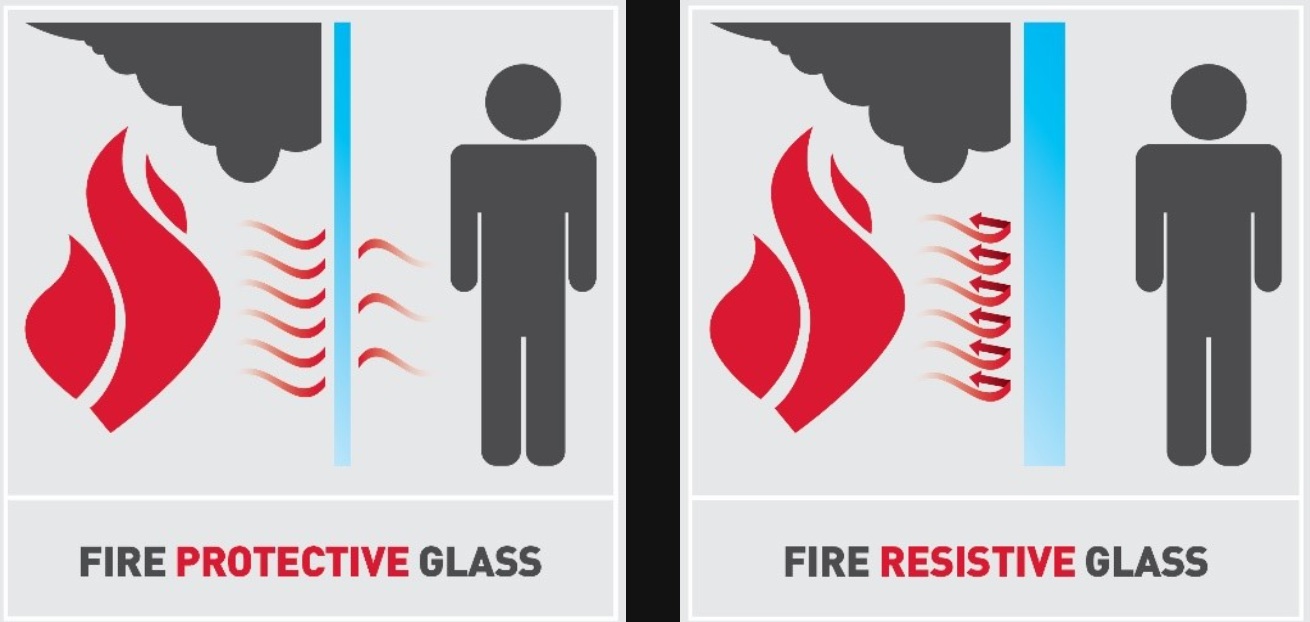
Fire-protection-rated glass stops the spread of smoke and fire while fire-resistance-rated glass blocks smoke fire, radiant and conductive heat. Credit: Courtesy of TGP
Fire-resistance-rated glazing systems are subjected to similar testing standards as fire-protection-rated ones, but they go a step beyond fire-protective glazing. To achieve a fire-resistive classification, the glazing assembly must block fire and smoke as well as radiant and conductive heat, as determined by standards developed by the National Fire Protection Association (NFPA), ASTM International (ASTM) and UL Solutions (UL). Since systems with fire-resistive ratings block heat transfer from both sides of the assembly, their size, area and scope is not limited—as long as they meet the durational requirements for their application these glazing solutions can be specified as floor-to-ceiling walls and as full-lite fire doors.
For ease of reference, applicable test standards can be found on the glazing’s fire label, which is standardized according to the IBC. Labels typically include the fire rating category, which application criteria it meets (window, wall, ceiling/floor and door), if it passes the hose stream test, its duration and if it meets temperature rise criteria. Technical Glass Products (TGP) provides a reference tool that breaks down what each mark on a fire label means. It can be used in tandem with the online version of TGP’s product SpeciFIRE tool to help project teams find the right glazing systems for their fire door needs.
Rising to the challenge: types of fire doors
In knowing the difference between fire-protection-rated and fire-resistance-rated rated glass and other basics of fire-rated door specification, designers can more efficiently create fire door assemblies that meet code requirements and improve sightlines between adjacent spaces. This knowledge allows these professionals to more accurately specify the correct products and systems early in the design process, reducing time spent on respecification or redesign.
For example, in critical areas like exit enclosures and other 2-hour rated fire barriers, the potential for high heat buildup is a major concern. To prevent the radiant heat from igniting materials on the safe side of the wall, sidelights and transoms are typically required to use fire-resistive glass. Without it, vision panels are limited to a small size, usually under 100 square inches (sq in), to minimize heat transfer.
By comparison, in a typical 1-hour corridor, the fire safety strategy is less about heat containment and more about limiting the spread of fire and smoke. For this reason, fire-protective glass can be used more extensively in door vision panels, sidelights, and transoms. The rating requirements for fire doors and other opening protectives can be found in Table 716.1(2) of the 2024 edition of the International Building Code (IBC).
In addition, according to this table, there are certain applications, such as exit access stairways and ramps, that require glazing to contribute to a fire door’s ability to meet temperature-rise criteria. Also known as temperature-rise doors, these systems block heat such that the ambient temperature on the non-fire side of a door will not exceed a specified temperature for at least 30 minutes during the fire tests—this helps ensure safe passage for occupants during a fire emergency. Common temperature benchmarks for temperature-rise doors are 250, 450 and 650 degrees Fahrenheit, with 250 degrees being the most stringent.
Full-lite fire-rated door assemblies that meet temperature-rise criteria can contribute to designs that prioritize increasing daylight access and improving visual connectivity. When these systems utilize narrow-profile fire-rated frames, they can offer a close visual match to adjacent non-rated assemblies. In fact, the renovation of Alan Magee Scaife Hall at the University of Pittsburgh includes Fireframes® Heat Barrier Series fire-rated doors. These doors increase the glazing area along the building’s central stairwell while the framing profiles create a cohesive design aesthetic between the fire-rated systems and the neighboring, non-rated exterior curtain wall.
Staying in frame and going beyond the glass
Again, it is crucial to understand that each component of a fire door must meet the minimum requirements for the door’s application within the built environment to be considered code-compliant. In addition to the glazing, this includes hardware, framing and other component parts. When it comes to framing, this component must meet the requirements for the fire door’s specific application and context. Additionally, its design, specifically profile dimensions and material, is often crucial to meeting project goals outside of code-driven minimums.

Versatile cover caps allow a wide range of code-compliant design options for fire doors and adjacent assemblies. Credit: Courtesy of TGP
For framing profile dimensions, there are many things that impact its design. First, the frame itself, like the glass it holds, must pass fire test standards. Further, it must have the strength to hold fire-rated glazing, which can be three to four times the weight of non-rated glass. In the past, these conditions resulted in fire-rated frames with wider profiles and bulkier edges than non-rated frames. This can be distracting when multiple glazing systems are in close proximity, such as a stairwell enclosure.
A more recent alternative is rollformed steel frames, which can be made narrow enough to closely resemble non-rated systems. Strong enough to hold high-performance fire-rated glass, this type of framing system can also incorporate cover caps in different materials—from aluminum to real wood veneer—without significantly increasing profile width. Not only does this help maximize code-compliant glazing areas but it also widens the contexts where this type of framing can be seamlessly integrated into the built environment.
Fire-rated design almost always comes with challenges
Whether a project needs a fire door that incorporates some amount of fire-rated glass or its design includes multiple fire-rated glazing assemblies across several elevations, designing, specifying and installing fire-rated glazing systems can come with several challenges. As such, project teams are encouraged to consult local building codes and to clarify ambiguities with an Authority Having Jurisdiction (AHJ) to help ensure the systems they specify meet the code-driven requirements.
Beyond this, architects and design firms can contact fire-rated glazing manufacturers, like TGP, to request literature or presentations that either clarify the basics of fire-rated design or speak directly to a project-, application-, or performance-based challenge. Project teams can also work closely with manufacturers to design systems that meet code requirements without compromising building goals for occupant wellness and comfort.
Meeting fire and life safety requirements begins with design, but it also entails routine maintenance and continued inspection to ensure no in-field modifications void a fire door’s labeling. Stay tuned for the next post in this series, which will examine inspecting the door, frame and hardware to ensure they are in proper working order.
Do you have questions about fire door inspection? Leave them in the comment box!
Click here to learn more about Allegion fire rated solutions, or visit iDigHardware.com/firedoor.
Devin Bowman is General Manager of Technical Glass Products (TGP) and AD Systems. With over 20 years of industry experience, Bowman is actively involved in advancing fire- and life-safety codes and sits on the Glazing Industry Code Committee (GICC). Email: Devin.Bowman@allegion.com. Contact him at (800) 426-0279.
You need to login or register to bookmark/favorite this content.



Leave A Comment