
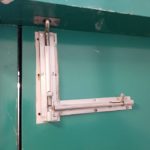
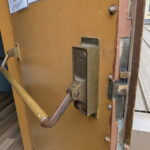
TJ Gottwalt of Allegion sent me today’s Fixed-it Friday photo, taken on a Canadian ferry pier. The added surface bolts are a common (and non-compliant!) “fix” for vertical rod panic problems. What would you have specified instead, and why?

You need to login or register to bookmark/favorite this content.
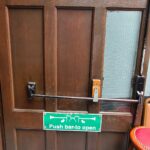
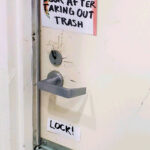


In most occupancies, and assuming the occupant load of 300 or less; key operated deadbolts that are readily distinguishable as locked, and with appropriate signage ‘This door to remain unlocked…” could be used.
I believe in occupant loads over 300 you would have to go electrical locking (such as mags) with the requisite sensor releases and signage.
Is there another solution?
Double doors with no center mullions are, or will always become, sloppy/floppy and unsecure. I believe that Vert Rod exit devices on pairs of doors are the weakest security solution that we continue to see. Perfectly installed on heavy , stiff doors they can work for a time. Any shift in the door, hinge, jamb, threshold, strike, or building, and they become an insecure opening. My dream is spec writers will one day see the shortcoming of this solution and quit cursing these doors with such a low security option.
Hi Glenn –
That could be a possibility if this door is the main entrance to a building or tenant space. One question that keeps coming up on the double-cylinder lock application – what is acceptable on the other leaf if it’s a pair? Some AHJs won’t allow manual flush bolts and the code doesn’t specifically address what to do.
– Lori
Hi Lori,
I’m looking for something that says we can NOT have a deadbolt, on each door in a pair, going into the header jamb. In other words replacing the slide bolts in this picture with key operated deadbolts.
We’re had this exact situation on a Place of Worship. We convinced the AHJ that we could do do this according to our state code 1010.2.4.3 (2025).
-Glenn
Hi Glenn –
If this door was a main entrance to the building or tenant space, I think that a double-cylinder deadbolt with indicator on each leaf (+ signage) could be acceptable as long as it was one of the occupancy types where double-cylinder deadbolts are allowed. I’d prefer to see cylinder flush bolts rather than deadbolts at the top of the door, but the higher location could be approved based on the “locks used only for security purposes” exception.
– Lori
A knowledgeable installer/ field technician. Yes, that was what should have been specified!
If the existing hardware parts were not available, I would have informed the customer that they would need to replace the hardware with something newer that does work. Both ADA requirements and Egress requirements are being violated at this opening.
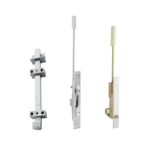
Repair the SVR device. It has been my experience most of the time they just need cleaning, lube and adjustment.
The problem is fishing the device thru the gap, and the solution will depend on if the security team wants to detect or delay. The facility looks like it has on-site security, and they may wish to consider “detect” to keep the feel of the opening. In that case, RX, door contacts and locking trim would solve the problem.
If you need to delay it’s another matter entirely.
I would remov both surface bolts and document it in an email as a life safety violation.
Rim exit devices and movable mullion.
I sure hope these have floor closers because I can’t imagine using REG arm closers in this application (yuck!). Or maybe they have auto operators, though I don’t see signage.
And anyone with a hanger can get into this cafe so…
I assume Canada has adopted ICC A117.1 so the bottom rods are an issue, but they may be grandfathered.
Option 1: Repair if possible, including replacement parts if needed and available.
Option 2: My preferred, rim x rim x removable mullion. They could still use cross bar devices, and the mullion would add security. They would need to check but an aluminum mullion might not require a change in backset.
Option 3: Replace with new SVR devices with the LBR option.
Mag locks are an option but I would still repair or install new devices for loss-of-power security.