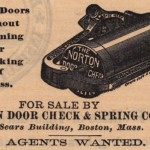
How I Discovered Door Checks (Part 2), by L.C. Norton
I posted Part 1 of this article a while back, and apparently there have been people waiting patiently for the second installment. As requested, here is Part 2. Part 3 to follow.

I posted Part 1 of this article a while back, and apparently there have been people waiting patiently for the second installment. As requested, here is Part 2. Part 3 to follow.
Last weekend I put together the annual family photo album so I could order copies for the grandparents. Mixed in with all of the vacation photos were a ton of doors. Someday my grown-up kids will be on the psychiatrist's couch..."My mother always took us places just so she could look for interesting doors...I'm scarred for life." :-)
I can't stop looking at the naked LCN 4040 behind Lindsey Vonn's head. Thank you to Eagle-Eye Jim Bystry of Ingersoll Rand Security Technologies for sending me the link.
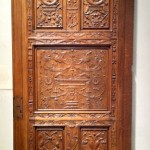
It warms my heart when someone says, "I saw this door and I thought of you." :-) That's what Angie Sutton of Ingersoll Rand Security Technologies wrote when she sent me this photo of an old vault door on a storage room at the county courthouse:
Check out these regular arm closers mounted on the push side of a pair with a transom panel. I would have used a parallel arm closer with a flush transom shoe, but I can appreciate the creativity.
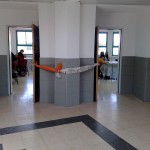
Which product application do you use when you have doors that open back-to-back and need to close upon fire alarm? I was just explaining my preferred option to a specwriter last week, and then these photos arrived...perfect timing!
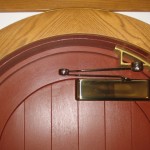
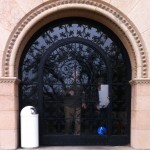
You don't see a whole lot of arched doors on new construction these days, but I think we probably have more than our fair share of beautiful old arched doors in the Northeast. Over the years I've had quite a few calls about how to retrofit new hardware onto existing arched doors, and the trickiest part is the closer. A floor closer would work well, but it's often difficult or impossible to install a floor closer on an existing door because of the required floor preparation.
Call me crazy, but this is one of my favorite days of the year - the first day of school. The summer is just too chaotic for me, with kids going every which way to various camps and activities - I need more structure in my life! So needless to say, I'm a happy camper today. I'm even happier because it was announced yesterday that this blog, my 4th baby, won the Ingersoll Rand Security Technologies President's Award in the Leadership category. WOOHOO! Thanks to all of you for visiting regularly and interacting with me. That's what blogging and social media are all about!
I was recently cleaning out a drawer and found copies of a 3-part article printed in Doors & Hardware in 1986. The articles were written in 1937. I thought I should preserve this piece of our history, so here is the first installment (others to follow).
A couple of weeks ago I told you about the significance of August 1st - it's my birthday (big deal), and also the day that the features of the LCN 4040XP are incorporated into the standard 4040 closer (BIG DEAL!). Every 4040 closer ordered from today forward will be shipped as a 4040XP - with the larger and stronger pinion, bigger bearings, and stronger teeth geometry. If you have questions about the changes, check out this FAQ document.
I spent last weekend in Stowe, Vermont with one of my BFFs and we stayed at an "inn," which seems to mean bigger than a bed and breakfast but not as modern as a hotel. As my friend said, "I got the keys...they're real keys - how quaint!" I won't get into how the lock on our room had to be unlocked with the thumbturn before you could turn the knob for egress, but I will share the completely inadequate mini-closer on the exterior door adjacent to our room. The door never closed and latched, and the kitchen staff hung out on the landing smoking butts (not the hinge kind). Good thing we had the high-security privacy chain on our room door.
Picture this. You wait by the mailbox for your brand spanking new iPad 2 to arrive. You carefully open the box and breathe in the intoxicating scent of Apple, then plug in the cable, sync your iPad with your iTunes account, and settle back to watch a movie. A few minutes into Despicable Me, the screen goes black. AAHH!!! You pack up your iPad, take it to the Apple store, and find out that it's not an Apple iPad after all - it's a KNOCKOFF!!!
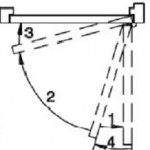
Back in the early 90's when the ADA was the newest focus of the door and hardware industry, delayed action closers were often specified and installed due to the assumption that they were required by the accessibility standards. Delayed action is a feature available on many door closers, which delays the closing cycle for up to a minute (or more depending on the manufacturer) from the maximum degree of opening to approximately 70 degrees. The delay is controlled by an additional valve which slows the flow of fluid for that initial period in the closing cycle. This feature can be helpful in some applications, but it is not required by code. The other segments of the closing cycle, the main speed and the latch speed, are also controlled by valves (see diagram below).
Here's the latest batch of reader photos...don't forget to send me any interesting doors you see on your summer vacations!
Every time I specify hardware for a door that swings into a pocket, a little alarm sounds in my head because at least 50% of the time there will be a problem that urgently needs to be fixed at the end of the job. This application requires coordination between the architect designing the pocket, the contractor building the pocket, and the distributor supplying the doors and hardware, and that's a lot harder than it sounds. The other problem is that when one pair on a project goes south, in most cases ALL of the pairs are a problem.
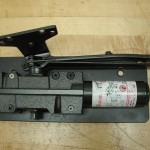
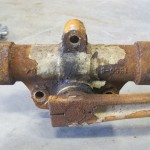
I received these photos a couple of weeks ago and we've been trying to determine whether this is a door closer, or possibly a lever-action shock for an old car. It was being used in an underwater application and needs to be replaced. Does it look familiar to you? If you know someone who might recognize it, please forward!
You just never know what's going to show up in my inbox. Last week I received the clipping below from Jim Bystry of Ingersoll Rand Security Technologies. Jim said he received it from Sue Shapiro of Bell Hardware in Klamath Falls, Oregon. I'm guessing Jim's had it laying around for a while because it's dated February 14th, 2005.
I'm still spending my Tuesday-Wednesday-Thursday nights at town meeting, so I REALLY appreciate all of the great photos that have been sent in lately.
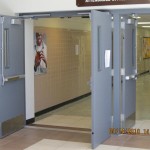
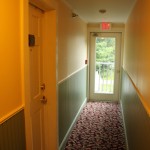
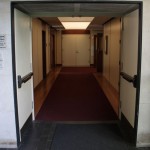
I saw both of these doors today, in two different facilities. Yes, they are both fire rated. One is a cross-corridor pair and one is a stair door.
I was recently elected as a town meeting member for my town (a pretty large town - 68,000 people), and tonight I attended my first-ever town meeting. It was pretty interesting to see government in action, but I also found time to hunt down some old doors for you all.
On our way home we had great weather while we were in the DC area, so we decided to stop at the zoo and let the kids get some of the crazies out. The lions were my favorite...a pride of 2 lionesses, 1 lion, and 7 cubs - just gorgeous. I could have watched them all day. At one point a lioness went to the door and I thought maybe she could smell food or hear someone making preparations. Apparently big cats can open doors, because the knob had a shield around it. The door in the tiger exhibit was the same, except that the tigers must be more impatient because instead of waiting and watching they're trying to dig their way in (see below).
This post was printed in the April 2011 issue of Doors & Hardware
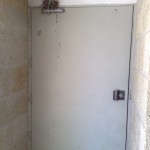
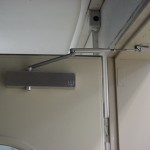
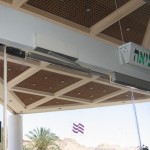
Eyal Bedrik of Entry Systems Ltd. sent me a plethora of photos recently. I think he sent his entire "Creative Closers of Israel" file. :-)
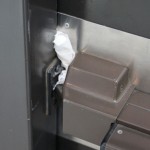
I have to admit, I visit the local frozen yogurt joint so often that the owners ask me if I want "the usual." Hey - it's YOGURT...practically health food! I wasn't sure how I'd be able to make it through their winter break - about 2 months. I survived, but the closer on their entrance door didn't. It lost all of its fluid and started looking for fingers to lop off.
My inbox is overflowing with reader photos again. Thanks everyone!
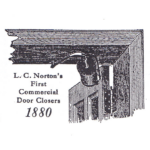
All the discussion about the unidentified piece of antique hardware reminded me to create a post about the invention of the door closer. Luckily, the story of the original LCN door closer was written down in approximately 1937, and I have reproduced it in this post. This story is near and dear to my heart, since the door closer was invented at Boston's Trinity Church, and I wrote the hardware spec for a large renovation there a few years back. The photo at right was taken about 10 years ago, and shows one of the original LCN closers at Trinity.
[I added an update at the bottom of this post!]
When I started this blog, my goals were to organize all of the code information I had into a searchable database, and to offer a more painless way to learn about hardware. I think one of the hardest things about starting out in this industry is the way most of us learn about it - at the School of Hard Knocks. There are some great classes available through DHI and other sources, but it can take a very long time to attend them all, which gives us plenty of opportunities to make mistakes. I know I've made my fair share over the years, so I wanted to help people learn a little bit at a time and hopefully make it as painless as possible.
My daughter Norah and I went to New Haven yesterday for what will hopefully be our last trip to Yale-New Haven Children's Hospital. Thank you to everyone who has inquired about her...she's doing great and is back to her old tricks.
Some creative and unusual hardware applications sent in by blog readers:
I swear, this blog is not going to become a collection of photos that can be found elsewhere on the web, but since two people sent me this photo today and it's pretty horrible, I just have to post it. It's another one from thereIfixedit.com, which is a really funny collection of weird stuff that people do to try to fix things.
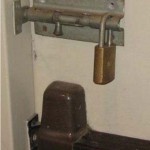
I'm off to Carmel this week so it's going to be a busy one. I don't know if I'll get to the next smoke door post but I'll post some more application photos to tide you over. Here's another gravity closer with a bonus padlock on a temperature rise egress door. And before someone comments that these don't need to be temp rise doors, this opening is in Israel so I'm not sure which code was in use when they were installed.
I think I'm onto something...asking everyone to send their vacation photos of oddball hardware applications has already netted me several, including this photo of a gravity closer from Quebec City. The cable goes from the face of the door, through the pulley that the brown outfit is hanging on, then through another pulley and attaches to a weight that the green outfit is hanging on. Complicated, but pretty inexpensive as long as you don't need door control. ;-)
I think these are about the tiniest closers I've ever seen. One was obviously not enough to get the bathroom door closed, so another one was added. The door still wouldn't close, so the closer was flipped around and mounted the opposite way. The door STILL wouldn't close, AND the sound of the closers was horrendous! (video evidence below)
Long before I started this blog, I had a personal one for my friends and family to keep up on what's going on in our household. Usually, I don't mix the two...most of my friends and family aren't very interested in door hardware, and I'm not sure I want my colleagues knowing that I sometimes squirt my kids with a spray bottle when they're misbehaving, but occasionally the lines get blurry.
I get a little self-conscious when I'm taking photos of doors because I think people are probably wondering why in the world I would be doing that. I haven't been approached by Security yet, but I'm sure that day will come.
This may be in questionable taste, but I thought it was cute. Hopefully anyone who is reading a website about doors and hardware won't be offended by the mention of "pee."
A visit to any volcanic region wouldn't be complete without a trip to the hot springs. We didn't want to miss anything, so we visited two different hot springs resorts - The Springs, and Tabacón.
A couple of days ago, one of our specwriters asked about a closer on a door with rescue hardware, and another specwriter advised him to use a double-acting closer. I was surprised to learn that they weren't aware of my FAVORITE LCN special template - ST-1895.
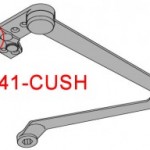
A few weeks ago someone asked me this question and I answered him directly rather than posting about it on the blog, but then yesterday I saw someone arrive at the site searching for the very same information. So, in case you too have been wondering what "CUSH" means in relation to door hardware, here you go...
Back in the day, before my restaurant choices were based on whether the establishment offered crayons, chicken nuggets, and a giant mouse or talking tree, I used to frequent a local cantina. The "naked" door closer on their ladies room door drove me nuts, so one night I showed up with a closer cover, screws, and a set of hex wrenches. As you can probably imagine, they looked at me like I had two heads and made me hand everything over to the bartender.
Just when I think I've seen it all, someone always surprises me. I received this photo today, and at first I couldn't really tell what was going on. Then I realized that the pipe has been cut to length to act as a hold-open. That's a first! When I asked what was holding the pipe in place, I was told that it's the pressure from the door closers! I pity the fool who leans against the door (especially if his friend leans against the other one)! BONK!
The 2009 edition of the International Building Code (IBC) contains an important change that's easy to miss if you're not looking for it. I stumbled across it a few months ago when someone asked me about the exception for cross-corridor doors without positive latching in I-2 occupancies.
In a post about opening force a while back, I wrote that fire doors do not have to meet the opening force requirements of the accessibility codes and standards. While that IS true, someone recently asked me a question that led to this further explanation.
Last weekend I opened the door to a sports facility where my son was attending a birthday party, and I saw an interesting (to me) application. My three friends scattered when they saw me whip out the camera...I still don't know why it's so embarrassing to be seen with someone taking a picture of a door, but it seems to be a universal reaction unless you hang out with other hardware people.
I received this photo the other day and I knew it was the perfect opportunity to talk about application-specific closers vs. universal closers.
I have a lot of pet peeves - just ask my family. One of my pet peeves is when I see a door closer on the "wrong" side of a door. It could be the corridor side of an electric room, the outside of a bathroom, or, like the photo to the left, the weather side of an exterior door. I just don't understand how a closer ends up on the wrong side of the door, especially when many of them (the one at left included) come packed with all of the parts and pieces required to install it three different ways.
I love seeing the inventive ways people install door hardware, and it seems like the product with the most creative installations is the door closer. LCN thought their stick-on installation templates would take the creativity out of door closer installation, but there are still plenty of inventive installations out there.
If you're a frequent visitor to this site you probably know the story...I posted a photo of a concealed closer that is installed so that it's visible through the frame face, and the hardware supplier/installer saw the photo on my site and emailed me to tell me the situation. Apparently it was not a mistake - it was an ingenious solution to a problem, and they used it on 15 pairs of doors in a hotel. I asked the supplier to send me a photo of the completed installation with the custom cover plates in place, and he recently emailed me to say that he "drove down to the Dead Sea and took pictures..."