
The topic of school security and safety has been mentioned several times at this week’s BHMA conference, and coincidentally, this is America’s Safe Schools Week! This week’s blog post from the Partner Alliance for Safer Schools (PASS) covers this issue in depth.
~~~
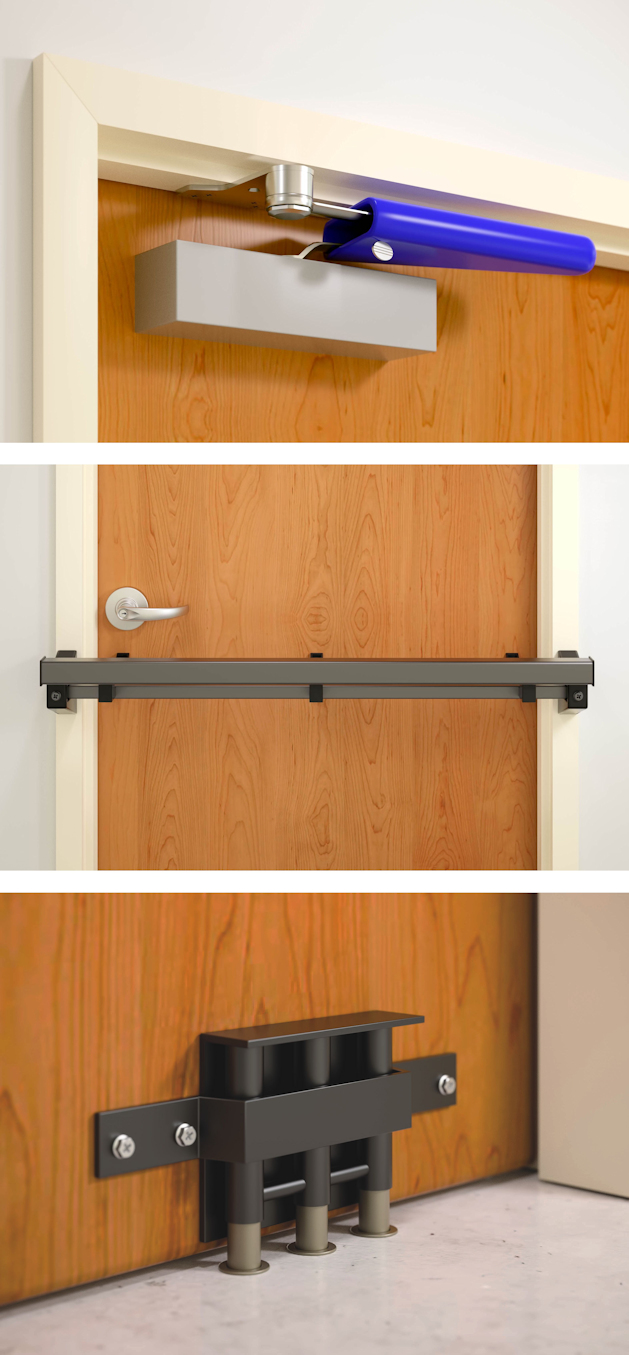
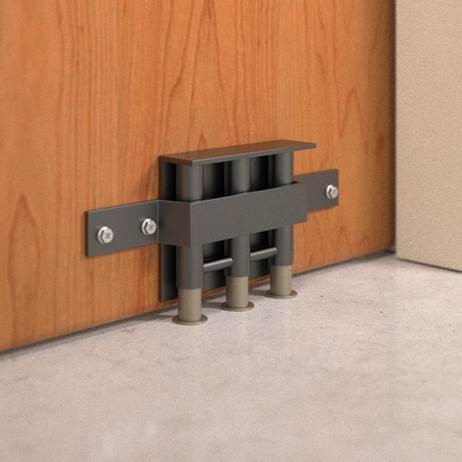
The barricade devices shown in these concept images do not meet the requirements of the model codes or the accessibility standards.
Why School Administrators Should Avoid Using Barricades for Emergencies
Introduction: A Common Pitfall
Barricade devices refer to any supplemental hardware or product designed to restrict the movement of a door, typically deployed in specific situations. These devices may include permanently installed components affixed to the door, as well as temporary solutions such as placing a fire hose over the door closer. Any item added to a door with the intent of limiting its movement qualifies as a barricade device.
Barricade-type devices appear in several forms, all of which share the same fundamental problem: they are not traditional door hardware and often violate egress, accessibility, and fire code requirements. Some common examples include:
- Security sleeves that slip over the door closer arm, preventing the door from opening. While simple in appearance, these devices are out of reach for most occupants, making them difficult or impossible for students and teachers to deploy or remove quickly. They block authorized personnel from entering and can trap occupants inside during an emergency.
- Supplemental locking devices, including bolts, bars, or other gadgets mounted within normal reach range on the door or attached door hardware that allow a teacher to “lock down” a door from the inside. These devices often require multiple motions to release, are not intuitively locked or unlocked, and may be difficult or impossible for individuals with limited dexterity to operate, creating Americans with Disabilities Act (ADA) accessibility violations.
- Floor-mounted barricade devices, which must be inserted into or removed from the floor manually. These devices often require bending or kneeling, again violating ADA standards, and they create tripping hazards when not properly secured.
Each of these products may be marketed as a “simple” lockdown solution, but when deployed, they override the life safety and accessibility features built into the door and locking hardware. These devices can transform a code-compliant classroom into a non-compliant and potentially dangerous environment in seconds.
Click here to continue reading the article from PASS.
You need to login or register to bookmark/favorite this content.





We need to have stricter penalties for Code and ADA violations. When it starts costing them money, they may start to realize that what they did was not a cost saving to doing the right thing.
Lock don’t block.. I do door work at a Jewish Academy K-12 school. They wanted me to install foot bolts on all the classrooms doors. I said no way Jose. Not going to happen. Call the fire marshal and get it in writing and I will. Never heard back. This school also has a private armed security company at all entry gates to the school.
Then after all the current events. The private armed company was gone and the Israel military took over all the gates. I Love seeing armed guards protecting our kids like as if they were gold.