
 I was just saying to someone the other day that after graduating with an architectural degree, I went into a related industry because I did not like the subjective nature of working as an architect. I like yes/no, right/wrong, which is why codes are such a great fit for me. If there are grey areas, my mission is to get rid of them.
The other day someone asked a question that turned out to be a grey area (as far as I can tell), and immediately went on my code development wish list:
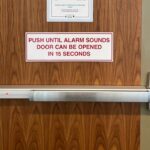
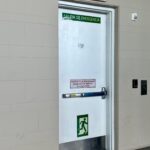
Are delayed egress locks permitted on doors serving electrical rooms where panic hardware is required?
This might seem like a strange question…I mean, why would someone want to delay egress from an electrical room? But with the rise in data center projects which typically have higher security than other types of facilities, delayed egress is being requested in locations that might have high voltage or high amperage equipment.
The I-Codes sections on delayed egress locks state the use groups where delayed egress locks are permitted, and in NFPA 101, Life Safety Code, this information is found in the occupancy chapters. I don’t see anything that would prohibit delayed egress locks, except in assembly, educational, and high hazard occupancies.
I checked the I-Codes section that addresses panic hardware on rooms with electrical equipment, which has been revised to more closely align with NFPA 70, National Electrical Code:
1010.2.8.2 Rooms with electrical equipment. Exit or exit access doors serving transformer vaults, rooms designated for batteries or energy storage systems, or modular data centers shall be equipped with panic hardware or fire exit hardware. Rooms containing electrical equipment rated 800 amperes or more that contain overcurrent devices, switching devices or control devices and where the exit or exit access door is less than 25 feet (7620 mm) from the equipment working space as required by NFPA 70, such doors shall not be provided with a latch or lock other than panic hardware or fire exit hardware. The doors shall swing in the direction of egress travel.
If the delayed egress lock was delayed egress panic hardware it seems like technically it would meet this requirement, but it seems like a terrible idea to me. Although the delayed egress lock is required to permit immediate egress (no delay) upon fire alarm and power failure, the time between an explosion or other incident in an electrical room and the release of the delay could be crucial. I would prefer to see an exit alarm with no delay for this type of room.
What’s your take on this application? Is delayed egress prohibited for these rooms in another code or standard? WWYD?
You need to login or register to bookmark/favorite this content.





Hi Lori,
Permitting delayed egress locks on doors in electrical rooms, vaults, etc would be a terribly bad idea!
A rationale that attempts to justify in the name of security is clearly placing a higher value on equipment or data than on human life. In the past 45 years I can not recall a single electrical vault that did not have controlled access limited to authorized persons. Decades ago electrical rooms could be spotty in terms of security, but in recent years with the additional emphasis on physical security and risk avoidance for general liability claims the access control to such rooms has improved immensely.
Back when delayed egress was created it was to deter an unwanted and often unlawful act while allowing staff a very short time to intervene. On electrical rooms and vaults the only people that would be delayed are authorized staff members and if they need to exit now any delay would potentially result in an injury or worse. On the other hand, if someone was to gain unauthorized access and then be delayed, even due to their own actions, I could reasonably foresee how a creative lawyer might argue the delayed egress was essentially nothing more than a booby trap.
That’s a horrible idea. They’d be better off making sure that getting into the electrical room was just as controlled as the server rooms. If I were an AHJ, they’d get an immediate NO. One serious injury or death and it’s all over.
I’ve always considered delayed egress as it’s own classification of locking as it can be accomplished in many ways with mag locks, exit hardware, exit hardware with mag locks, ect. And due to seeing it as it’s own locking classification I’ve considered the nfpa 70 not allowing other locking functions to include delayed egress. As the code was explained to me the purpose is if there’s an explosion you hit the door and go through it and not splat giving at least a small chance of less damage done to you.
Although , Delayed Egress Fire Exit Hardware potentially fits the criteria for room with overcurrent devices. This room type also fits the criteria for a high hazard area. Occupancy classifications are necessarily for the entire building. There are many buildings with rooms that are high hazard, yet they may be within an occupancy classificstion that allows Delayed Egress.
I would never specify delayed egress in a high hazard room. My opinion is Life Safety supersedes security.
The AHJ would have the final say.
That said, an example would be Airport Terminal Buildings (while not high hazard), where the door opening separates Airside and Landside areas. Airport Terminals are typically classified as Assembly Occupancies where Delayed Egress is not permitted. In the case of Airports, the Airside is the secure side while also serving as an Exit Discharge. The Code falls short for this building type. The best solution is Delayed Egress, yet AHJ Approval is still required.
I have worked on some buildings where the AHJ will allow deviation in the code requirements due to the high security required for that building.
An electrical room doesnt seem to fit this scenario. Access Controlled Fail Secure Fire Exit Device with a card reader on the Egress side for an auditable record of who exits the opening would be a logical choice. Local Alarm can be addressed with a external sounder or within the Exit Device. An alarm would would also be indicated at the Security Command Center.
Thanks Craig! I was looking at the IBC to see if there is some language that would make an electrical room Group H and I don’t see it. Would this be more of an AHJ call?
– Lori
Here is what the IBC Commentary says:
Certain electrical rooms are required to have panic hardware. Refer to Chapter 27 and NFPA 70: National Electrical Code® (NEC) for specific requirements for where panic hardware or fire exit hardware is required. The type of room regulated creates a potentially hazardous environment. In the event of an electrical accident, the more immediate egress provided by the panic hardware is desirable.
As an AHJ, I would not allow delayed egress on this door.
I have had this exact thing at least two times, both of which provided two exit doors: one through a door into the building corridor, the other directly to the exterior. Problem here is that I did not want the company who had to have access to this room at any time; to access directly into the restricted corridor. You see this a lot, in older buildings, particularly problematic where the electrical room is also connected to a mechanical room, then that mechanical room exits to the corridor which has a higher level of security. In both cases, the solution was “apparently approved” by the AHJ and my details and function charts clearly identified why. One of these was in New York City where it is required that ConEd have accessd 24/7