
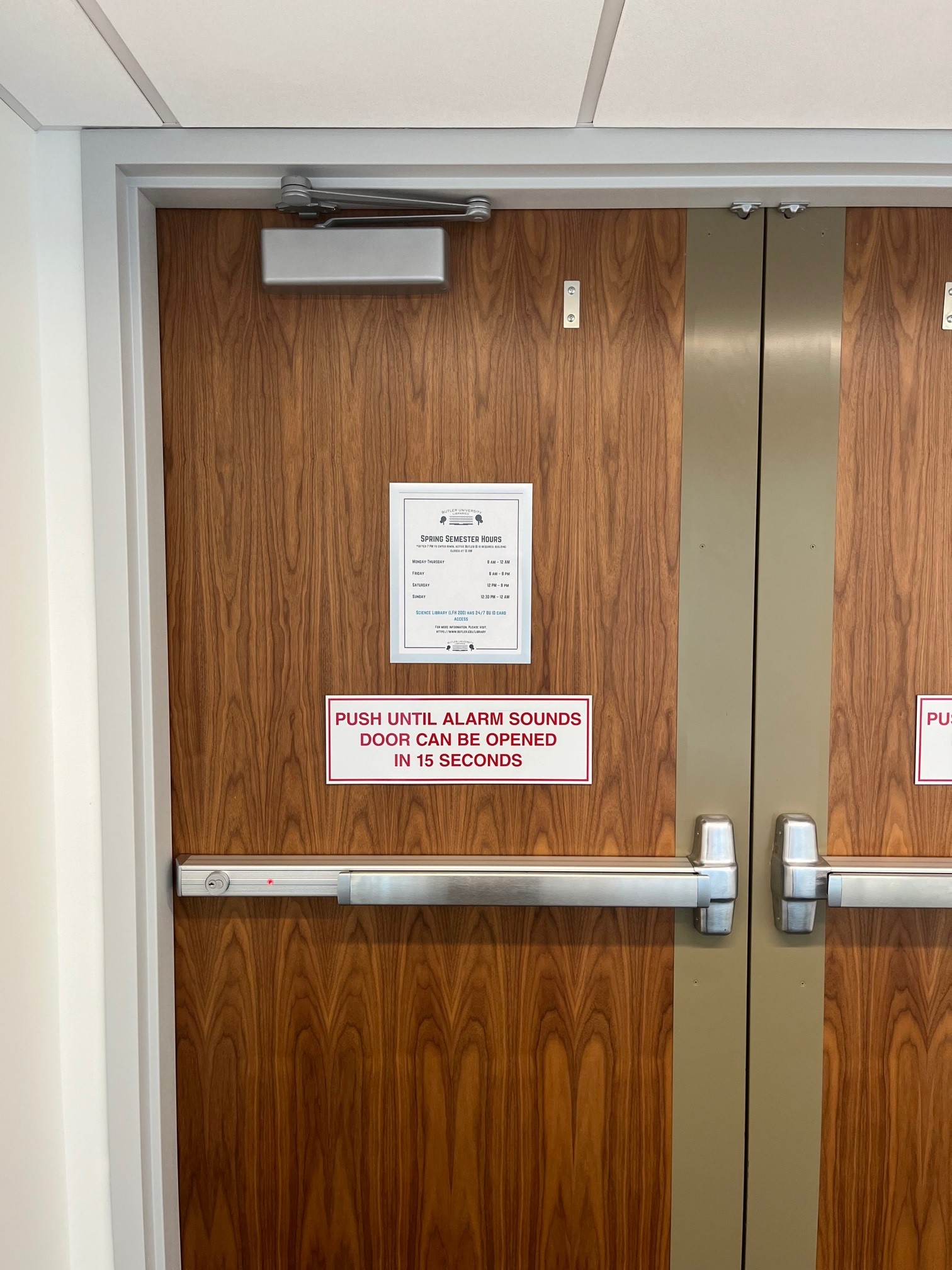
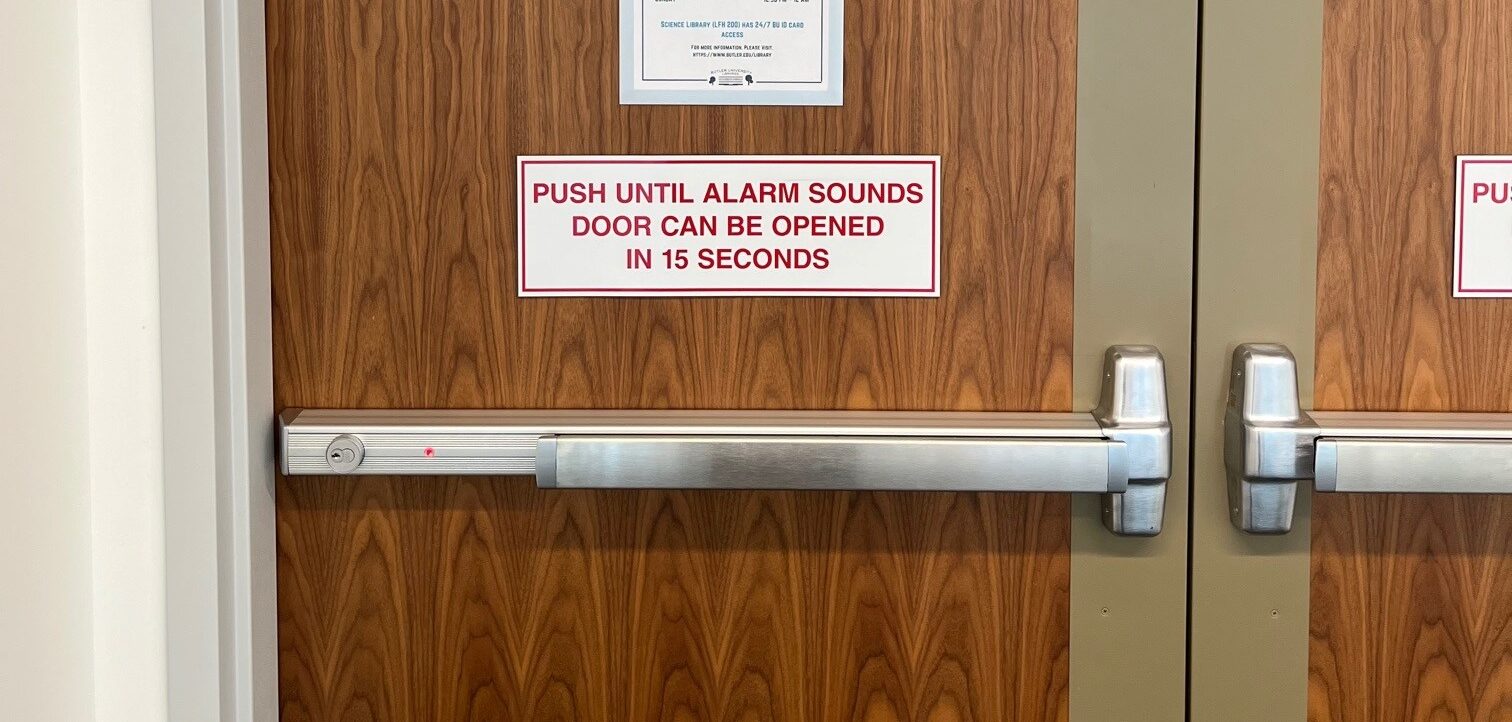
 I was working on a presentation the other day about code questions on delayed egress locks, and I came across the term “gang bus” related to the Von Duprin Chexit. I didn’t previously know what this feature was called, so I’m guessing some of you might be wondering too.
Here’s how this option is described in the installation instructions:

When would this option be used? I can think of two situations…feel free to add more in the comments!
1) On a pair of doors with Chexit devices on both leaves, the gang bus could be used so that when someone tries to exit and starts the 15-second timer on one leaf of the pair, the timer on the other leaf would start simultaneously and both leaves would allow free egress after 15 seconds. The model codes do not specifically require this, but this application may be desired by the end user or the authority having jurisdiction (AHJ).
2) If there is a need for two delayed egress locks in one path of egress, things could get a little tricky depending on which model code must be followed, as well as the occupancy type. An example of this application could be a desire to have one delayed egress lock on a door entering an exit stairwell on an upper floor, and an additional delay on the stair discharge door at ground level. Things to know:
- NFPA 101, Life Safety Code does not limit the number of delayed egress locks in a means of egress – except in lodging or rooming houses where there is a limit of one delay per escape path.
- The International Building Code (IBC) currently limits most use groups to one delay per egress path (read on for exceptions). Prior to the 2015 edition, the limit was one door with a delayed egress lock before entering an exit (like a stairwell). In the past, the code would have permitted our stairwell example because a building occupant would encounter one delay upon entering an exit, and another delay once they were inside of the exit stairwell. Current and recent editions of the IBC would not permit that in most use groups.
- The IBC currently includes two exceptions, where two doors with delayed egress locks would be permitted in one egress path:
- Group I-1, Condition 2, Group I-2 or I-3 – not more than two delayed egress locks with a combined delay of 30 seconds, max.
- Group I-1, Condition 1 or Group I-4 occupancies – not more than two delayed egress locks with a combined delay of 30 seconds, max. – automatic sprinkler system required
So, how does the gang bus option factor in here? I have seen situations where the activation of one delayed egress lock simultaneously starts the timer on a delayed egress lock further down the egress route. So if someone activated the upper-level stairwell door, the gang bus option could be used to activate the lock on the stair discharge door at the same time. This option on the Von Duprin Chexit allows up to 8 Chexits to be connected.
This application is not specifically addressed in the model codes, so it is up to the AHJ whether it would be acceptable. Note that the delayed egress locks are required by the model codes to allow immediate free egress (no delay) upon activation of the fire alarm/sprinkler system and upon power failure.
Any questions?
You need to login or register to bookmark/favorite this content.





New word Monday,,,
Great new feature!!
Have seen release of two doors, when one starts the release.
As I recall, gang bus is achieved by connecting the gray wire. When one Chexit is activated, it triggers the other, and both begin the 15 or 30 second delay.
I have used this feature a number of times in stair door applications, much as you described, but with one variation. When the floor device is activated, the grade-level exit simply unlocks, so there is only one delayed egress event in the means of egress path. It works well, but to do it properly a cable needs to be run directly to the exit door at grade.
If that connection is not direct, and is instead routed through an access control panel, my understanding is that it is no longer a fully rated arrangement. The design also needs to be fail safe. In this type of application, the Chexit at the exit door is simply placed in bypass mode (like a card reader input) by wiring it in series with the fire alarm release output from the floor Chexits. My designs are very specific in this regard, but some AHJs would not approve it because TWO devices ALWAYS means two delays. My response to this was there is only one delay in the MoE path. In my home state of Kentucky, I would have to demonstrate the completed installation. In Chicago, IL and Mesquite, TX. I could not. As you note often, check with the local AHJs. Where it was not permitted, I just had the integrator set the Chexit to zero time delay and i changed the signage. Which brings up another issue: why does Allegion not make a Chexit Alarm exit device (keep all the features of a Chexit, but without the delay)?
Thanks for sharing your insight, Jim! How would the no-delay Chexit differ from a Von Duprin exit alarm? Maybe we can make it happen!
– Lori
Does the gang bus also activate the audible alarm on multiple exit doors when it activates the timers? Because that could be used as an emergency alarm throughout a building, or a wing of a larger building.
Thanks for asking this question, Misha! Sorry for the delay – I didn’t know the answer!
When one device is activated, the other(s) connected by the gang bus also sound their alarms, which makes perfect sense because if someone activates Chexit #1 and another person is waiting to exit at Chexit #2, they should both have the audible alarm to tell them something is happening.
– Lori
Here is a corrected version that keeps your meaning and voice but fixes grammar, punctuation, and flow:
The Chexit has all the features I need for my design: LBS, DPS, armed/disarmed status, Gang Bus, bypass, pre-alarm features, lock trim, sensing, and so forth. But the big thing was the flashing LED, which provided a visual warning that the alarm was armed and reassured valid cardholders that the alarm was off. Back in the day, a number of these features were not available on your standard exit alarm, despite my continued requests that they be added to the product line.
I usually dealt with it by simply not hooking up one of the wires between the solenoid release and the board. I think the present boards are supervised, so if you do not connect that wire, the device will not work.