
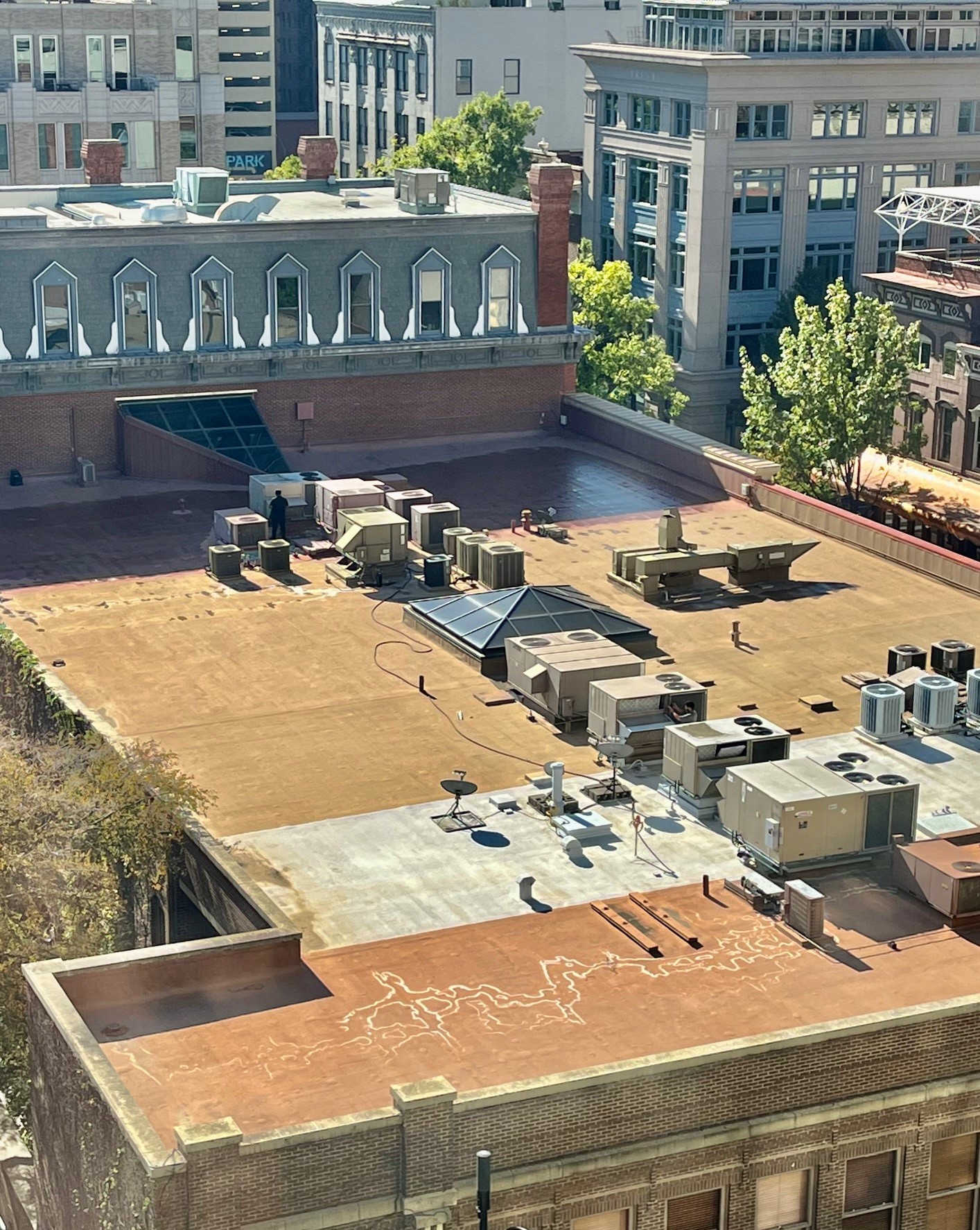
 A Quick Question came up the other day and I’m wondering what you would all do in this situation…
For a roof door that allows access to mechanical equipment on the roof, what are your preferred locking methods or functions – both electrical and mechanical?
If a door is serving an occupied roof, such as a roof-top restaurant or roof terrace, the International Building Code (IBC) includes specific requirements for the locking hardware. The applicable section was added in the 2021 edition of the code, and permits doors serving exterior spaces to be locked when the space is not occupied, preventing unauthorized access to the building. To read more about this application, visit this Decoded article.
Many roofs are not considered occupied/occupiable, for example, a roof with mechanical equipment that is only accessed by technicians. The model codes address these doors differently from the previously mentioned exterior spaces. From the IBC: Doors serving roofs not intended to be occupied shall be permitted to be locked preventing entry to the building from the roof. NFPA 101, Life Safety Code states that if a stair enclosure allows access to the roof of a building, the door to the roof must either be kept locked or shall allow reentry from the roof.
If the door leading from the stair to the roof is locked on the stair side (this is recommended for most buildings), the door can also be locked on the roof side, preventing unauthorized access. So what is the best way to lock these doors, if locking on both sides is desired?
I’ve seen a passage set along with a separate double-cylinder deadbolt…this would permit the technician to access the roof and then exit freely when the work was complete, but could also result in the door being accidentally left unlocked. Hardware that requires a key or a credential on both sides would be the most secure, but could leave the technician locked outside if their key or credential is misplaced while they’re working on the roof.
What’s the best way to handle this application? WWYD?
You need to login or register to bookmark/favorite this content.



Combination Lockbox with key,
Combination written inside RTU access panel. Or they call facilities for the combination assuming they have a cell phone..
That’s a great idea, Charles!
– Lori
If the roof door is locked, a panic button on the roof side wouldn’t be a bad idea, especially when considering the small possibility of an unintended person being on the roof (e.g. by climbing to the roof while the door is unlocked and a technician locking it without checking if anyone is on top, by climbing out a window from an adjacent building that is taller, or by landing in the wrong place when skydiving). The button could function similar to an elevator bell button, it could signal a constantly attended location in the building, or it could automatically dial 911 to summon rescue assistance.
Similarly, and simply, posting a telephone number to the constantly attended location would likely be 99% effective, very few service folks not carrying and utilizing their cellphones for work. Not as cheap would be dual keyed-alike locking latches with blanks on the opposite side.
Biometric access, if one loses that credential, they probably won’t be leaving the roof on their own.
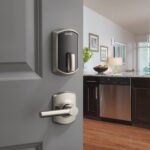
We work on the skyline building in San Diego. Our go-to in these situations is locked on both sides. A deadbolt is easy, but not automatic locking. If auto locking in needed, then we use a double sided lever with a code pad, with key override. Since weather on roof tops is always an issue (even in San Diego) The MOST weather proof that have found is an Alarm Lock DL5200 as their electronics are fully potted.
The PDL5300 uses numerical codes, cards or fobs, and so the credential can be stored on a smart phone. For exterior rated smart locks, these are the best we know of.
Thanks Glenn! I always appreciate your sharing your expertise!
– Lori
This would actually be a great idea for a new L Series mortise function, specifically for this application.
Operation would work as follows:
– Lock includes deadbolt, latchbolt and auxiliary latch
– Cylinders on both outside (stair side) and inside (roof side)
– Levers on both sides
– OUTSIDE lever always remains locked
– When a key is used on the OUTSIDE to retract the deadbolt, the INSIDE lever unlocks, and the key can then be used to retract the latchbolt to open the door
– INSIDE key can only be used to retract the deadbolt (and unlock inside lever), not to project it
– When a key is used on the OUTSIDE to project the deadbolt, the INSIDE lever also locks
This would result in the ability to protect against unauthorized access to the building from the roof, but help prevent a situation where someone working on the roof would become locked on the roof, since they have to “key back out” to lock the roof door. Since the lever stays rigid on the stair side, like a storeroom function lock, this also protects against entry onto the roof by unauthorized individuals.
The inside cylinder would be for emergency access back into the building if a key holder is present on the roof, and another key holder locks the roof door (you could prevent this scenario, however, by ensuring only one key can access the roof – using a key trap device or sign-out procedure).
Thanks for thinking this through! 🙂
– Lori