
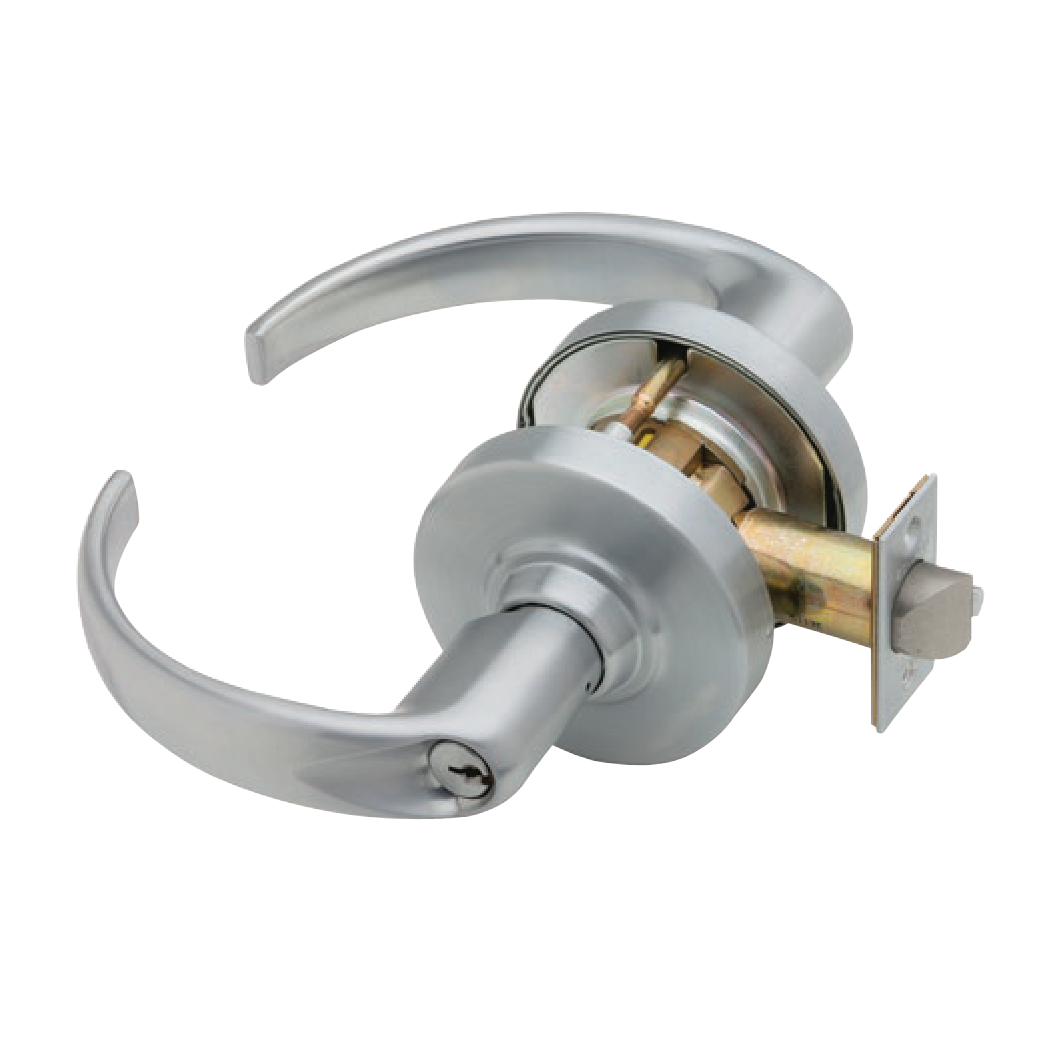
 Today’s Quick Question came up recently, regarding an upcoming change to the 2027 International Building Code (IBC):
Is a storeroom function lock acceptable for use on a classroom door that the IBC requires to be lockable from inside the room?
To my surprise, when I asked Google this question using iDigHardware as a reference (to see if I had already addressed this topic), Google AI’s answer was “no.” I disagree!
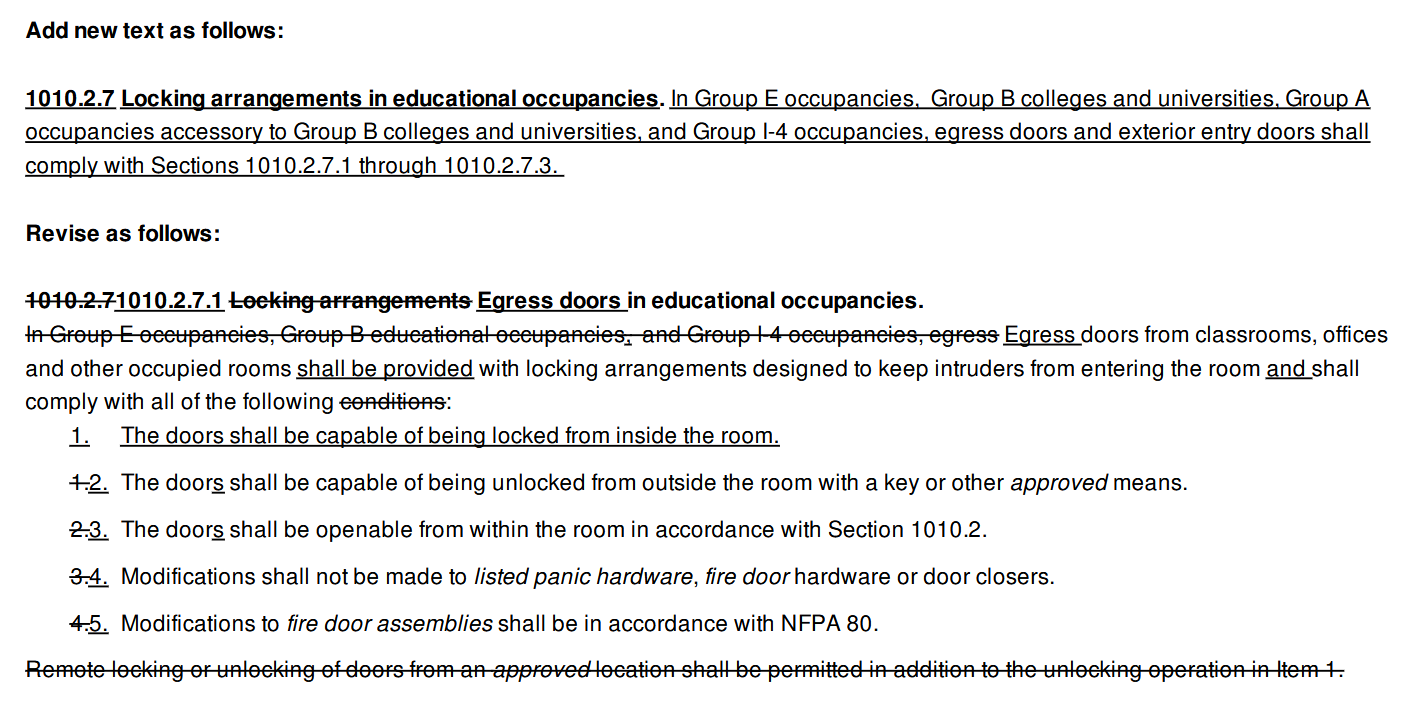
A proposal (E57-24) has been approved for the 2027 IBC that will apply to occupiable rooms in educational facilities, and will require doors serving those rooms to be lockable from inside the room. Here is a portion of that proposal – there are additional changes related to exterior doors in these facilities:
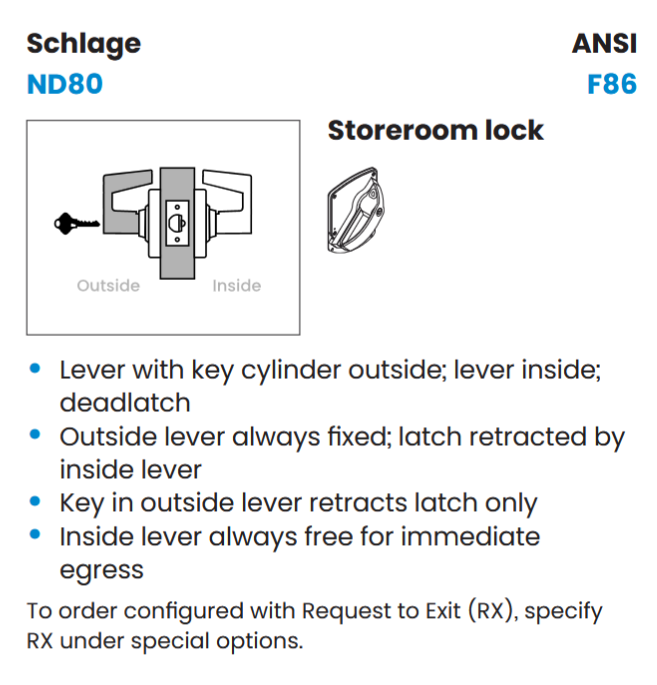 Storeroom function locks have become a popular function for classroom doors, because these locks are always locked on the outside while allowing free egress at all times. When the proposal above was being discussed, the interpretation of the BHMA committee was that a storeroom function lock would meet the requirements of this section, because closing the door (from inside the room) would result in a door that was locked to prevent access.
Other functions such as entrance/office function (thumbturn or push button inside), classroom security function (key cylinder inside), or locks with electrified access control would also be acceptable. Traditional classroom function locksets, which require the door to be opened and a key inserted in the outside lever, would not meet the new requirements.
I expect to see a clarification in the 2027 IBC Commentary that will help to express the intent of the code with regard to storeroom function locks, but in my opinion, they do meet the intent, as closing the door also locks the door. I can’t think of any reason that the code would want to prevent the use of storeroom locks. Keep in mind that there may be state or local requirements that are more restrictive than the IBC, so it’s important to check the adopted codes and applicable laws.
Do you have an opinion on this topic? I’d love to hear it!
You need to login or register to bookmark/favorite this content.
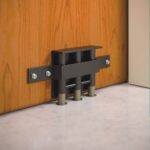
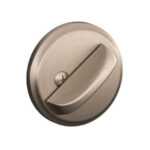


I always check to see if my state has any conflicting codes or statutes. To my surprise our Division of the State Architect (DSA) has a bulletin. BULLETIN: DU 24-04 EDC 17586 (AB 2565, 2024) INTERIOR DOOR LOCKING REQUIREMENTS FOR K-12 SCHOOLS. The state law requires that school projects REQUIRE updating the classroom hardware to current codes. (Security Classroom hardware with locked/unlocked indicators) Good news for hardware sellers.
There is an exception:
a) Doors that are locked from the outside at all times; doors with locks that lock from the inside, and pupil restrooms are exempt from the requirements.
So, Storeroom function and Office function locks are OK in California!
Thanks for the info, Glenn!
– Lori
AI has a knack for getting things wrong. You should not rely on AI for anything important. Read the actual code section itself, not some AI-generated nonsense.
Another example where AI-generated nonsense can cause actual confusion is… suppose you got on a plane and the person sitting next to you was wearing body armor, like so: https://x.com/atfcstore/status/2049265090189558159
You try to search if it’s legal, and the first result is an AI saying it’s illegal. What sort of confusion do you think could ensue?
(In reality, there isn’t such a law. The term “body armor” shows up nowhere in TSA’s regulations at Code of Federal Regulations, Title 49, Subtitle B, Chapter XII.)
And another example is the common belief that there’s a “brothel law” that supposedly means that a university can’t have a sorority. This is a very common myth, but it isn’t really a law.
I’m assuming this is exactly why this has piece was written. While most of us who deal with Code’s know to look much further than a simple search, there are large numbers of people, who when faced with a question, will find the quickest, simplest answer and AI is exactly that. This is especially true of those who are tasked with things that seem to be on the periphery of their primary job. I guess “simple” is relative if you end up being required to change something… It’s important to be current on where the public and even maintenance and installers are getting their info, as it allows us to be more proactive in ensuring the right messaging is readily available.
If 1010.2.7.1 is adopted as listed above a storeroom function lock would not meet the No. 2 requirement.
Hi Patricia –
The intent of the requirement to unlock the door from the outside is that school staff or first responders can access the room when the door is locked. A storeroom lock would meet the intent of that requirement (IMO) because someone with a key can access the room by retracting the latchbolt and opening the door. I can’t think of a reason why the code would require the door to be left unlocked.
– Lori
Hi Lori.
It appears I agreed with the AI response. As the code is covering more than classrooms I can’t see where many offices would want storeroom function locks. If “momentarily” was added after unlocked it would indicate more clearly that a storeroom function could be used. Perhaps they need to add more information.
Hi Patricia –
There will be more information in the IBC Commentary – it just hasn’t been finalized yet. The code doesn’t require storeroom function locks, it only permits them (in my opinion and that of the BHMA committee). If a school wants to use locks with a push button/thumbturn on the inside, or a key on the inside to lock the outside lever, that would be acceptable too. The important thing is that the code will require lockable doors which will help to ensure that this best practice is followed.
– Lori