
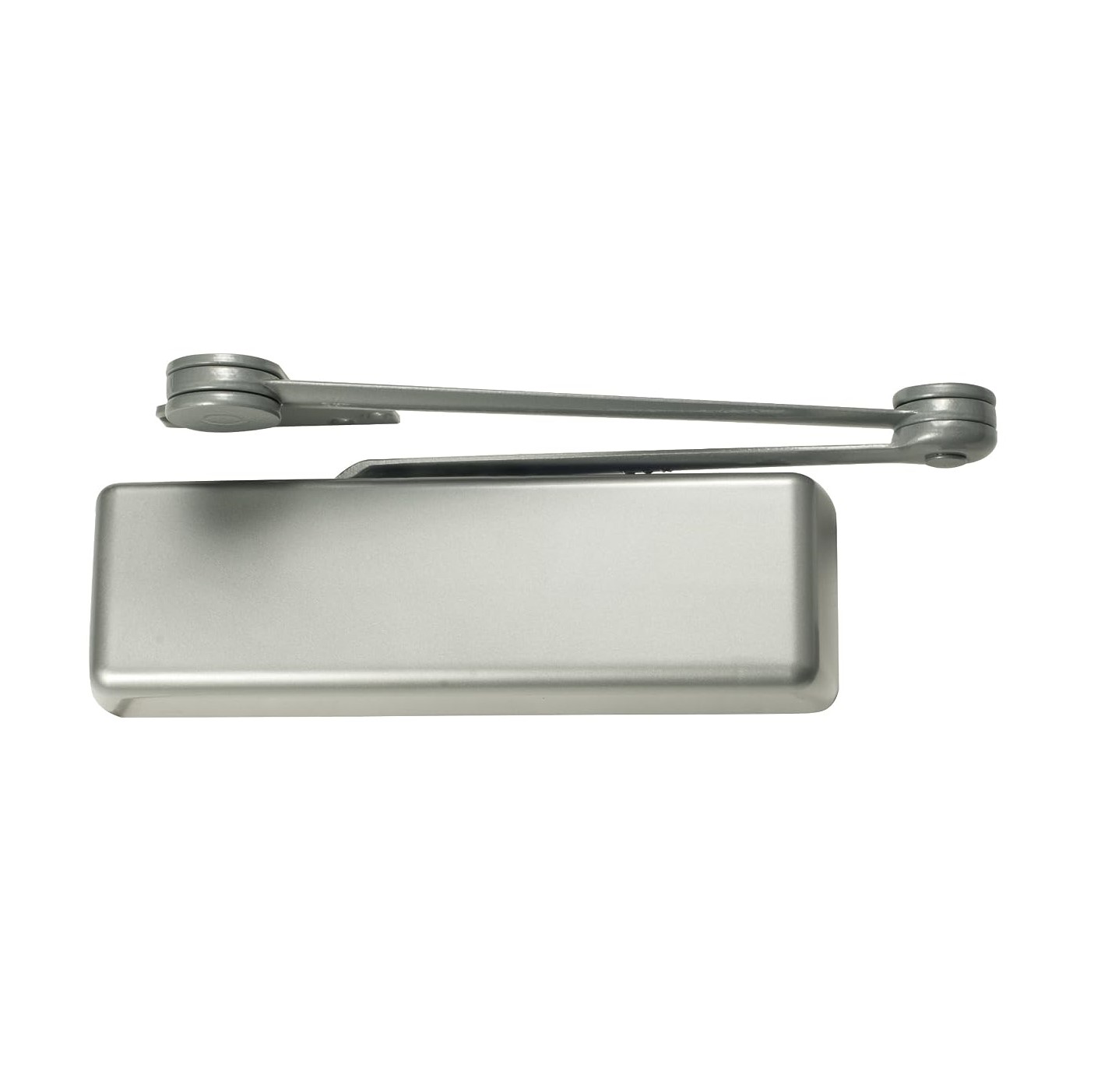
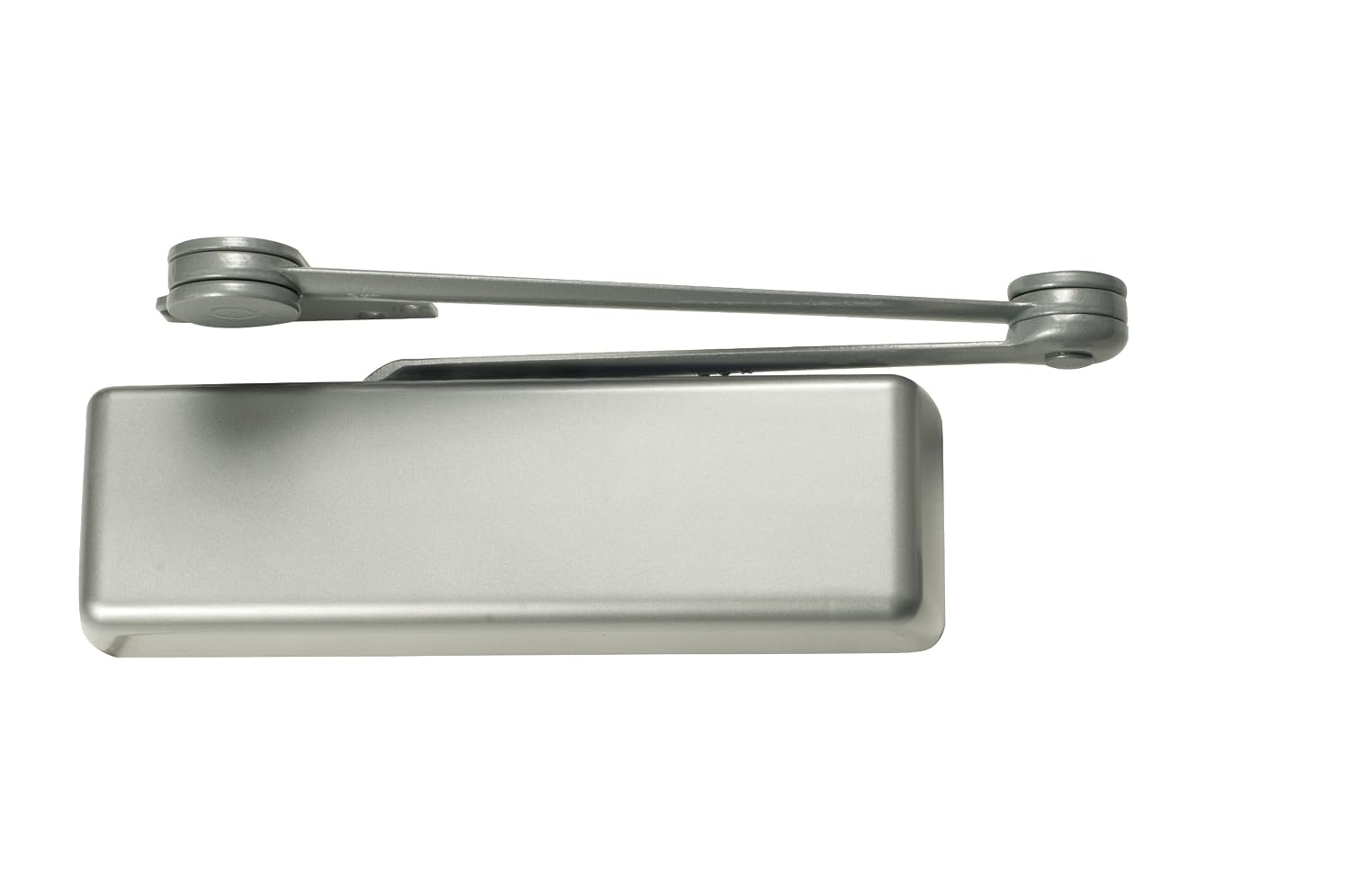
 Today’s Quick Question still comes up on occasion:
Is a delayed-action door closer required by the accessibility standards?
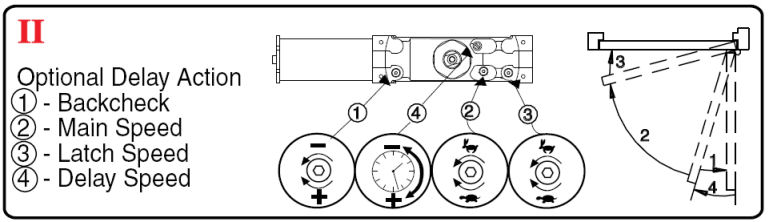
Back in the early 1990’s when the ADA became a focus of the door and hardware industry, delayed-action closers were often specified and installed due to the assumption that they were required by the accessibility standards. Delayed action is a feature available on many door closers, which delays the closing cycle for up to a minute (or more depending on the manufacturer) from the maximum degree of opening to approximately 70 degrees. The delay is controlled by an additional valve that slows the flow of fluid for that initial period in the closing cycle. This feature can be helpful in some applications, but it is not required by the model codes or referenced standards. The other segments of the closing cycle, the main speed and the latch speed, are also controlled by valves (see diagram below).
The accessibility standards used in most US states are ICC A117.1 – Accessible and Usable Buildings and Facilities, and the ADA Standards for Accessible Design. These standards establish a minimum closing time so that the door closes slowly, but they do not require a delay before the closing cycle begins. If a door is equipped with a door closer, the minimum closing time is 5 seconds from the 90-degree open position to 12 degrees from the closed position. For doors with spring hinges, the closing time required by the standards is 1.5 seconds from the 70-degree open position to the closed position; this increased speed/lack of control may make a door difficult for some users to maneuver through. Note that state or local requirements may vary so it’s important to reference the adopted code or standard.
A delayed-action closer may be useful for some interior doors, but the decision to specify/supply this feature must be carefully considered. The assistance provided by the delay for some users may cause confusion for others. In many cases, having a door stand open for a minute will be a real inconvenience, and I’ve seen people attempt to manually close the door behind them. I typically reserve the use of delayed-action closers to fire-rated storage rooms, and certain doors in health care facilities, like tub rooms. When this feature is supplied where it is not needed and maintenance staff learns that they can disable the delay, money has been spent for a feature that will never be used.
A related question is whether a delayed-action closer is acceptable for use on fire doors. Prior to the 2018 edition of the International Building Code (IBC), this was not specifically addressed in the code, but it was clarified in the 2018 edition with this paragraph:
716.2.6.5 Delayed-action closers. Doors required to be self-closing and not required to be automatic closing shall be permitted to be equipped with delayed-action closers.
This text is found in Section 716 – Opening Protectives, which means that delayed-action closers are permitted to be used on fire door assemblies. Note that this added section does not include a specific limit on the amount of time that the closing cycle can be delayed.
For reference, here are the applicable closing speed excerpts from each of the accessibility standards:
ICC/ANSI A117.1 – 2017:
404.2.7 Closing speed. Door and gate closing speed shall comply with 404.2.7.
404.2.7.1 Door and gate closers. Door and gate closers shall be adjusted so that from an open position of 90 degrees, the time required to move the door or gate to an open position of 12 degrees shall be 5 seconds minimum.
404.2.7.2 Spring hinges. Door and gate spring hinges shall be adjusted so that from an open position of 70 degrees, the door or gate shall move to the closed position in 1.5 seconds minimum.
2010 ADA/ABA Standards:
404.2.8 Closing Speed. Door and gate closing speed shall comply with 404.2.8.
404.2.8.1 Door Closers and Gate Closers. Door closers and gate closers shall be adjusted so that from an open position of 90 degrees, the time required to move the door to a position of 12 degrees from the latch is 5 seconds minimum.
404.2.8.2 Spring Hinges. Door and gate spring hinges shall be adjusted so that from the open position of 70 degrees, the door or gate shall move to the closed position in 1.5 seconds minimum.
Any questions?
You need to login or register to bookmark/favorite this content.






I’ve often thought that because of the ultra short closing time on Spring Hinges, that they should NOT be allowed. Is there a reason that they are allowed?
That’s a great question, Glenn, and I don’t know the answer. Maybe because the closing force is typically lower than a door closer? Spring hinges are definitely not the best choice for applications where door control is important, in my opinion.
– Lori
You have probably addressed this. I recently encountered doors in a school that were difficult for me to open due to excessive spring tension I am assuming. When door closing device is so strong that ordinary folks struggle, it is too strong. What can be done and how do you measure the effect of any adjustment?
Hi Jerry!
For interior, non-fire-rated doors, the opening force limit is 5 pounds. Most closers nowadays are adjustable so the force can be decreased if needed. For exterior doors and fire doors, the model codes allow 30 pounds to set the door in motion and 15 pounds to open the door fully. Even though this is acceptable by code, it can be difficult for some building occupants to open the doors. It can be a bit of a balancing act – making sure the doors have enough power to close against air pressure, gasketing, etc. but still be easy enough for people to open. In some cases an auto operator can help, but there are manual force limitations for low energy operators as well. I would start by trying to reduce the spring size of the door closer.
– Lori