

This article was published in the first year of my Decoded column…15 years ago! It was due for an update, and I’m guessing there are still people who are not aware of these requirements.
This post was published in Door Security + Safety
.

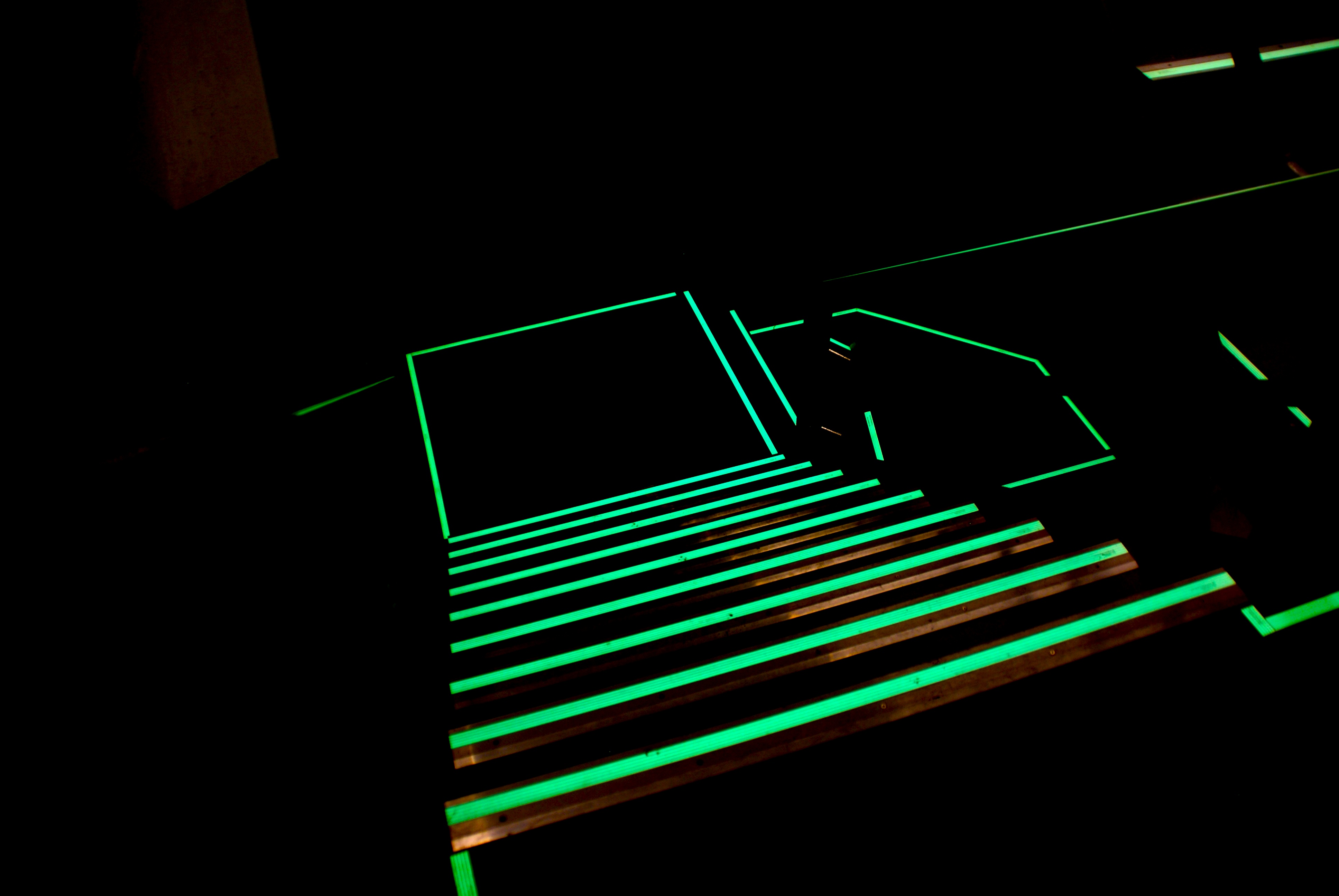 Requirements for luminous egress path markings (NFPA 101 calls them “Exit Stair Path Markings”) were first added to the 2009 editions of the International Building Code, the International Fire Code, and NFPA 101 – The Life Safety Code. These markings on stairs, walls, floors, and doors help illuminate the egress path within exit enclosures, which can be difficult to navigate in emergency conditions. This change was one of the recommendations made by the World Trade Center Building Code Task Force in 2002, and became a requirement for high rise buildings in New York City.
The products used for luminous egress path markings may be self-luminous or photoluminescent, in accordance with UL 1994 – Standard for Safety of Low Level Path Marking and Lighting Systems, or ASTM E2072 – Standard Specification for Photoluminescent (Phosphorescent) Safety Markings (refer to the model codes for charging and luminance specifics). The International Building Code defines self-luminous as “Illuminated by a self-contained power source, other than batteries, and operated independently of external power sources.” Photoluminescent is defined as “Having the property of emitting light that continues for a length of time after excitation by visible or invisible light has been removed.” I define it as “glow in the dark” which probably isn’t technically correct, but gets the point across.
I combed through the model codes to find out where and when these products are required, since I can already hear several architects hyperventilating at the thought of this white-ish (with a hint of green) material marking the exits. The codes are very similar when it comes to describing the requirements for luminous egress path markings related to doors (there are additional requirements for other building components):
- Emergency exit symbol mounted within the bottom 18 inches of the door. The symbol must comply with NFPA 170, and must be at lest 4 inches in height, centered horizontally, with the top of the symbol no higher than 18 inches AFF.
- Door hardware marked with luminous material – IBC/IFC: Not less than 16 square inches of luminous material located behind, immediately adjacent to or on the door handle and/or escutcheon, NFPA 101: hardware used to release latch outlined with 1-inch minimum stripe – OR:
- Panic hardware – 1-inch wide minimum stripe for the entire length of the touchpad or crossbar.
- 1-inch to 2-inch stripe around frame – on face of frame or if the frame face is not wide enough the stripe may be on the wall.
The doors that require these markings are also consistent between the codes, and the locations are actually fairly limited. The IBC describes these doors as “Doors through which occupants must pass in order to complete the exit path,” and NFPA 101 describes them as, “All doors serving the exit enclosure that swing out from the enclosure in the direction of egress travel.” Basically, the codes are describing doors within an interior exit stairwell, exit ramp, or exit passageway, that lead to out of the stairwell – the exit discharge and any additional doors that you have to use to reach the exit discharge after you are in the exit enclosure. The markings are not required for doors leading into the stairwell, although local codes may require this. The IBC also contains exceptions for lobbies that serve as part of the exit path (2009 and subsequent editions).
The final piece of the puzzle is the list of occupancy types where the markings are required. The IBC requires luminous egress path markings in exit enclosures and exit passageways of high-rise buildings that house Group A – Assembly, B – Business, E – Educational, I-1 – Institutional, M – Mercantile, and R-1 – Residential occupancies (in the 2009-2015 editions, the markings were required for I occupancies, but beginning with the 2018 edition they are limited to I-1). This requirement is found in Section 1025.1 of the 2024 edition of the IBC. They are not required for buildings that are not high-rise buildings, or in other occupancies even if the building is a high rise.
NFPA 101 states that the markings must be installed where required by the occupancy chapters. However, to date there have been no occupancy chapters that reference the requirements for exit stair path markings. If and when future editions of NFPA 101 include references within the occupancy chapters, exit stair path markings will then be required. [Note: I have combed the Life Safety Code looking for occupancies that require the markings, but have found none. If you know otherwise, please leave a comment!]
Refer to the model codes for additional information, and check local codes for modifications that may affect luminous egress path markings.
For information about specifying this coating on panic hardware, refer to this post.
Photo courtesy of BALCO.
You need to login or register to bookmark/favorite this content.




Leave A Comment