
Today’s post is the thirteenth post exploring the inspection criteria for fire door assemblies. The thirteenth criterion listed in NFPA 80 for the inspection of swinging doors is:
(13) Signage affixed to a door meets the requirements listed in 4.1.6.
In today’s Decoded article I addressed some recent changes to the NFPA 80 requirements applicable to signage mounted on fire door assemblies.
Click here to read other posts in this series and learn more about fire door inspection.
~~~
This Decoded article, Decoded: Signage Limitations on Fire Door Assemblies, will be published in Door Security + Safety
.

For as long as I can remember, NFPA 80 – Standard for Fire Doors and Other Opening Protectives, has limited signage on a fire door assembly to 5 percent of the area of the door face. For a 3-foot x 7-foot door, the maximum allowable sign based on the 5 percent calculation would be slightly more than one square foot. NFPA 80 has also traditionally required signs on fire doors to be installed with adhesive.
Changes to the NFPA 80 standard have raised this month’s question:
What are the current limitations on signs attached to fire door assemblies, and when do the changes go into effect?
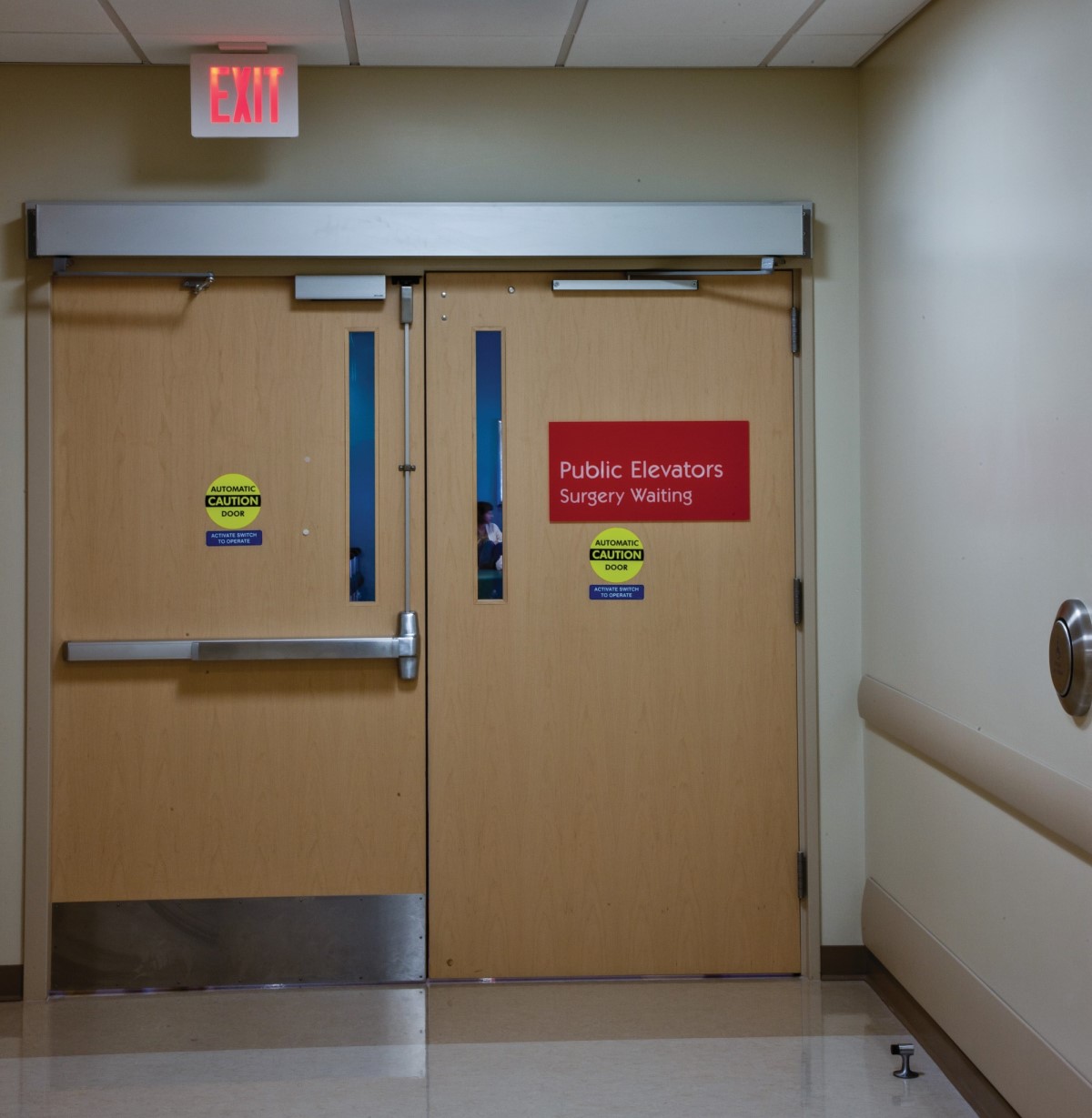
According to the 2022 and 2025 editions of NFPA 80, signs painted on fire doors using stencils or similar methods are not limited in size.
The 2019 edition of NFPA 80, along with previous editions, permits informational signage installed on the surface of a fire door, in accordance with the door manufacturer’s listings or as detailed in the standard. This includes the limit on the total area of signage not to exceed 5 percent of the area of the face of the door. This edition and those prior require attachment with adhesive and specifically prohibit the use of metal fasteners such as screws or nails for attaching signs to fire doors. These limitations continue to apply in jurisdictions where the adopted code or codes reference the 2019 edition of NFPA 80 or an earlier edition.
The requirements for signage were modified in the 2022 edition of the standard and were carried forward into the 2025 edition with a few modifications. These requirements will apply in jurisdictions where the adopted codes reference the 2022 or 2025 editions of NFPA 80. Typically, the model code will reference the most recently published edition of the standard. For example, the 2019 edition of NFPA 80 was referenced in the 2021 model codes, the 2022 edition is referenced in the 2024 model codes, and the 2025 edition will likely be referenced in the 2027 model codes.
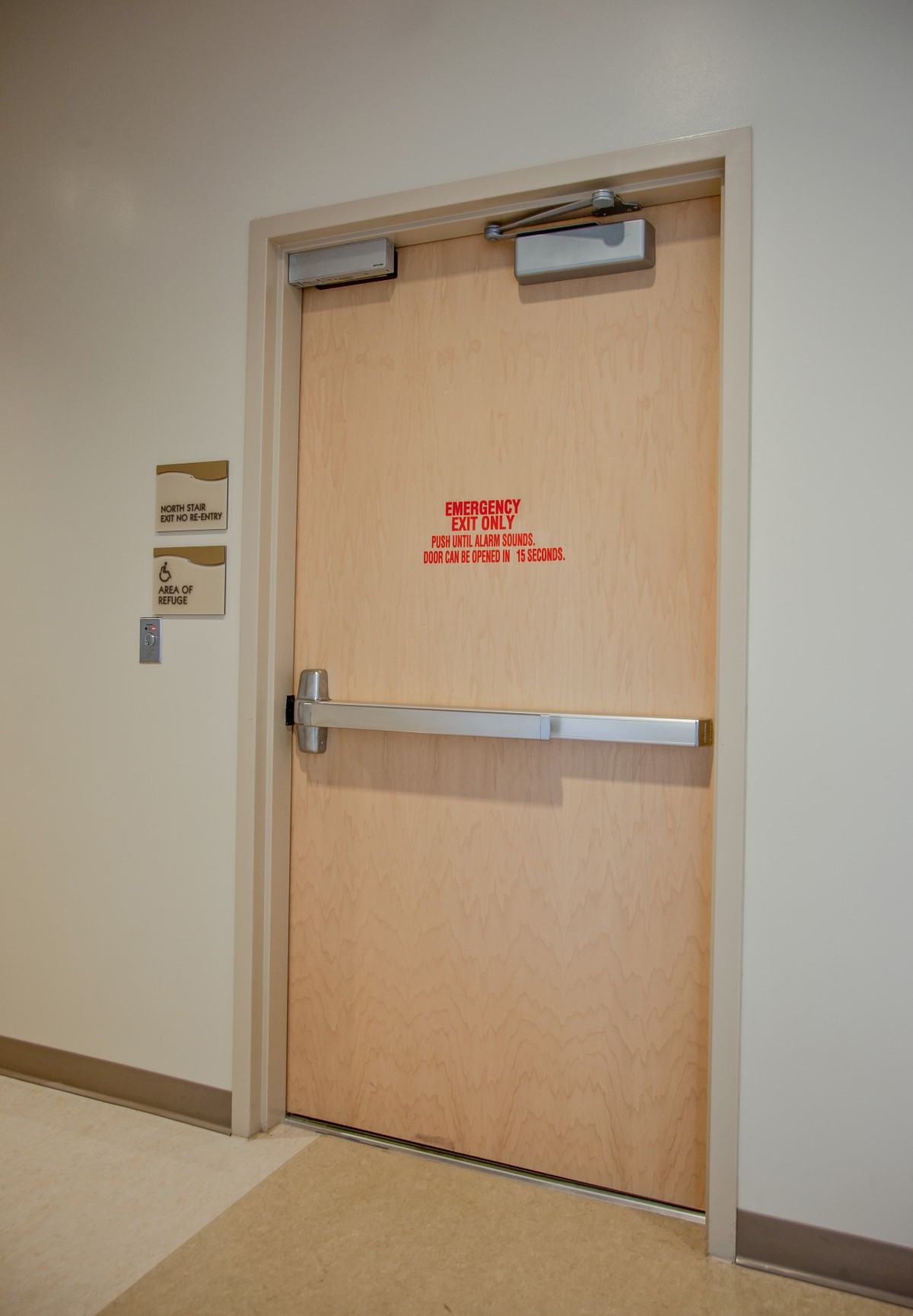
According to the 2022 and 2025 editions of NFPA 80, signs painted on fire doors using stencils or similar methods are not limited in size.
What’s new?
As with previous editions of the standard, in the 2022 and 2025 editions, signage is allowed on fire doors as described in NFPA 80 or as permitted by the door manufacturer’s published listings. Regarding size limitations, the standard now addresses the size based on the material the sign is made from.
The 2022 edition states that the 5 percent limit applies to signs made from combustible materials or from vinyl that is up to 0.008 inches (0.2 mm) thick. In the 2025 edition, instead of vinyl, the limit applies to polymeric materials of the same thickness. Vinyl is one example of a polymeric material, along with acrylic, polycarbonate, polystyrene, polypropylene, and many other materials.
If the signage is painted on the door with stencils or similar methods, the size is not limited. In addition, NFPA 80-2022 states that metal signage up to 20-gauge thickness may measure up to 200 square inches in area – for a 3-foot x 7-foot door, a sign of this size would be almost 7 percent of the 21-square-foot area of the door face. In the 2025 edition, the 20-gauge measurement has been changed to 0.04 inch (1 mm).
Unlike previous editions of the standard which prohibited the use of screws or nails to attach signs to fire doors, the more recent editions allow mechanical fasteners meeting certain criteria. The specific requirements of NFPA 80 differ between the 2022 and 2025 editions:
NFPA 80 – 2022 Edition:
4.1.3.2.3 Up to four steel or stainless steel sheet metal screws up to U.S. size #8 (4.2 mm) or up to four other steel fasteners not exceeding 0.17 inch (4.2 mm) shall be permitted to penetrate one side of a fire door to attach metal signs.
NFPA 80 – 2025 Edition:
4.1.6.2.3 For hollow metal doors and 1/3-hour-rated wood doors, up to four steel or stainless steel sheet metal screws up to US size #8 (4.2 mm) in diameter or up to four other steel fasteners not exceeding 0.17 inch (4.2 mm) shall be permitted to penetrate one side of a fire door to attach signage.
4.1.6.2.4 Steel fasteners permitted by 4.1.6.2.3 shall not exceed 0.5 inch (12.7 mm) in length.
Note that the 2022 editions limits the mechanical fasteners to metal signs, and the 2025 edition does not. In addition, the 2025 edition has been changed to limit the use of fasteners to hollow metal doors and 20-minute wood doors, while the door material was not specifically stated in the 2022 edition. Both editions clarify that the fasteners can only penetrate one side of the fire door, with the 2025 edition limiting the length of the fastener to ½ inch. Adhesive must be used for applications that do not meet the criteria above, although the 2025 edition clarifies that a door manufacturer’s listings may allow another method of attachment.
Signage on Glazing
The 2022 and 2025 editions of NFPA 80 prohibit the installation of signage on glazing in fire doors. This is consistent with the 2007, 2010, and 2013 editions of NFPA 80. However, the 2016 and 2019 editions of the standard specified that signs could not be installed on fire-protection-rated glazing; this was typically interpreted to mean that signage would be permitted on fire-resistance-rated glazing.
A paragraph in Annex A of the 2016 and 2019 editions stated that when signage was required by code to be attached to a fire door (for example, signage for a delayed egress lock), and there was no other option but to put the sign on the glazing, it should be fire-resistance-rated glazing that had been evaluated for temperature rise on the unexposed surface. This annex note does not appear in the 2022 or 2025 editions, and Chapter 4 prohibits installation of signage on glazing without being specific about the type. This indicates that signage must not be installed on any type of glazing in a fire door, so it’s important to consider the location of signs when choosing a door elevation.
Finally, NFPA 80-2022 and 2025 state that signs must not impair or interfere with the proper operation of the fire door – this paragraph was also included in earlier editions of the standard.
Conclusion
When considering the installation of signs on fire doors, keep in mind that the most recent editions of NFPA 80 which include the new requirements may not yet be referenced by the adopted code(s) in the project’s jurisdiction. For example, the Department of Medicare and Medicaid Services (CMS) has currently adopted the 2012 edition of NFPA 101 – Life Safety Code, which references NFPA 80-2010. It could be several years before the 2022 or 2025 edition of the standard is adopted by reference for health care facilities. Technically, in order to use the updated signage requirements, the Authority Having Jurisdiction (AHJ) would have to approve them as an equivalency or a code modification.
You need to login or register to bookmark/favorite this content.




Happy New Years! Appreciate all of the safety and security insights you have shared.
Thanks Joe!
– Lori