
 This question came up recently and I’m doing some research on the answer. I’m wondering if any of you have insight. If you do, please leave a comment!
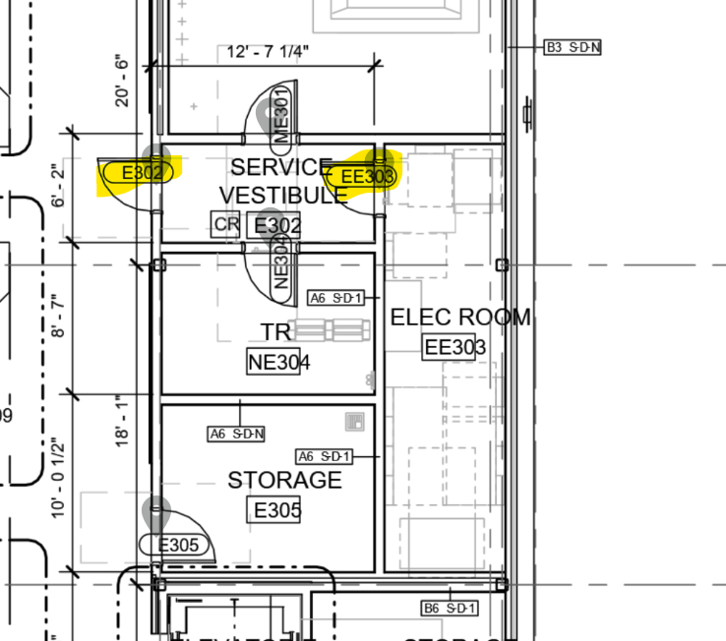
Using this partial plan as a reference and assuming this electrical room requires panic hardware, the question is whether one or both of the highlighted doors require panic hardware in order to comply with the International Building Code (IBC) or the National Electrical Code (NFPA 70).
I don’t want to influence your decision, so here’s the IBC section to ponder:
1010.2.8.2 Rooms with electrical equipment. Exit or exit access doors serving transformer vaults, rooms designated for batteries or energy storage systems, or modular data centers shall be equipped with panic hardware or fire exit hardware. Rooms containing electrical equipment rated 800 amperes or more that contain overcurrent devices, switching devices or control devices and where the exit or exit access door is less than 25 feet (7620 mm) from the equipment working space as required by NFPA 70, such doors shall not be provided with a latch or lock other than panic hardware or fire exit hardware. The doors shall swing in the direction of egress travel.
WWYD?
You need to login or register to bookmark/favorite this content.

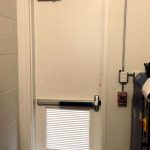

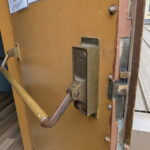



I think that ‘doors serving’ is the key. I would just do the door from the electrical room itself. Otherwise, every door in any exit route after door 302 (at the hall) would also have to be equipped with panic hardware.
Once the person has been able to get out of the electrical room, the access vestibule protects them.
This is a good one. The Code says “…Exit or exit access doors serving transformer vaults, rooms…”. To me, the word “serving” tells me that BOTH need panic hardware since both doors SERVE the room.
My answer would be both doors require panic hardware.
1. It included the word “” Doors. “””
2. Like other panic hardware, you include all doors in the exit path, till you get out.
I think I’d lean toward the one door directly into the electrical room. The plural of “doors’ to me infers that if there are multiple direct doors into the room, they all must be so equipped. What would the hazard be in “Service Vestibule”? And if the door to that space is considered “serving the electrical room” does every door from the public way leading to the electrical room not serve similarly? I’ll note, I’m not a direct IBC user, so I have little experience in the way they frame their requirements.
A critical part of the requirement for panic hardware is “where the exit or exit access door is less than 25 feet from the equipment working space”.
Vestibule door E302 is within 25 feet of any working space in the half of the Electrical Room nearest to door EE303.
An electrician who’s hands were burned by an arc flash with temperatures up to 35,000 °F (3.5 times hotter than the surface of the sun), and/or hit by grenade force projectiles and molten metal droplets from an arc blast might at best be able to only apply body force against the panic hardware to open the egress door.
Assuming a bad possibility, an arc flash occurs on equipment located directly opposite door EE303, electric arcing continues in equipment that is now on fire, and door EE303 closes too slowly to shield the injured electrician from additional heat if they are unable to operate a lever to open Vestibule door E302.
I would argue in favor of providing panic hardware on Vestibule door E302.
If the Owner rejects the additional cost for panic hardware at this door, it would be advantageous for the Specifier to have an email/paper trail documenting the Specifier’s intent for and the Owner’s rejection of the panic hardware in case there is ever an injury lawsuit. The statute of repose for injury lawsuits resulting from latent design defects is 10 years in many states.