Delayed Egress vs. Controlled Egress
Delayed egress vs. controlled egress...can you explain the difference? Do you know when and where each type of locking hardware is allowed, and what the IBC requires in order to ensure life safety?

Delayed egress vs. controlled egress...can you explain the difference? Do you know when and where each type of locking hardware is allowed, and what the IBC requires in order to ensure life safety?
I am often asked whether it is code-compliant to install a separate deadbolt with a latchset or lockset on a dwelling unit entry door in an assisted living facility. Most doors in a means of egress are required to unlatch with one operation for egress. While there is an exception...
A couple of months ago I wrote a post about murals in health care occupancies and a change to the 2015 edition of NFPA 101 - The Life Safety Code. I just read an article in Australian Ageing Agenda about the practice of disguising doors in memory care units, and how this affects the patients...
I'm spending time at a VA hospital, where my father is currently in hospice care. Even under these circumstances I can't help looking at the hardware, and I know my father would tell me to go ahead and share it. I haven't taken many photos but there are a couple below. In case I don't get a chance to post tomorrow, consider this an early Fixed-it Friday post...
There was an important change to the 2015 International Building Code (IBC) that could help to reduce the occurrence of child abduction from hospitals. Many maternity wards have infant abduction systems that use a sensor to activate a delayed egress lock when a baby is taken near the exit. But for some facilities, delayed egress locks may not be enough...
In January of this year, I wrote about a tragic fire at a senior home in L'Isle Verte, Quebec, in which 32 of the home's residents were killed. The inquest into this incident is currently underway, and I've been keeping an ear to the ground to see if there are any lessons to share...
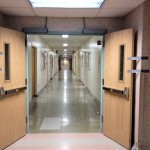
Is rescue hardware allowed on a corridor door in a hospital or nursing home? Is the door able to provide an effective barrier to limit the passage of smoke without the frame stop?
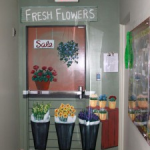
For those of us concerned with egress requirements, disguising the egress side of a door is a questionable method of preventing elopement, since egress doors must be readily distinguishable...
I received this photo from Chuck Noble of Certified Fire Door, and it is the epitome of Wordless Wednesday...
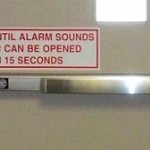
To some, locking doors to prevent egress may seem like a step backward. But in some applications, the danger of elopement is much greater than potential hazards of controlled egress. Until now, it has been difficult for memory care facilities to balance the code requirements for free egress or delayed egress, with the needs of their residents...
A few years ago I met Brad Keyes of Keyes Life Safety Compliance, who is a terrific resource when it comes to life safety questions about health care facilities. When I received the question below I sent it to Brad, and his answer was so comprehensive and helpful that I asked if I could post it here. It is relevant to all types of health care facilities, not just ambulatory health care. Thank you Brad, for allowing me to share this information!
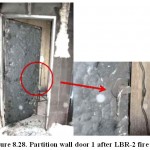
While this test report was not heavy on door-related data, I thought some of you would enjoy reading about this groundbreaking study which looked at how a test building was affected by several simulated earthquakes, and then how the damaged building's fire safety systems performed in a series of fire tests. I found the video below fascinating:
This photo was taken in a health care facility and was sent to me by both Jim Jensen and Jeff Tock of Ingersoll Rand Security Technologies. :-(