
This article is a great resource on fire door assemblies, and it is included in the Allegion Code Reference Guide. BIG NEWS – I just updated the guide and it will be ready for print and download soon! In the process, I also updated this article that was originally published in Life Safety Digest, a publication of the Firestop Contractors International Association (FCIA).
More attention has been focused on fire doors and egress doors in the last decade, as the inspection requirements of NFPA 80, Standard for Fire Doors and Other Opening Protectives have become adopted and enforced. Since the 2009 editions of the International Building Code (IBC), International Fire Code (IFC), and NFPA 101, Life Safety Code, inspections of fire door assemblies have been required, with the codes referring to detailed criteria included in NFPA 80. Beginning with the 2007 edition of the standard, fire door assemblies must be inspected annually, and any deficiencies found must be corrected without delay. In addition to annual inspections, the 2013 edition of NFPA 80 and subsequent editions require fire door assemblies to be inspected after installation and after maintenance or repair work is completed.
 The Door Security and Safety Foundation is an organization that exists to promote secure and safe openings that enhance life safety, through education and partnerships with like-minded organizations. The Foundation’s research has identified the top ten deficiencies on swinging doors with builders hardware:
1. Painted or missing fire door labels
The label found on the edge or top of a fire door and in the rabbet of a fire-rated frame may be made of metal, paper, or plastic, or may be stamped or diecast into the door or frame. Labels must be visible and legible. Some embossed labels can still be read if they are painted, but if a painted label is illegible, the paint must be removed. If labels are missing or can’t be made legible, the Authority Having Jurisdiction (AHJ) may require the doors or frames to be re-labeled by a listing agency.
 2. Poor clearance dimensions around the perimeter of the door in the closed position
The maximum clearance allowed by NFPA 80 at the head, jambs, and meeting stiles of pairs is 3/16 inch for hollow metal doors, and 1/8 inch for wood doors rated more than 20 minutes. The 2016 and subsequent editions allow a clearance of 1/16 to 3/16 inch for HPDL-faced doors, wood doors, and stile and rail doors with a rating up to 1/3-hour installed in hollow metal frames.
New products have been successfully tested and listed for use on a fire door assembly where clearances are larger than what is allowed by NFPA 80. For clearances in excess of what is permitted by the standard, listed gasketing products may be permitted as an alternative to replacing the door. Shimming the hinges with metal shims may help to correct the problem, and there are metal edges available that are listed for use when a door needs to be increased in width to reduce the clearance. Door shoes and sweeps are now available that have been tested and listed to address excessive clearance at the bottom of a fire door, as well as products that extend the thickness of the frame stop when there are perimeter clearance problems.
3. Kick-down door holders
 A kick-down door holder is a simple mechanical device that is mounted on the bottom corner of the door and flips down to hold the door open. Because fire doors must be self-closing, automatic-closing, or power-operated (with a few exceptions), a kick-down holder is not an acceptable way of holding open a fire door. A mechanical hold-open feature in a door closer and other types of hold-opens such as wedges, hooks, and overhead holders are not allowed for fire doors either.
An automatic-closing fire door is held open electronically, and closes upon fire alarm activation. This may be accomplished with a wall- or floor-mounted magnetic holder, a closer-holder unit which receives a signal from the fire alarm system or incorporates its own smoke detector, or a separate hold-open unit that is paired with a standard door closer.
Existing fire doors may be equipped with fusible link closer arms, which incorporate a fusible link that is intended to melt during a fire and release the hold-open. Current building and life-safety codes do not allow fusible link arms on doors in a means of egress, because they do not allow the doors to control the spread of smoke. Automatic-closing doors must be initiated by the fire alarm system or smoke detection in most locations.
4. Auxiliary hardware items that interfere with the intended function of the door
These auxiliary items may include creative ways of holding open the door or providing additional security. In many cases the auxiliary items create an egress problem, for example, additional locks or surface bolts (most egress doors must unlatch with one releasing motion), chains or creative devices used with panic hardware, or electronic access control products that have not been installed with the required release devices for code compliance. Hardware installed on fire doors must be listed for that purpose, and items not listed for use on a fire door must be removed. Holes left by the removal of auxiliary items and other components must be filled in accordance with NFPA 80, typically either with steel fasteners, or with the same material as the door or frame. Fire door caulk is now available but there are limitations on door material, fire rating, and hole size.
Field preparation for these auxiliary items may also create a problem on fire doors. NFPA 80 limits job site preparation of fire doors to holes for surface-applied hardware, function holes for mortise locks, and holes for labeled viewers. Until the 2016 edition of the standard, the maximum hole diameter was 1 inch (25 mm), except holes for cylinders which may be any diameter. The 2016 and 2019 editions of NFPA 80 allow round holes of any diameter to be prepared in the field, if allowed by the manufacturers’ listings. Protection plates may be field-installed, and wood and composite doors may be undercut in the field a maximum of 3/4 inch (19 mm) (check with the door manufacturer first). Field modifications beyond what is allowed by NFPA 80 may void the label and require re-labeling of the assembly.
5. Fire doors blocked to stay in the open position
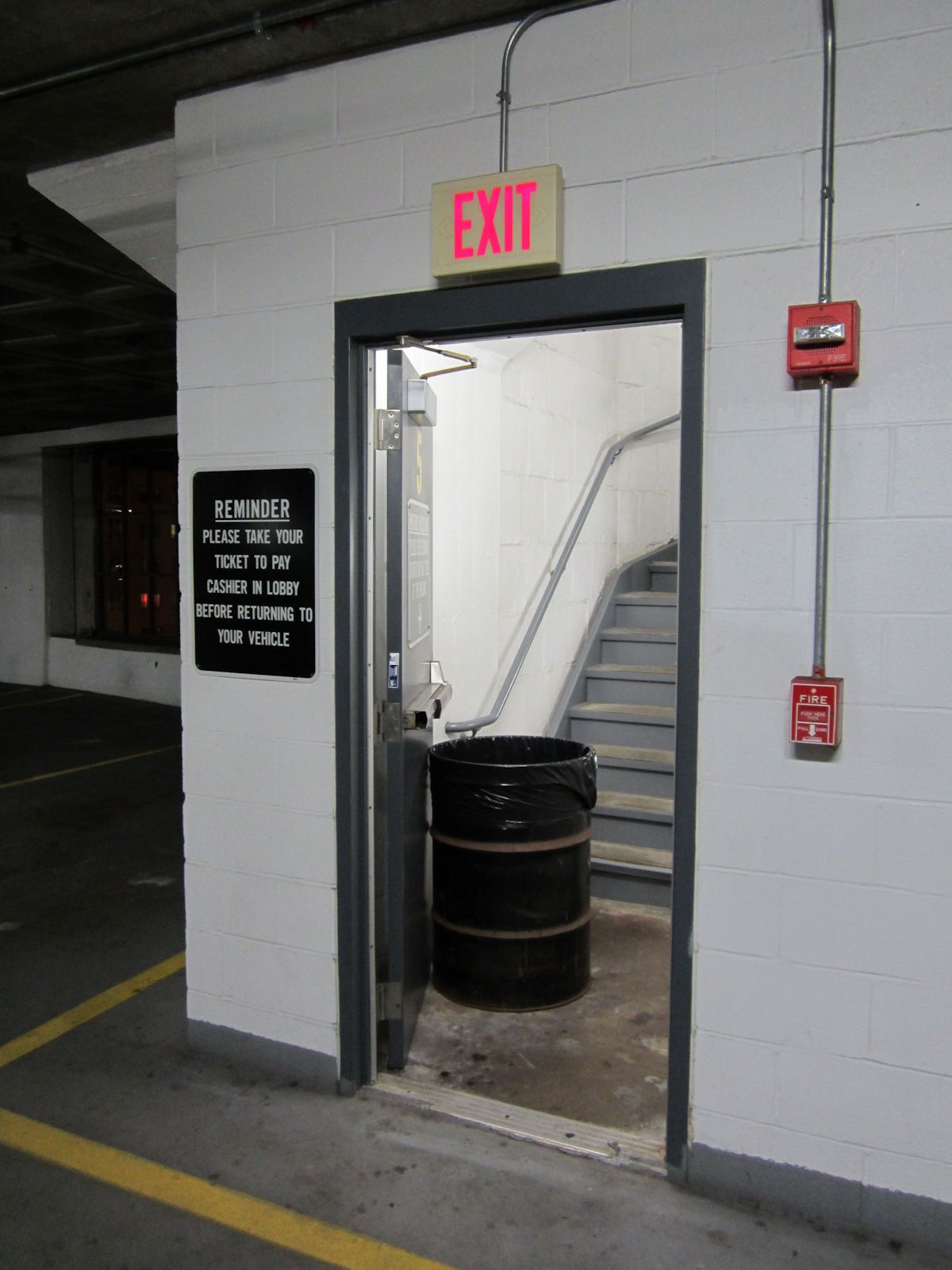 If a fire door is not able to close, it can’t compartmentalize the building and prevent the spread of fire and smoke. Fire doors are typically blocked open for the convenience of the building’s occupants. Many people don’t understand the function of fire doors, and may compromise life safety without realizing the results of their actions. Educating facilities staff and the building’s occupants on fire door requirements can help to avoid a problem, and/or a fine from the local fire marshal.
6. Area surrounding the fire door assembly blocked by furniture, equipment and/or boxes
In addition to the annual inspection of fire doors, recent editions of NFPA 101 – The Life Safety Code require certain egress doors to be inspected annually as well. The area leading to fire and egress doors must be kept clear for egress purposes, and to provide the required maneuvering clearance for accessible openings.
If a fire door is no longer used as a door, building occupants will sometimes place furniture or stack stored items against the door. NFPA 80 requires fire doors that are no longer in use to be removed and replaced with wall construction matching the adjacent wall. A fire door typically carries a lower hourly rating than the wall, because the fuel load against an operable door is much less than a wall with furniture and other materials against it. If a 20-minute door in a 1-hour wall has an increased fuel load because it is no longer operable, it will not be able to withstand fire for the required amount of time. Check required egress routes before removing any door.
7. Broken, defective or missing hardware items (latch bolts and/or strike plates, closer arms, cover plates, etc)
Hardware may not perform as designed and tested if it is missing parts or if the hardware has become damaged. Bent closer arms may not close the door properly. Missing cover plates may create a passage for smoke, and a missing strike or latchbolt could mean that the door does not stay positively latched when exposed to the pressures of a fire. When defective hardware is noted, it must be repaired or replaced without delay.

8. Fire exit hardware installed on doors that are not labeled for use with fire exit hardware
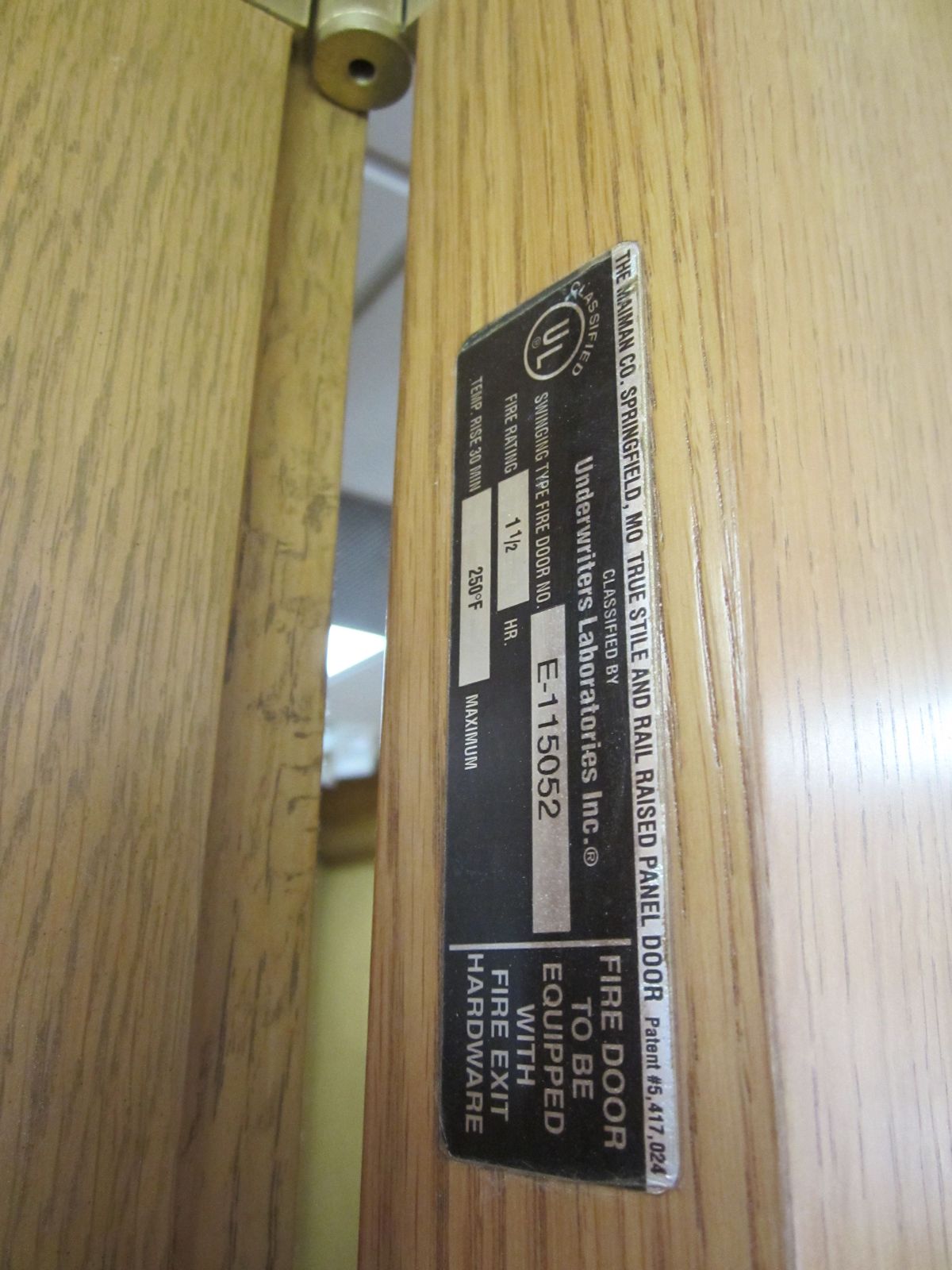 Fire exit hardware is panic hardware that is listed for use on a fire door. It is not equipped with mechanical dogging (the ability to hold back the latch) because fire doors need to positively latch, but electric dogging may be used as long as the latch projects automatically if a fire occurs.
Fire exit hardware is not required for every fire door. Its use is determined by the occupancy type and the occupant load. The IBC requires panic hardware/fire exit hardware for assembly and educational occupancies with an occupant load of 50 people or more (2006 edition and later). NFPA 101 requires panic hardware/fire exit hardware for assembly, educational, and day care occupancies with an occupant load of 100 people or more. Both of these model codes also require panic hardware for high hazard occupancies, with any occupant load per the IBC, and with an occupant load of more than 5 per NFPA 101.
When fire exit hardware is installed, NFPA 80 requires the door to have a label stating, “Fire door to be equipped with fire exit hardware.” This ensures that the door is properly reinforced for the fire exit hardware. An existing door that is prepped for a lockset may not be reinforced for fire exit hardware or  carry the proper label, so fire exit hardware should not be retrofitted to an existing door that was not originally prepped for it unless the label allows both types of hardware.
9. Missing or incorrect fasteners
In most cases, hardware must be installed with the fasteners provided by the manufacturer. Installers sometimes use other fasteners for faster installation or because the original fasteners have been lost. There must be no missing fasteners on hardware installed on fire doors, and some products may require through-bolts if the door does not have adequate blocking or reinforcing.
10. Bottom flush bolts that do not project ½” into the strike
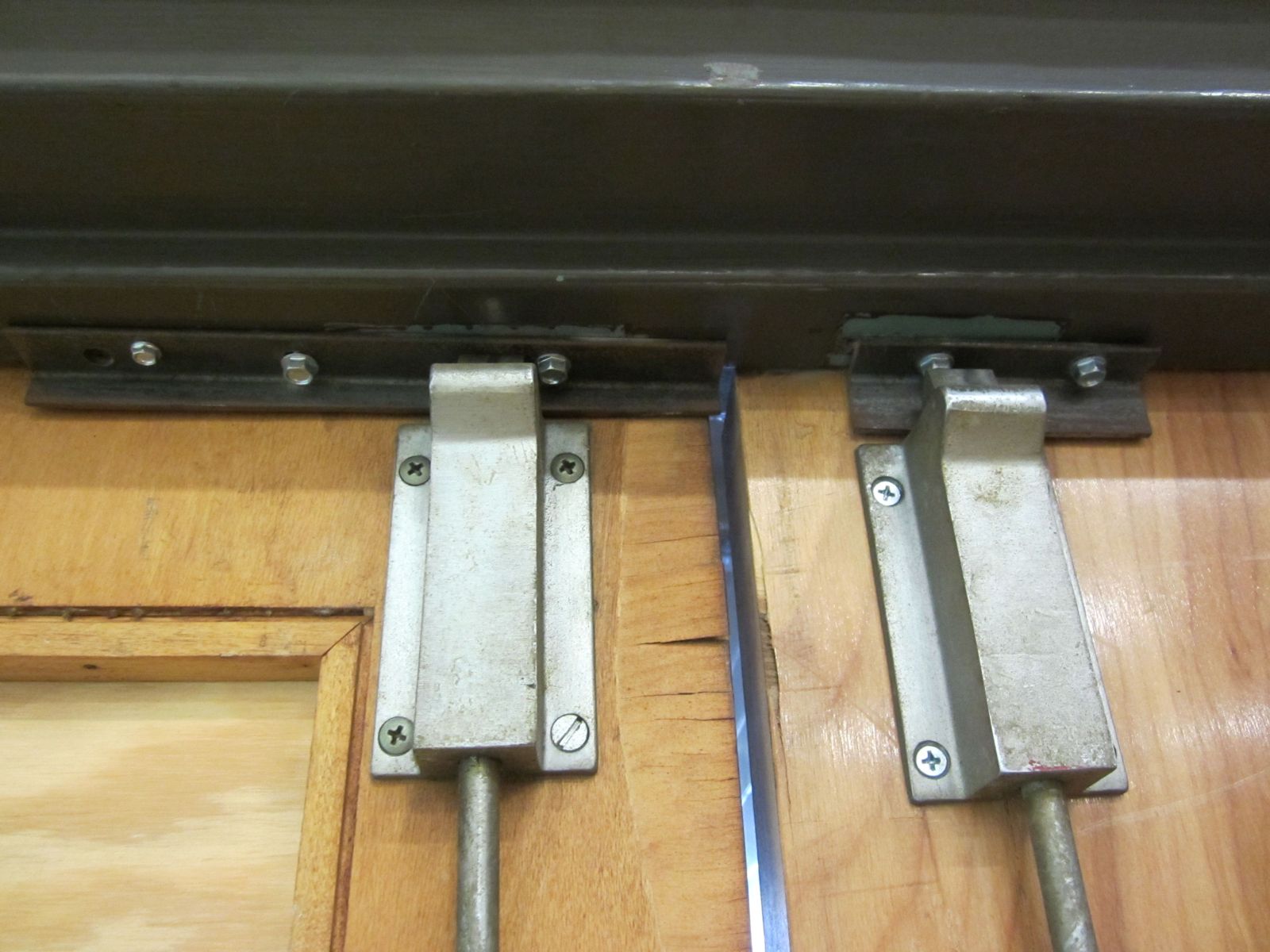
Flush bolts are used on the inactive leaf of pairs of doors when the active leaf has a lockset. There are three types: manual, automatic, and constant-latching. They typically project into the frame head and into the floor, although there are some automatic and constant-latching bolts which have a top bolt only, and incorporate an auxiliary fire pin. This pin projects when a certain temperature is reached and engages into the edge of the other door.
Manual flush bolts are projected and retracted manually, and are only allowed by NFPA 80 on fire doors “where acceptable to the AHJ, provided they do not pose a hazard to safety to life.” Annex A – Explanatory Material states, “This provision limits their use to rooms not normally occupied by humans (e.g., transformer vaults and storage rooms).” The use of manual flush bolts is also limited to certain applications by the egress code requirements, because it requires two motions to unlatch the door when manual flush bolts are installed, and they are not within the allowable reach range for accessibility.
Automatic flush bolts project automatically when the active leaf is closed, via a small trigger on each bolt. When the active leaf is opened, the bolts retract automatically, making them acceptable for use on most egress doors that don’t require panic hardware. The inactive leaf must not be equipped with “dummy” hardware (lever or bar) which suggests that the inactive leaf can be operated independently. Automatic flush bolts are considered positive-latching and can be used on fire doors as long as fire exit hardware is not required. When automatic flush bolts are used, a coordinator is also required to ensure that the inactive leaf closes before the active leaf.
Constant latching flush bolts have an automatic flush bolt on the bottom, and the top is a spring-loaded bolt which is retracted manually to open the door. These bolts provide a higher degree of security than the other two because the inactive leaf is more likely to be closed and latched properly. They can be an egress issue for some doors because the top bolt has to be retracted manually, and it is not within the accessible reach range. A coordinator is also required for this application if the inactive leaf is equipped with a door closer.
When the bottom bolt doesn’t engage properly, there is no assurance that the fire door will perform as it was designed and tested during a fire. The undercut of the door must be carefully coordinated to ensure the proper engagement of the bottom bolt. Another issue with flush bolts on fire doors is that the coordinator/auto flush bolt combination can be difficult to keep functional in a high-use opening. If the latches don’t retract properly or if the inactive leaf is pulled or pushed without opening the active leaf first, the corners of the door can be susceptible to damage because of the volume of material removed to prepare the door for the flush bolt. This problem is particularly common on wood fire doors.
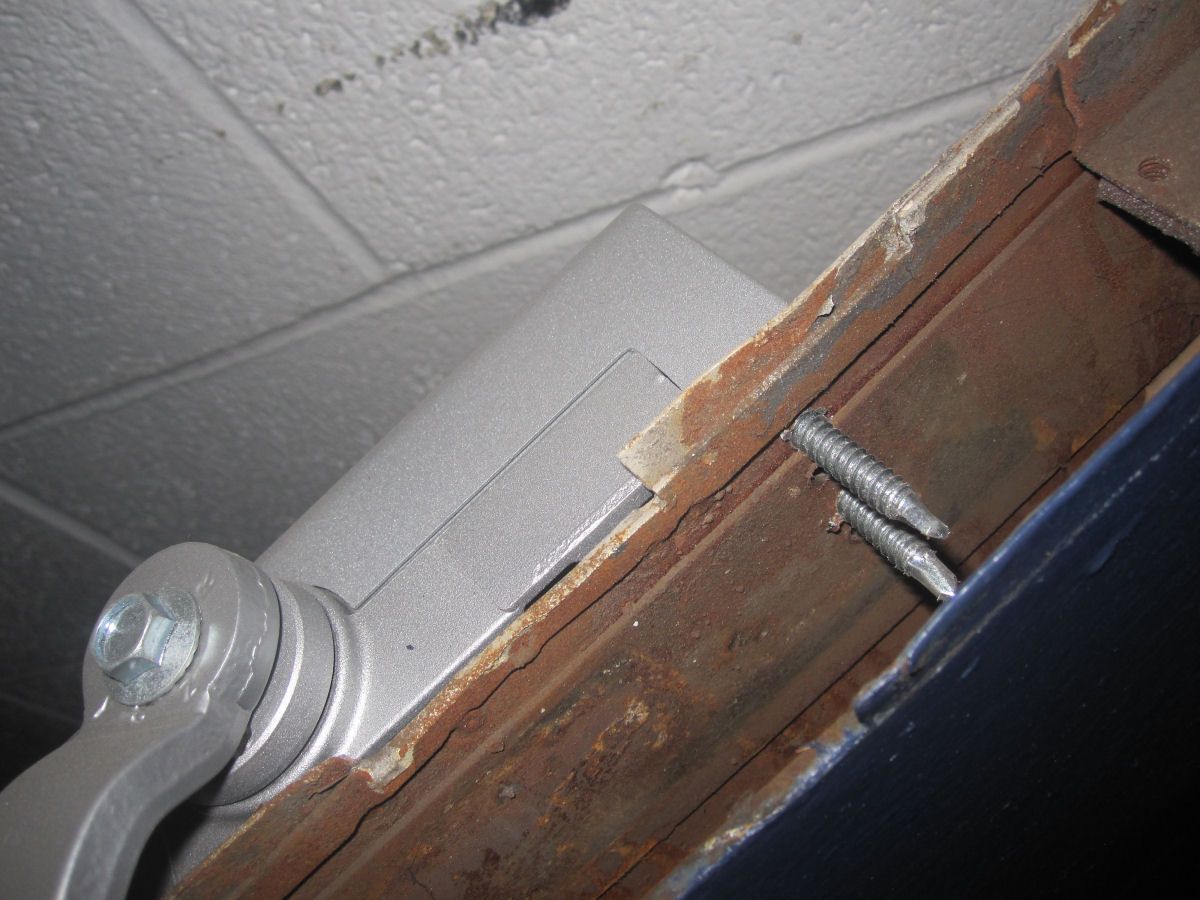
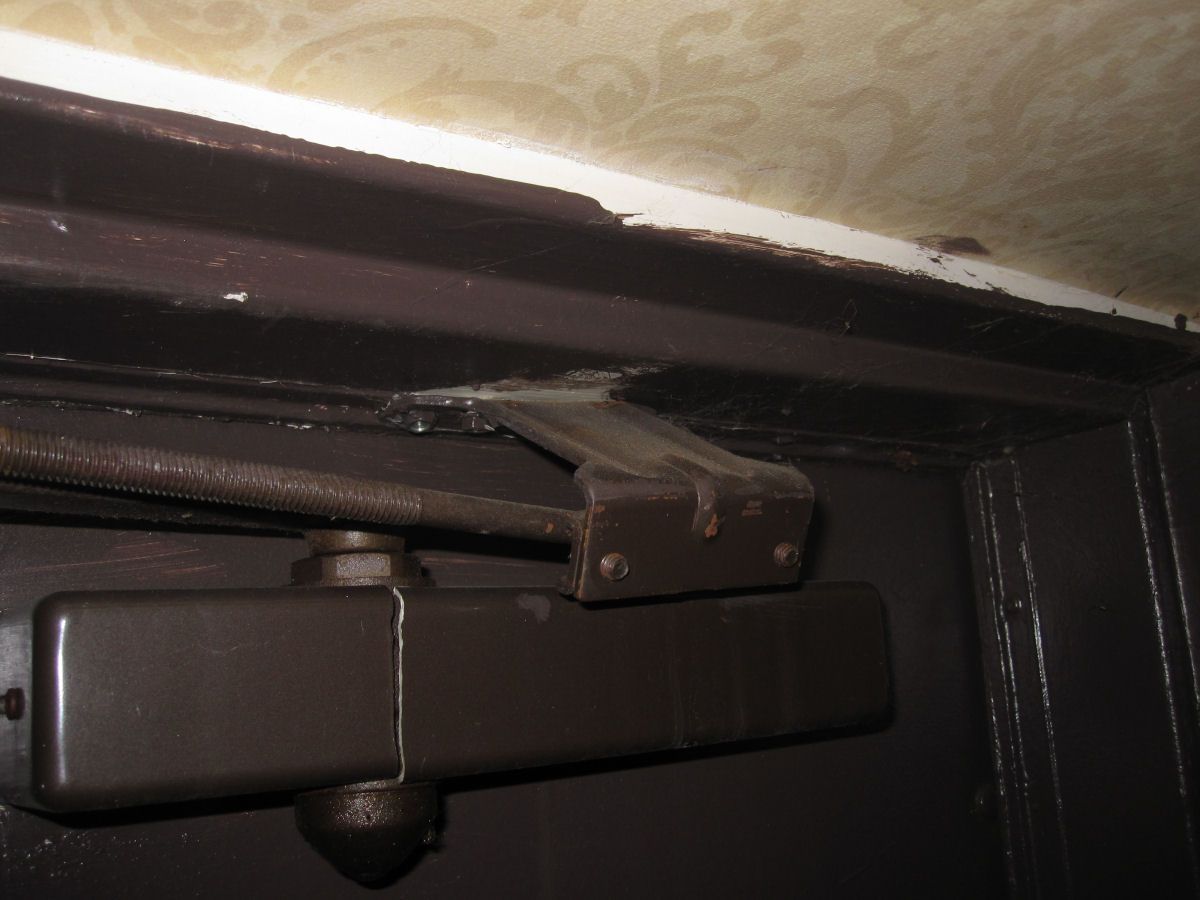
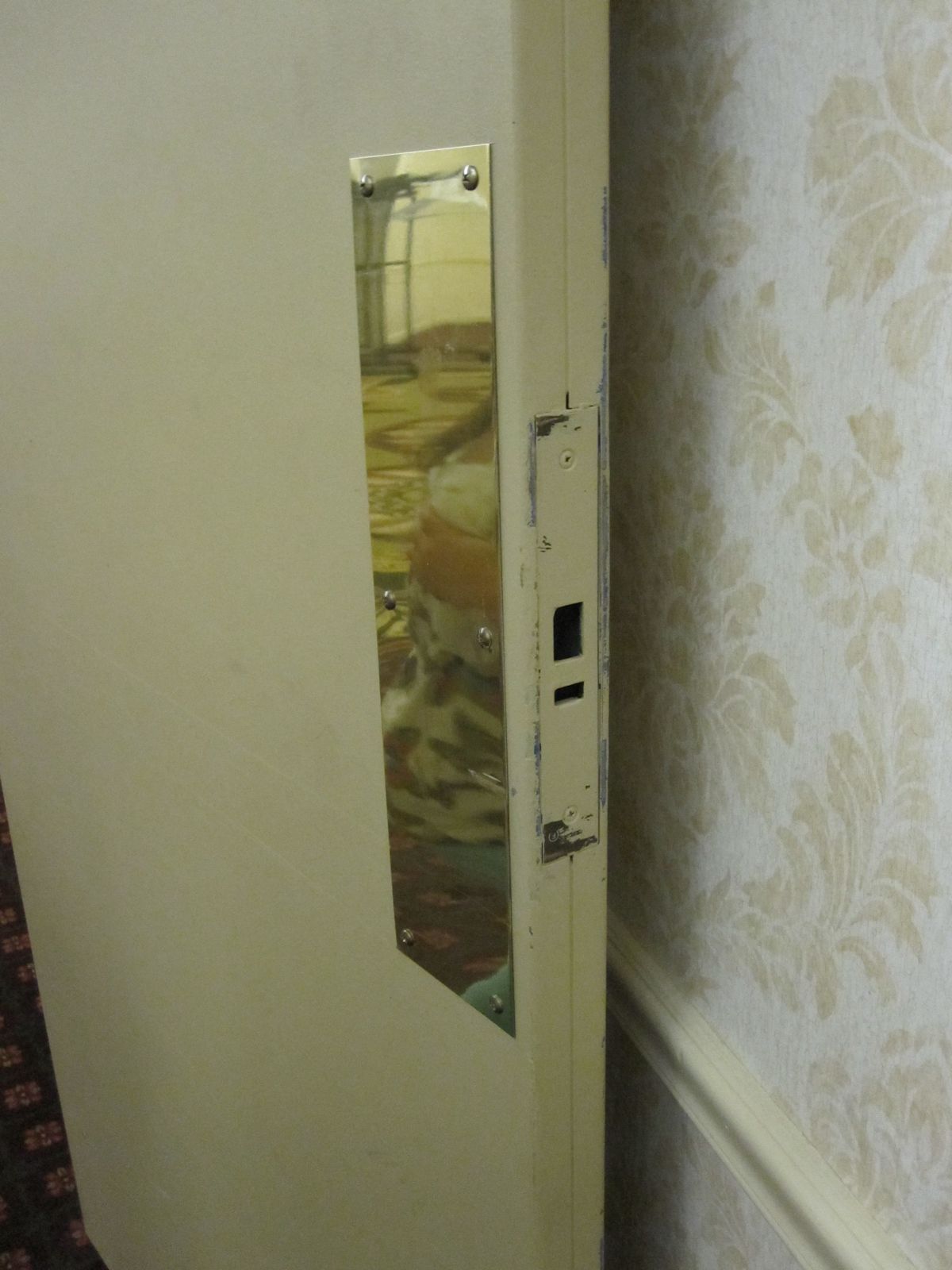
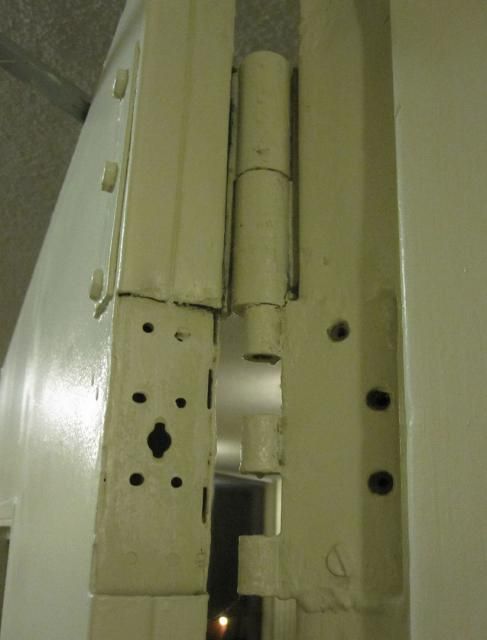

The requirements for the annual inspection of fire and egress doors have drawn attention to the condition of existing doors, and the potential failure of these doors to perform in a fire or emergency. If the inspection requirements are not being enforced in your area, fire and egress doors are still required to be properly maintained, so now is the time to make a plan for inspecting the doors in your facility and repairing or replacing deficient components. Written documentation of fire door inspections must be kept for review by the AHJ. Inspections may be conducted by an individual who is knowledgeable about the type of doors being inspected, and there are several fire door inspection training programs available.
You need to login or register to bookmark/favorite this content.




Great information
For item. # 2 do not guess,!!!
Get a handy dandy Gap Gauge!!!
https://doorgapgauge.com/The-DoorGap-Gauge-Single-Unit
I have found a number of situations in which a contractor installed a door hardware labeled “Panic Hardware” in a location requiring fire rated hardware. In one building, all the exterior doors which had no reason to be fire rated had the fire rated hardware incorrectly installed and the interior doors that required fire rated hardware had “Panic Hardware” installed! And the dogging mechanism was clearly present on the locations that should have been fire doors – simple inspection. I always enjoy reading your posts and will be 85 on May 30th. Oh! to be 83 again!
Wow! 85! I’m glad you’re still reading iDigHardware, Jerry!
– Lori
I haven’t checked in a while, but I’m going to still say there’s no code that requires the bottom flushbolt to project into the strike 1/2″. I know automatic flush bolts claim to have a throw of 3/4″, but it’s not realistic. That 3/4″ is accomplished if you depress the actuator so that it’s at least flush with the door stile. The reality is you’re going to have a reveal between the pair of doors, you’ll add a rub plate but you’re also goin to have bevels which increases the spacing between a pair of doors. In the end, you’re lucky if you can get 1/2″ throw from your flush bolt-your flush bolt would literally have to start off already inside the strike to meet this 1/2″ penetrations requirement. I’ve been through this with Keith Pardoe, I know I’ve brought it up with you as well, I’ve had conversations with Door Controls Intl., (they actually asked if I find the code could I let them know). The biggest problem we’d face is that floors vary, they’re not perfectly level, so you would need your strike to be the highest part of the floor if you could get the bolt to even throw far enough to get the 1/2″ penetration. It’s not a code, no fire label requires it, they only list 1/2″ or 3/4″ throw, it’s not the same as penetration. If it were the requirement, no fire rated doors with automatic flush bolts would be compliant, it’s not realistic-and the same thing goes for top flush bolts. I have some pictures i have where we mated up door sections as if they were a pair of doors, with one flush bolt and a rub plate on the “active” leaf. When we set the reveal at exactly 1/8″, we had almost 7/16″ throw. We determined the flush bolt would have to start off being 1/16″ inside the strike to be compliant. Manufacturer’s instructions do not specify anything about 1/2″ penetration, and I’ve yet to see a UL or WH listing stating it.
But I’ve been wrong before. Please let me know if I’ve missed something. Thank you.
This is useful.
Can you expand on why you cannot use automatic flush bolts with fire exit hardware? I have a specification written with Mortise Exits x coordinator x auto flush bolt and finding out this configuration is not a part of the UL listing for mortise fire exit hardware.
Hi Josh –
I checked on the 9975-F and it is acceptable to use on a rated pair with auto flush bolts on the inactive leaf.
– Lori
Thank you! That’s an advantage, others do not.