
In yesterday’s post, I shared some information from BHMA about PCRs, and today’s guest post from Aaron Owens of Allegion covers more about EPDs. Feel free to leave any questions in the comment box!
~~~
 Unveiling Sustainable Advantage: How EPDs Empower Informed Choices
Transparency Meets Sustainability:
In today’s era of heightened environmental awareness, architects, engineers, and builders increasingly seek transparency and quantifiable data to guide their sustainable building practices. Enter Environmental Product Declarations (EPDs), invaluable tools empowering informed product selection and bolstering sustainable practices, ultimately driving sales for environmentally conscious companies.
Demystifying the Data:
Think of EPDs as detailed environmental report cards for individual products. At their core lies a comprehensive Life Cycle Assessment (LCA), akin to a financial audit for environmental impact. LCAs meticulously analyze each stage of a product’s lifecycle, from raw material extraction and processing to manufacturing, transportation, use, and end-of-life disposal or recycling. They quantify resource consumption, emissions, and other environmental burdens at each stage, providing the foundation for creating accurate and meaningful EPDs.
Industry Standardization: The BHMA PCR’s Role:
Developing consistent and comparable EPDs across the building hardware industry is crucial. The Building Hardware Manufacturers Association (BHMA) Product Category Rule (PCR) serves as a standardized roadmap by following ISO 21930 requirements and establishing clear guidelines on:
- System boundaries: Defining which lifecycle stages are included in the assessment.
- Data quality: Specifying data sources and ensuring their accuracy and consistency.
- Calculation methods: Determining how environmental impacts are quantified and aggregated.
- Reporting format: Ensuring EPDs are presented in a clear, standardized format for easy comparison.
By adhering to the BHMA PCR, manufacturers guarantee their EPDs are not only credible but also readily comparable to others within the industry. This empowers architects, engineers, and builders to confidently evaluate the environmental performance of different products and make informed decisions aligned with their sustainability goals.
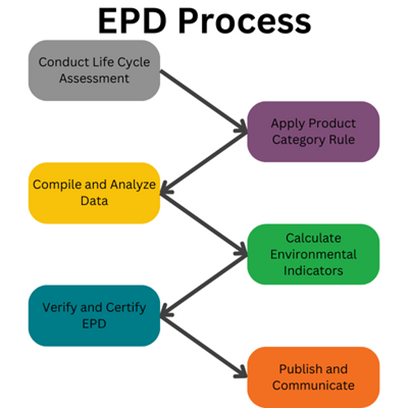 Building the EPD:
Understanding the process behind EPD creation fosters trust and transparency. Here’s a simplified breakdown:
- Conduct a comprehensive LCA: Analyze the product’s lifecycle impact using established methodologies.
- Apply the BHMA PCR: Ensure adherence to industry standards for EPD development.
- Compile and analyze data: Gather and interpret data from various sources, including internal records, industry databases, and LCA software.
- Calculate environmental indicators: Quantify the product’s impact on categories like climate change, resource depletion, and water usage.
- Verify and certify the EPD: Partner with a third-party program operator like UL Environment or EPD North America to certify the accuracy and transparency.
- Publish and communicate: Make the EPD readily available to customers and stakeholders.
Leveraging EPDs for Sustainable Specifications:
As sustainability requirements continue to shape the building industry, EPDs are becoming essential tools for architects, specifiers, and project teams. When evaluating door hardware for green building projects, consider these practical applications:
- LEED Certification: EPDs contribute to Material and Resources (MR) credits, particularly MR Credit: Building Product Disclosure and Optimization – Environmental Product Declarations.
- Transparent Comparisons: EPDs allow specifiers to objectively compare the environmental performance of similar products from different manufacturers.
- Client Requirements: Many building owners and developers now require sustainability documentation, making EPDs valuable assets in specification decisions.
When selecting building hardware, don’t hesitate to ask manufacturers for their EPDs. Products with third-party verified EPDs demonstrate a manufacturer’s commitment to transparency and environmental accountability. As more manufacturers develop EPDs following the BHMA PCR, specifiers will have greater ability to make data-driven decisions that support sustainable building goals.
By incorporating EPD considerations into your specification process, you contribute to industry-wide progress toward more sustainable building practices—one project at a time.
You need to login or register to bookmark/favorite this content.







Leave A Comment