
In this Decoded article for the next issue of Door Security + Safety Magazine, I answered some frequently asked questions about which doors require panic hardware.
~~~
This Decoded article will be published in Door Security + Safety
.

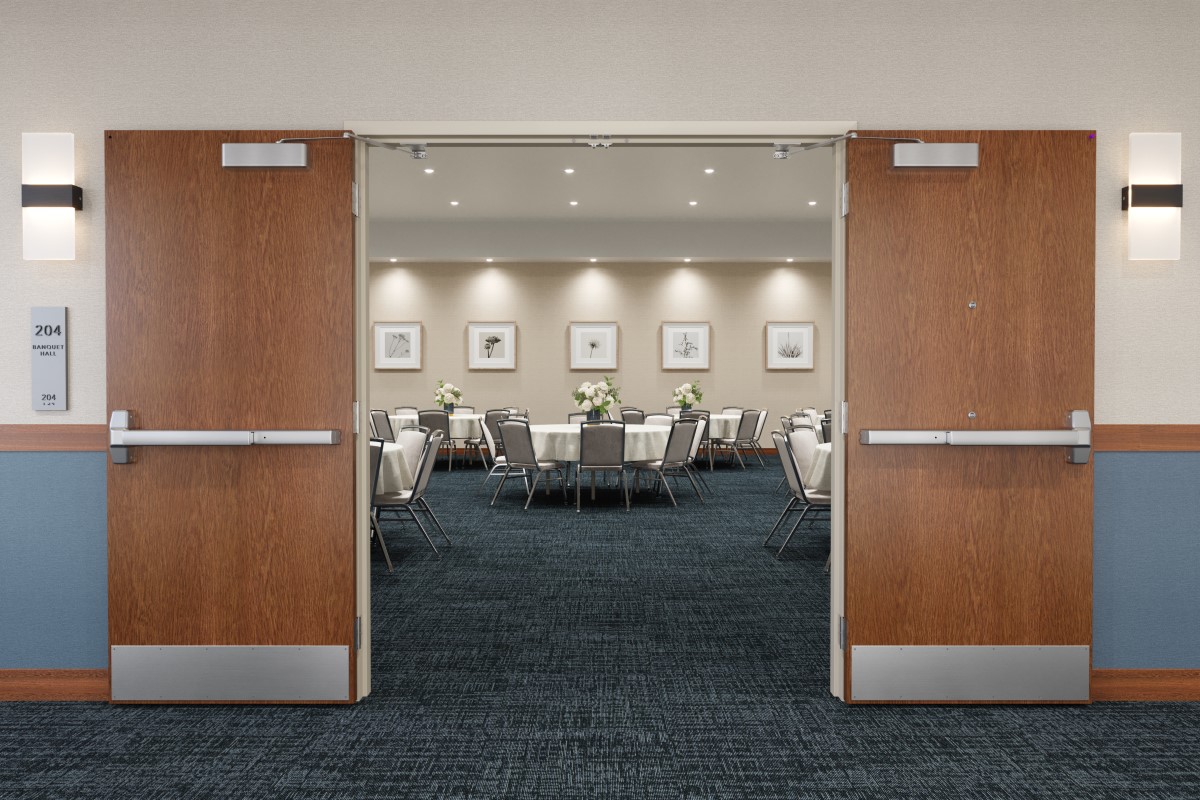
The model codes spell out where panic hardware is required for doors serving certain occupancy types and occupant loads.
When it comes to panic hardware, the requirements of the model codes have not changed much in the last 20 years, but there are still questions that arise often. This month’s Decoded article is a quick refresher on the requirements, including the answers to some frequently asked questions.
I like to use the term “panic hardware” instead of exit device, crash bar, push bar, or any of the other terms that could be used to describe this particular type of hardware. That’s because panic hardware is a term that is defined in the model codes. The International Building Code (IBC) and International Fire Code (IFC) define panic hardware as: “A door-latching assembly incorporating a device that releases the latch upon the application of a force in the direction of egress travel.” The definition for panic hardware also refers to fire exit hardware, which is defined as: “Panic hardware that is listed for use on fire door assemblies.”
Based on these two definitions, using the term “panic hardware” is inclusive of both panic hardware and fire exit hardware. With that said, I do use the term “fire exit hardware” when I’m specifically referring to panic hardware that is installed on a fire door assembly.
Which occupancy classifications and occupant loads require panic hardware?
Beginning with the 2006 edition, the IBC and IFC require panic hardware on swinging doors equipped with a lock or latch, serving the following:
- Group A, assembly or Group E, educational occupancies with a calculated occupant load of 50 people or more
- Group H, high hazard occupancies of any occupant load
The NFPA codes mandate panic hardware on required means of egress doors equipped with a lock or latch, serving:
- Assembly, educational, or day care occupancies with a calculated occupant load of 100 people or more
- Areas of high hazard contents with a calculated occupant load in excess of 5
Note that these requirements apply to doors that are equipped with a lock or latch. If a door has push/pull hardware, for example, and no locking or latching hardware, panic hardware would not be required. Also keep in mind that the requirements apply to certain occupancy types and certain calculated occupant loads; both criteria must be met. For example, a residential occupancy with an occupant load of 200 people would not require panic hardware because although the occupant load is over the threshold, the model code requirements for the use group (R-residential) do not mandate panic hardware.
One question that comes up occasionally is whether the requirement for panic hardware apply only to the doors immediately serving the space in question (for example, a theater), or whether the requirement applies to all doors in the means of egress for that space. The answer is: the latter. The I-Codes (IBC and IFC) state: “Swinging doors serving a Group H occupancy and swinging doors serving rooms or spaces with an occupant load of 50 or more in a Group A or E occupancy shall not be provided with a latch or lock other than panic hardware or fire exit hardware.” All of the doors in the means of egress between these spaces and the public way are “serving” these spaces.
NFPA 101 – Life Safety Code applies the panic hardware requirements to “any door in a required means of egress” from spaces with the occupancy classifications and occupant loads stated above. The means of egress extends from any point in the building to the public way, so all doors in that path that are equipped with a lock or latch would require panic hardware.
Are there any exceptions in the model codes for the panic hardware requirements?
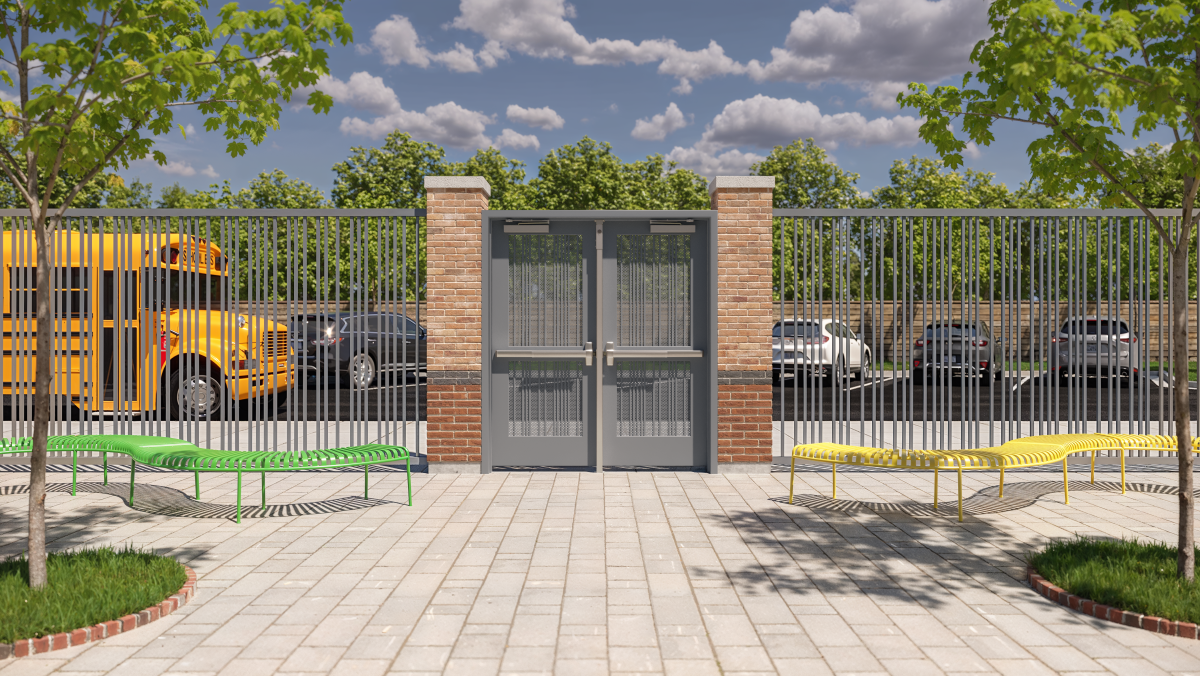
Some doors serving exterior spaces will require panic hardware, while others may be permitted to have key-operated locks (double-cylinder deadbolts).
There is an exception in both sets of model codes that would allow key-operated locks (double-cylinder deadbolts) instead of panic hardware on the main exterior door(s) or main door(s) to a tenant space, including some assembly occupancies. The I-Codes also permit doors serving enclosed exterior spaces such as courtyards and roof terraces to have key-operated locks if certain criteria are met.
The 2024 IBC made a change to the exceptions for doors required to have panic hardware that are also equipped with electrified hardware – typically electromagnetic locks. Previous editions of the code permitted electrified locks to be released by a sensor detecting an approaching occupant on doors with panic hardware, however, the 2024 edition removed this exception. The other option is to have electrified locks released by a switch in the panic hardware. Beginning with the 2024 code, only the second option is permitted on doors equipped with panic hardware, and sensor-release locks may not be used on these doors.
Are there additional types of rooms that are required to have doors with panic hardware?
Recent editions of the IBC require panic hardware on doors serving refrigeration machinery rooms that are larger than 1,000 square feet in area. At least two egress doors are required from these spaces, the doors must be outswinging, and both doors must be equipped with panic hardware or fire exit hardware. The IBC also requires panic hardware on doors serving some rooms that contain electrical equipment. According to the 2024 edition, these rooms include transformer vaults, rooms designated for batteries or energy storage systems, and modular data centers. Rooms containing electrical equipment rated 800 amperes or more that contain overcurrent devices, switching devices or control devices require panic hardware when the exit or exit access door is less than 25 feet from the equipment working space.
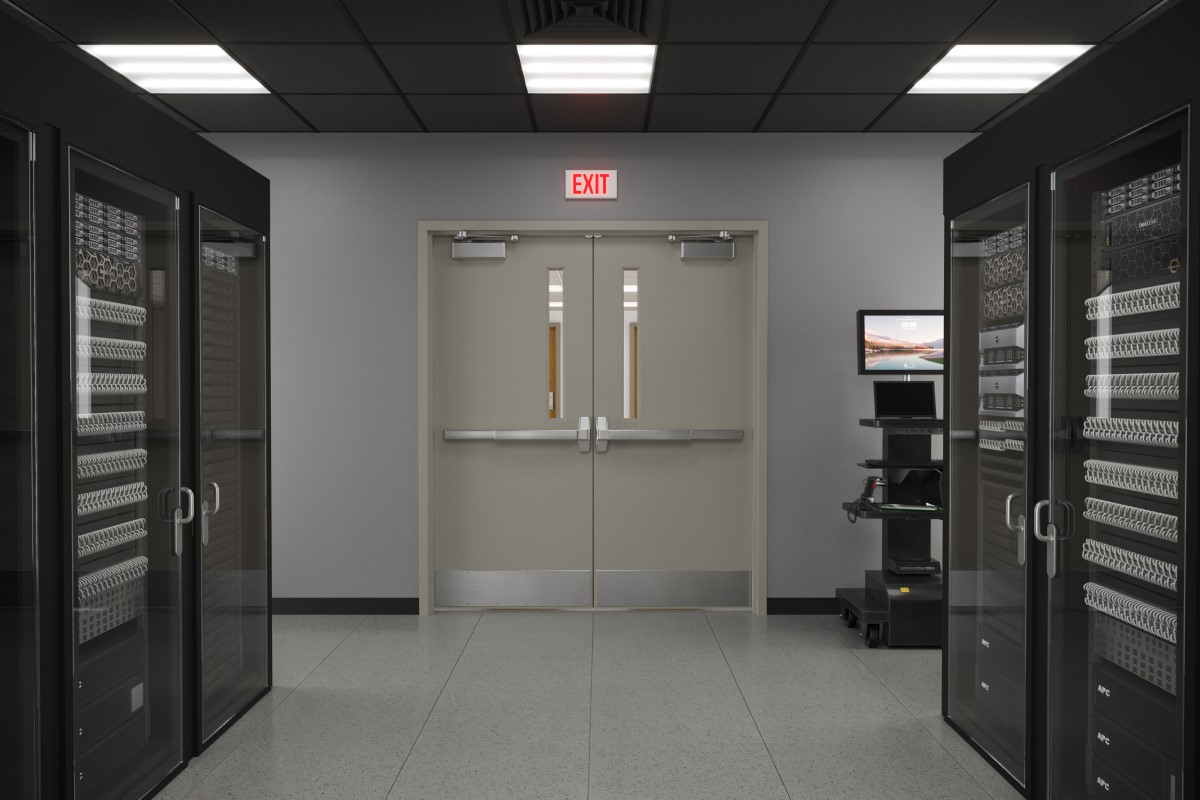
Some rooms housing electrical equipment are required to have outswinging doors with panic hardware or fire exit hardware.
NFPA 70 – National Electrical Code requires panic hardware on some rooms housing electrical equipment. The requirements vary slightly depending on which edition of the code has been adopted, but recent editions require panic hardware on doors serving:
- Rooms housing equipment of 1000 volts, nominal, or less, with equipment rated 800 amps or more that contains overcurrent devices, switching devices, or control devices
- Electrical vaults and rooms housing equipment of more than 1000 volts, nominal
- Transformer vaults, battery rooms, and modular data centers
The NFPA 70 requirements apply to personnel doors doors intended for access to and egress from the working space, and that are within 25 feet of the nearest edge of the required working space around the electrical equipment. There may be other locations where panic hardware is required by the state or local codes, so it’s always best to check the adopted codes in the project’s jurisdiction.
What other code requirements apply to panic hardware?
Where panic hardware is installed, it must comply with the following:
- Panic hardware must be listed in accordance with UL 305 – UL Standard for Safety, Panic Hardware, and fire exit hardware must be listed in accordance with UL 305 and UL 10C – Standard for Positive Pressure Fire Tests of Door Assemblies. In addition, NFPA 101 requires panic hardware to be listed to ANSI/BHMA A156.3 – Exit Devices.
- The actuating portion of the hardware – the push-pad or crossbar – must measure at least half the width of the door leaf. If panic hardware is required on balanced doors, the panic hardware must be push-pad type, and the pad must not extend more than one-half the width of the door (NFPA 101 states “approximately one-half the width of the door leaf”). This measurement is taken from the latch stile of the door.
- The force required to unlatch the door must not exceed 15 pounds according to the I-Codes and the NFPA codes. However, the ADA Standards for Accessible Design require operable parts of hardware to operate with a maximum of 5 pounds.
- Panic hardware must be mounted between 34 inches and 48 inches above the floor. NFPA 101 includes an exception for existing installations, which may be installed between 30 inches and 48 inches above the floor.
- NFPA 101 specifically states that panic hardware (in other than detention and correctional occupancies) must not be equipped with anything that prevents the release of the latch when pressured is applied to the releasing device.
- Fire doors serving the areas required to have panic hardware must have fire exit hardware, and the latch may not be held in the retracted position unless the devices are listed and approved for that purpose. Fire exit hardware with the electric latch retraction feature is typically permissible if the latch projects automatically upon activation of the fire protection system.
As always, it’s important to check the adopted codes for requirements related to a particular jurisdiction. For questions, consult the adopted code or the Authority Having Jurisdiction (AHJ).
You need to login or register to bookmark/favorite this content.





Great article.
Thanks Sean!
– Lori
I have some questions
Hi Mario –
I’m happy to try to answer them!
– Lori
[…] the OBC aligns with the International Building Code (IBC) and NFPA 101 (Life Safety Code). The key threshold is occupant load: assembly and educational occupancies with loads exceeding 50 to 100 people […]