
This is a great Quick Question, and it has come up several times lately:
According to the 2024 IBC, would an accessible public entrance serving a school auditorium with an occupant load of 400 people require doors with automatic operators?
In a past Decoded article, I covered the requirement that was added in the 2021 edition of the International Building Code (IBC), requiring the accessible public entrances in some buildings to have doors with automatic operators. You can review that article for detailed information on the change, which was carried forward into the 2024 edition of the code.
One of the use groups that this requirement applies to is Group A – Assembly, with the exception of A-5, which applies to assembly occupancies for outdoor activities, like stadiums, grandstands, bleachers, and amusement park structures. For Groups A-1, A-2, A-3, and A-4 with a calculated occupant load of more than 300 people, the accessible public entrances must now have at least one door/one set of doors (ex. exterior and vestibule) with automatic operators.
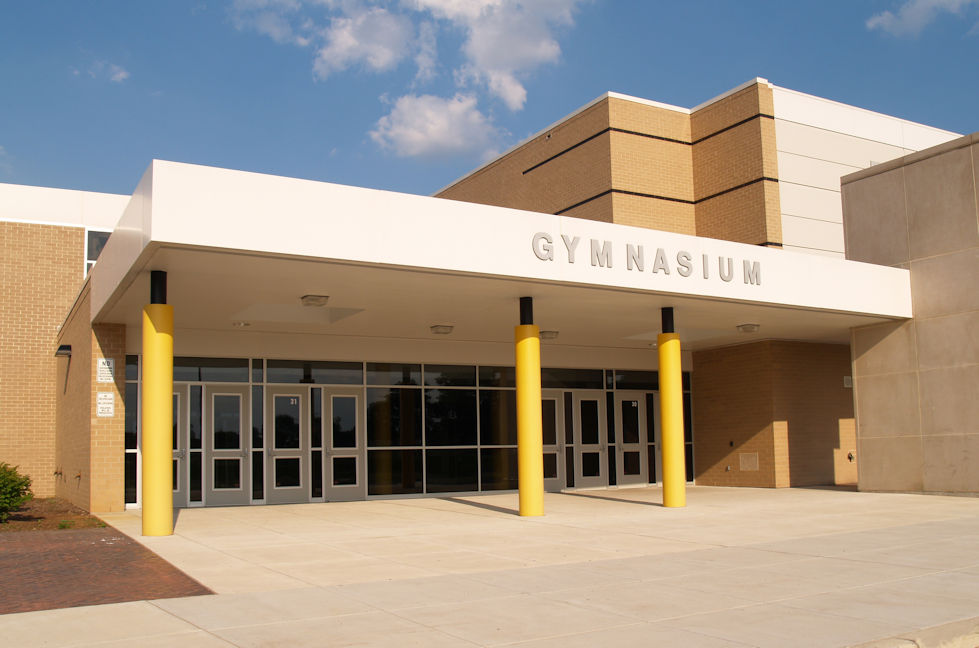
Would this requirement apply to schools, which are typically considered Group E – Educational occupancies? How does the code address the assembly spaces within a school – the gym, auditorium, library, cafeteria, etc.? In Chapter 3 of the IBC it states, “A room or space used for assembly purposes that is associated with a Group E occupancy is not considered a separate occupancy.” This means that if there’s a space used for assembly purposes in a group E occupancy, it can be considered part of Group E.
However, if we dig a little deeper in the IBC Commentary (a version that includes explanatory information about the code), it explains that there are many types of assembly spaces within a typical educational facility, which can be considered an extension of the Group E classification. BUT, the Commentary states: “The assembly functions are to be used solely by the students and staff of the school. If the spaces are to be used for functions where more than the students and staff are in attendance. they would be classified into the appropriate Group A occupancy based on their specific function.”
The Commentary goes on to give examples of other uses of these assembly areas, such as a meeting of a community service organization or a community crafts fair. Using the spaces within the school for purposes like these would require the assembly spaces to be classified as Group A – at least according to the Commentary. I think the original intent of the code change proposal was to exclude schools, and if the assembly spaces are categorized as Group E, the auto operators would not be required. But if a space is considered Group A as mentioned in the Commentary, things get murky.
With all of this in mind, and seeing no specific exception for school assembly spaces in the section for auto operators on accessible public entrances, my opinion is that the requirement could be applied to the accessible public entrances serving the assembly areas of the school, if those areas are sometimes used for events where people other than students and school staff are present.
What do you think? Have you run into an interpretation in the field?
You need to login or register to bookmark/favorite this content.



Almost always, gyms, auditoriums and cafeterias/commons will have public functions, especially at the MS and HS levels. Basketball games, musicals, concerts, graduations, even school board meetings will have general public. This is one of several reasons we always specify at least one entrance with operators on school buildings. Frankly I am surprised the code hasn’t required them in Group E occupancies; they are a small investment that makes a big difference for a lot of people, even able-bodied ones.
How are these entrances handled from a security standpoint, especially these days when schools are basically locked down during school hours to protect the students & staff from outside intruders?
Hi Jim –
Great question! I would specific electric latch retraction panic hardware along with the auto operator. The exterior actuator for the operator would not open the door until an electronic credential is presented or the door is unlocked by someone in the office. When the doors are unlocked for a period of time, the actuator would open the door.
– Lori
Lori:
We’ve had to be careful with this arrangement. While it makes sense for a receptionist to push a button to both unlock the door and activate the operator, the feedback from the AHJs is this is then no longer a “knowing act,” and then you would need the safeguards in place for a full-power operator. So we still make the person push the button after the latch is retracted. It’s OK to activate the operator with a card reader however.
Thanks for sharing this info, Todd!
Maybe we should modify the definition in the BHMA standard to clarify this issue. The current definition of a knowing act is: Any conscious action with the expected result of opening a door. This includes but is not limited to: wall or jamb-mounted contact or non-contact switches such as push plates; the action of manual opening (pushing or pulling) a door; and controlled access devices such as keypads, card readers, wireless transmitters and keyswitches.
If someone is using a wireless transmitter for example, they may not be right at the door so for someone standing at the door, the door opening automatically would come as a surprise.
– Lori