
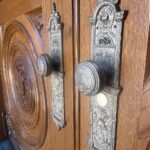
In today’s guest blog post, Mark Kuhn shares some sound doors that he saw recently during an appointment with his wife for some testing.
~~~
 Some people have asked me (and Lori) where we come up with our topics…well, I had an up close and personal STC door encounter recently…or at least my wife did. I was just there to take pictures .
Special door assemblies can always pose a challenge, and I would say some of the most challenging are STC doors. For anyone I just lost in my first sentence, STC stands for Sound Transmission Class. In simple terms these are the types of doors we use when we are worried about sound transferring from one side of an opening to the other side. An STC rating takes into consideration frequency and decibels and then gives a material (in our case a door) a rating based on its ability to stop the transfer of sound.
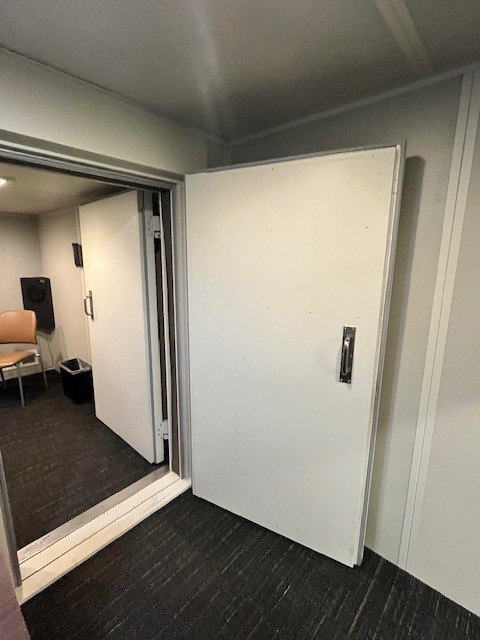 What makes these openings a challenge is not typically the specifying of the hardware (although this can be a little complicated and I’ll explain why in a minute). No, what makes them challenging is that they are normally presented like this; “We want those doors to be sound rated.” or “We want sound doors at those locations.” And sometimes people will even use the term STC but have no idea what it really means. To a door and hardware professional, this is a little like saying, “I want a shirt” – you didn’t give me enough information…I need style, size, color, etc. All of these are needed if I’m going to get you a shirt and the same goes for a “sound door.”
What most people don’t understand is the average commercial wall construction (3-5/8” metal stud with a single layer of 5/8” sheetrock on each side) has an STC rating in the mid-40’s while the average solid core wood door (perfectly sealed against sound transmission) only has an STC rating in the high 20’s. And a standard hollow metal door (perfectly sealed against sound transmission) only achieves an STC rating in the low 30’s…BTW in the STC world the higher the number the BETTER (the more sound is stopped). Armed with this information, the average architect or owner now sees that the door is the weak spot in their sound barrier, and we have a serious conversation about STC rated doors.
I would say that my projects where STC doors come up in conversation fall into 2 categories:
- They say, “Thank you very much for the information” – then they go research STC doors and the various ratings and the cost to achieve those various ratings. Spoiler alert, the higher the rating the higher the cost. And they come back to me with more information. Either the “true STC doors” fit in the budget and I they will call out actual STC ratings. Or they don’t fit in the budget, and they ask me to use sound rated seals on standard doors. But, either way I have allowed them to make an informed decision.
- OR – they know exactly what they want as far as STC ratings are concerned. I typically see this when I’m writing a spec for a facility that deals with STC ratings…a theater, TV/radio station, hospital or even a courthouse.
Remember I said that sometimes the hardware on STC doors can be a little complicated? Well as you can imagine, the hardware complications are concerning the seals on the door. And surprisingly it’s the lower rated STC doors that can be the most complicated. The reason is, these doors can sometimes come with seals (typically an adhesive seal at the head and jambs and a concealed automatic door bottom) and sometimes they do not. This depends on the door manufacturer and how they’ve tested their STC doors.
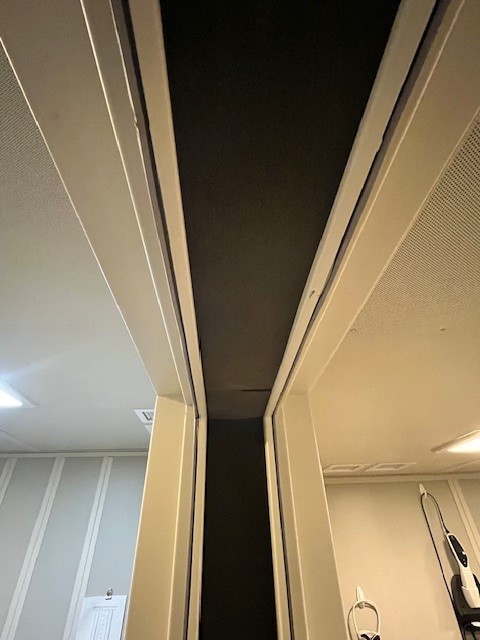
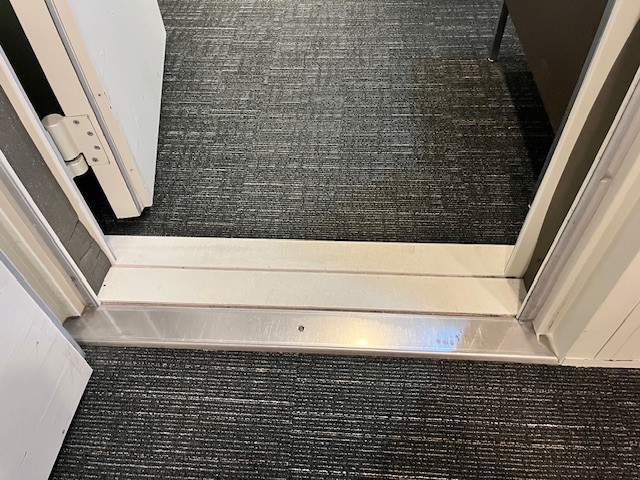
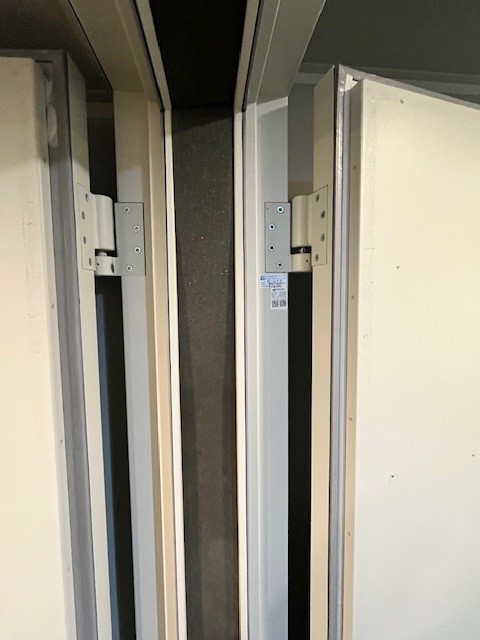 Another complication is that some manufacturers have tested with special hinges called cam-lift hinges. Instead of a spring-loaded automatic door bottom sealing the bottom of the door, there is a built-in (non-moving) seal across the bottom of the door and the entire door lowers when it closes. These are all things we need to know about when writing the hardware sets for these types of doors. The reason the higher STC rated doors (STC 50 and above) are not as complicated, is because these doors almost ALWAYS come with their own seals and cam-lift hinges.
I could probably go on for a little longer, but I’ve touched on the high points of STC doors and hardware. Before I get a lot of technical comments, it was my intention not to get too far into the weeds. I know STC is a science unto itself and we could write a book on the subject (and I’m sure that there are many books on the subject ).
Do you have experience with STC doors? Feel free to leave a comment!
You need to login or register to bookmark/favorite this content.




Good explanation of STC doors and the challenges they present when specifying!
We work on courthouses often and have used STC rated doors. Magor learning curve for me on the first courtroom.
What complicates the hardware are the auto openers and electric locks. While cam lift hinges are preferred the rest of the hardware needs to be able to handle the doors vertical movement.